
Navigation
Author: Dao Hua Marriage and Family Law FirmDate: 2026-04-28Reads:times
Practical Experts in Marriage and Family Affairs Dispute (Mediation/Litigation)
Ten years of focus on; marriage and family legal services for bulk property matters
Guangdong Dao Hua Law Firm, Dao Hua Marriage and Family Law Team, Tang Yunhong Lawyer, Top Ten Divorce Lawyers in Shenzhen, Top Ten Inheritance Lawyers, Professional Divorce and Inheritance Litigation Lawyers in the Guangdong-Hong Kong-Macau Greater Bay Area, Famous lawyers for large family properties, numerous successful cases, especially skilled in handling: difficult property division/court litigation, listed company equity/fund/share division, real estate, Shenzhen small property rights houses/farmer houses, land, factories, virtual currency assets, Hong Kong divorce property division, marital/divorce property agreements, tax planning, debt isolation, divorce property transfer, international inheritance, will notarization, will/inheritance disputes litigation, will drafting and validity determination, old city renovation and demolition, civil and criminal overlap, cross-border collaboration, etc. Service areas: Guangdong, Shenzhen, Futian, Hong Kong, Macau, overseas, Guangzhou, Zhongshan, Zhuhai, Foshan, Huizhou, Dongguan.

One, the basic case situation
A Hong Kong elder Mr. Chen, in his early years, spent 100,000 yuan to purchase a residential property in Luohu District, Shenzhen, and registered the shares as 50% each for Mr. Chen and his daughter. Now, considering his old age and inability to manage the Shenzhen property, Mr. Chen plans to transfer his 50% share of the property to his daughter's name to complete the inheritance of family wealth and avoid disputes after a century. However, when he went to the Real Estate Registration Center to inquire, the staff informed him that due to the current average value of the property in that area having exceeded one million yuan, if the transaction is handled according to the regular market price for buying and selling or gift transfer, various taxes such as deed tax, personal income tax, and value-added tax must be paid, with a total not less than 100,000 yuan, which is costly.
Through a friend's introduction, Mr. Chen found the Dao Hua Law Firm in Guangdong and entrusted the firm's lawyers to seek the legally compliant and cost-effective transfer plan to smoothly pass on the property.
Two, focal points of the dispute
Confirm core demands, retrieve and confirm policies
1. Communicate and understand the core demands:After accepting the commission, after comprehensive communication, the Daohua lawyer learned that the client, as they grow older, hopes to directly hand over the property to their daughter for management and leasing, and wishes to transfer the shares to their daughter before death in the most cost-effective tax and fee manner.
2. Policy precision mining:Combining Mr. Chen's core need to transfer the property to his daughter immediately, Dao Hua lawyer, after a comprehensive search of the relevant policies of Shenzhen Real Estate Registration and Taxation, located the rules for the transfer of property between direct relatives, where the value-added tax, personal income tax, and deed tax can be calculated based on the registered price. After visiting the tax bureau and the real estate registration center on the spot to inquire and verify, the lawyer confirmed the current feasibility and the procedures and requirements for handling this policy.
3. Principal qualification verification:After a comprehensive review of the materials provided by Mr. Chen, it was confirmed that Mr. Chen and his daughter are direct relatives, meeting the subject conditions for policy application; at the same time, it was confirmed whether Mr. Chen and his daughter have the qualification as subjects for real estate transfer registration in Shenzhen as Hong Kong residents, as well as the differences in the process and materials for the transfer of real estate between Hong Kong residents and mainland residents.
(2) Customize the optimal plan, promote material collection
1. Optimal Solution Determination: After evaluating the tax cost differences generated by various transfer methods such as sales, gifts, and others, and fully communicating and explaining to Mr. Chen, the final decision was made to adopt the combination solution of "“sales transfer between direct relatives + taxation based on registered price”". This solution can enjoy the lowest tax base while also avoiding the possibility of high individual income tax in the future secondary transaction of the gifted property.
2. Material collection:
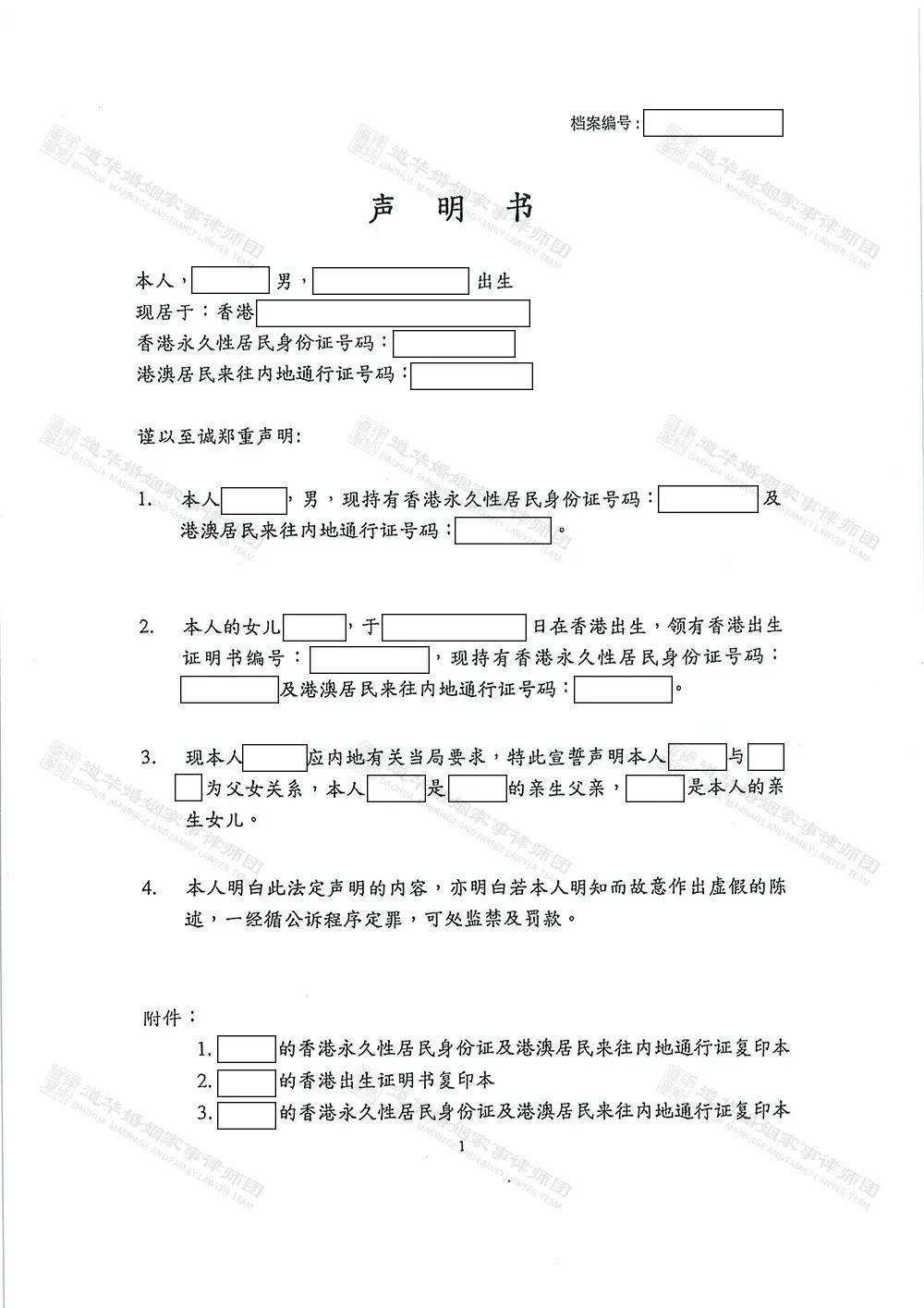
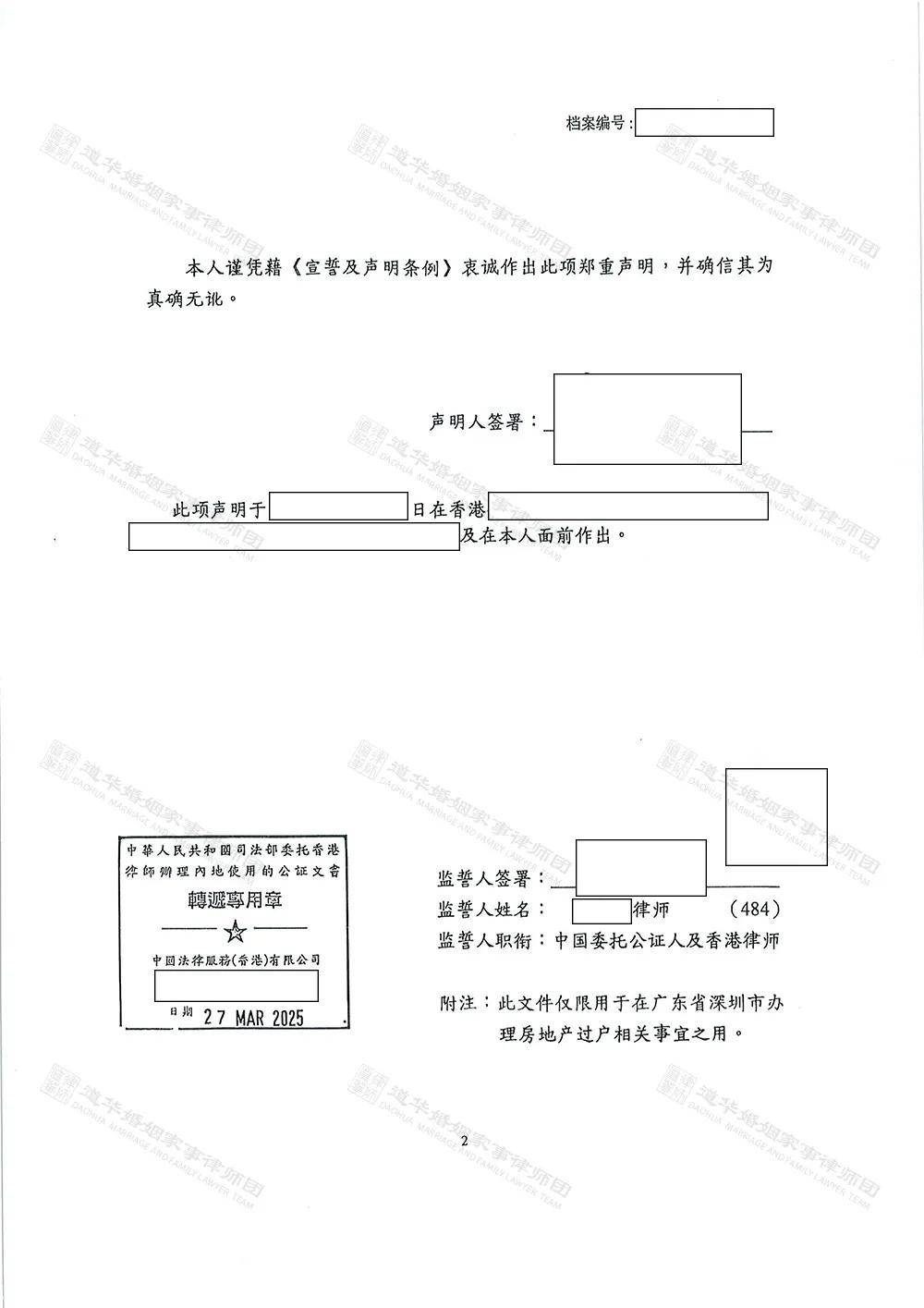
(1) Identity category: Mr. Chen and his daughter's Hong Kong Permanent Resident Identity Card, Mainland Travel Permit for Hong Kong and Macau Residents, and proof of kinship documents notarized and forwarded by a Hong Kong lawyer and a Chinese notary public.
(2) Real estate: Real estate ownership certificate.
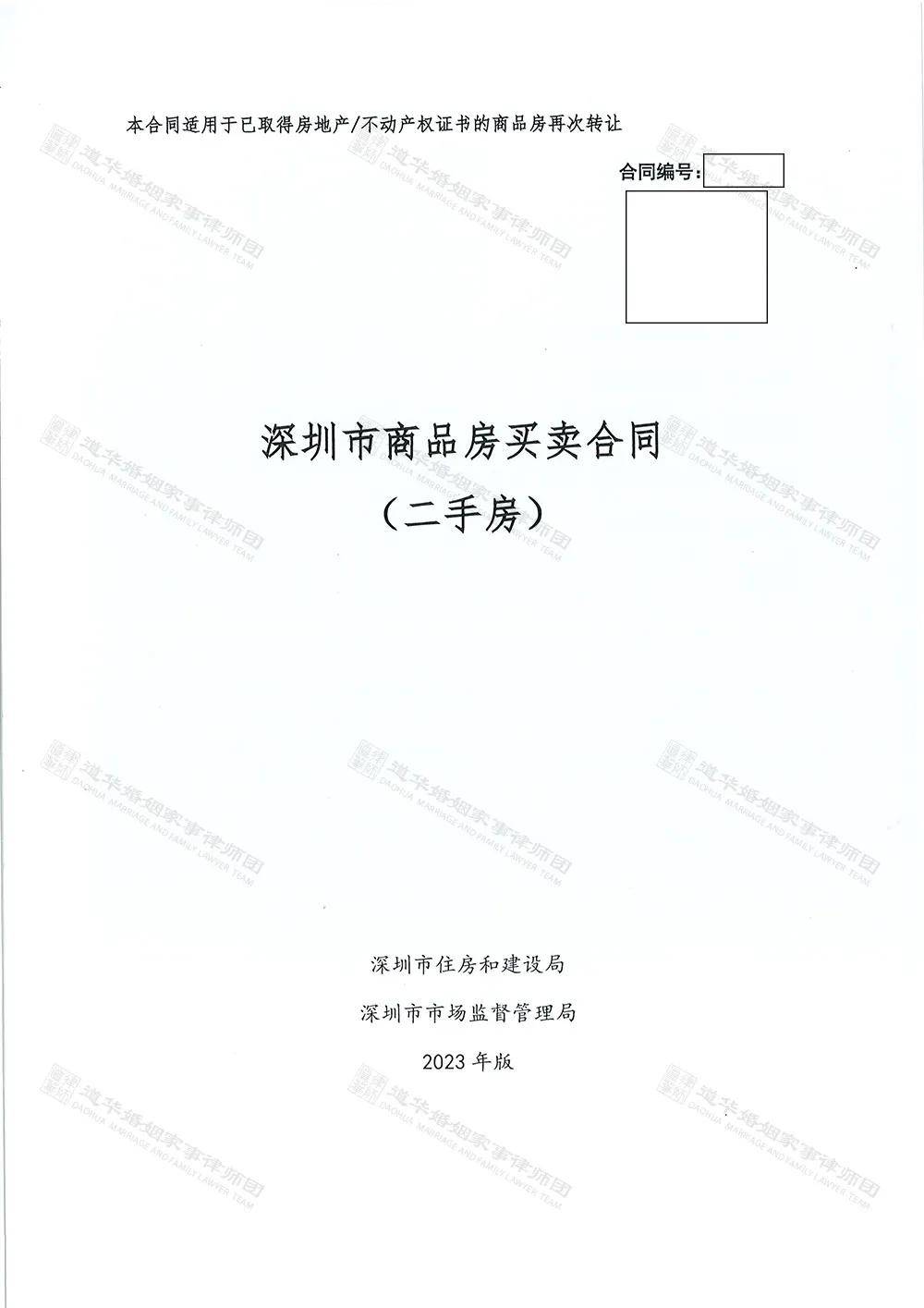
(3) Transaction type: Prepare the "Shenzhen Second-hand House Purchase and Sale Contract" according to the registered price and go to any notary office in Shenzhen to handle the notarization documents for the purchase and sale contract.
(3) Process handling and tax declaration
1. Real Estate Registration Application: Submit a transfer registration application to the Shenzhen Real Estate Registration Center, clearly stating the declared transaction price as the original registration price of the property, and submit proof of direct family relationship, applying for special tax calculation policy.
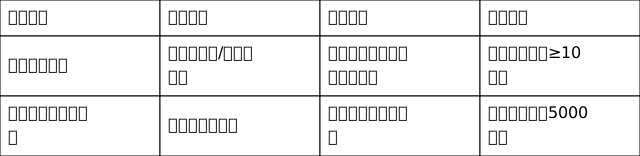
2. Tax valuation and payment: The tax authorities, based on the Shenzhen direct-line kinship transfer policy, approve the original registration price as the tax base. The final calculation of the tax payable is only the deed tax, stamp duty, and registration fee, totaling 5,000 yuan.
3. Transfer of property rights completed: After the payment of taxes and fees, the Real Estate Registration Center legally handles the transfer procedures, transferring the ownership of the property to Mr. Chen's daughter.
Section 3: Results of the Case
The lawyers of this firm successfully transferred Mr. Chen's Shenzhen property to his daughter's name within 2 months of accepting theentrustment, by accurately applying the direct relatives' property transfer tax preferential policy of Shenzhen. The original estimated tax and fee of over 100,000 yuan was reduced to only 5,000 yuan, achieving a tax reduction ratio of over 95%, and fully realizing the core demand of the client for low-cost inheritance of property.
Four, Summary and Expansion —— Low-cost Shenzhen Property Inheritance Path
(1) Shenzhen policy on transferring real estate to direct relatives
1. Basic content and core advantages
For property transfers between direct relatives, there are special tax calculation rules: when buying and transferring property between direct relatives, it is possible to apply to use the original registration price of the property as the basis for taxation, rather than the market valuation price. Essentially, the tax authority recognizes that "transactions between direct relatives at the original registration price" fall under the category of "tax basis significantly low but with legitimate reasons," thereby allowing taxation based on the registration price.
2. Conditions for the applicability of the policy
Principal Conditions: Both parties of the transaction must be direct relatives, including parents and children, grandparents and grandchildren, great-grandparents and great-grandchildren, and spouses. In this case, Mr. Chen and his daughter meet the principal requirements.
Method conditions: The transfer of ownership by sale and purchase must be adopted; gifts and inheritance are not applicable to this tax calculation rule.
Real estate conditions: The real estate must have an original registration price (i.e., with clear historical purchase contracts and invoices as evidence), and the registration price must be significantly lower than the current market valuation. In this case, the real estate property, due to its early purchase time and extremely low registration price, fully meets the conditions.
Material conditions: A notarized proof of direct kinship, real estate ownership certificate, original purchase contract and invoice are required to verify the kinship and the authenticity of the registered price.
(2) Inheritance transfer
1. Basic content and core advantages
In addition to the cross-border sale and purchase method adopted in this case, inheritance transfer is another statutory method to achieve the lowest cost inheritance of real estate, particularly suitable for wealth inheritance arrangements after the owner's centennial.
(1) Extremely low tax and fee costs: There is no inheritance tax in our country for inheritance, and the transfer of real estate through inheritance can be exempt from stamp duty, personal income tax, and value-added tax in accordance with the law. Only the stamp duty (0.05% of the assessed value), real estate registration fee (also known as the processing fee, 80 yuan), need to be paid, and the overall cost can be ignored.
(2) No purchase qualification restrictions: Inheriting property is not affected by Shenzhen's purchase restriction policy, and the heir does not need to have the purchase qualification to handle the transfer.
2. Applicable Conditions and Procedures
Applicable conditions: The property owner (the deceased) has passed away; the heir is a legal heir (spouse, children, parents, etc.) or an heir or legatee who has the right to inherit and acquire the property by virtue of the deceased's will.
Application process:
(1) Material preparation: death certificate of the deceased, proof of kinship, real estate ownership certificate, will (if any).
(2) Handling inheritance confirmation: In the absence of disputes, handle inheritance right notarization; in the presence of disputes, obtain a valid legal document through litigation.
(3) Application for transfer: Apply for inheritance transfer registration at the Real Estate Registration Center with a public certificate or court document.
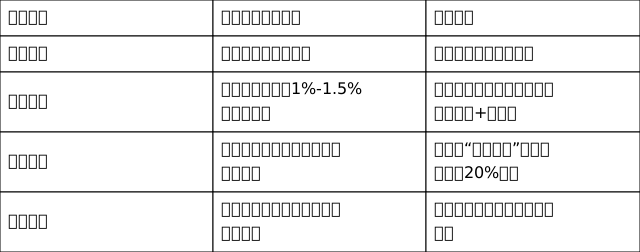
(3) Comparison of the two plans
Chapter 5: Tang Yunhong's lawyer's experience in handling cases
Real estate inheritance is never just a simple transfer of property rights; it is a heavy responsibility of trust and expectation, carrying the affection of the elderly for their children and also concerning the orderly continuation of family wealth. In terms of real estate transfer taxation in our country, in addition to national laws and regulations, local policies have different provisions on the methods of taxation and preferential treatment, resulting in local differences. In practical operations, many parties often fall into traps due to their lack of understanding of policies and regulations, incurring high tax and fee costs.
In this case, Mr. Chen, as a Hong Kong resident, was not very familiar with the mainland policies. Upon learning that the taxes reached 100,000 yuan, he once considered giving up until he found Dao Hua Law Firm to assist him in successfully completing the transfer. Based on the relevant provisions of the Civil Code of the People's Republic of China and the practice of Dao Hua Law Firm in handling property inheritance in Shenzhen and the Guangdong-Hong Kong-Macao Greater Bay Area, the following experience in handling property inheritance among relatives is summarized:
1. Deeply exploring local policies is the key to tax savings.Shenzhen, as a special economic zone, has special policies for transferring properties to direct relatives and historical legacy properties. When handling the inheritance of overseas residents' properties, it is necessary to accurately search for and apply local special rules rather than rely solely on general tax laws. In this case, from the initial anxiety of the client facing a high tax bill of one hundred thousand yuan, to precisely finding a policy breakthrough and ultimately completing the transfer for only 5,000 yuan, we truly feel that professional legal services can not only solve practical problems but also alleviate the client's anxiety and fulfill their wishes.
2. Cross-border entity materials must be compliant:Hong Kong residents handling real estate matters in mainland China must have their identity and family relationship proofs notarized by a Chinese notary public and transmitted by the China Legal Service (Hong Kong) Limited; otherwise, they do not have legal validity. Cross-border property transfers involve differences in rules between the two places and cannot afford any negligence. The rigorous review of each document is a solemn response to the entrustment of the principal and an essential line of defense against legal risks.
3. The selection of plans needs to take both the present and the future into consideration:Choose between buying and inheritance transfer, considering the time nodes of inheritance, current tax costs, and the future tax costs of the children's property disposal, and provide full-cycle legal advice. We fully understand that property inheritance is not only the transfer of property but also the continuation of family emotions and responsibilities. Therefore, every scheme design strives to balance current costs and long-term interests, not to disappoint the trust and expectations of the client.
As lawyers, we not only need to be proficient in laws, regulations, and local policies, but also to possess empathy, stand in the client's shoes, and provide professional, rigorous, and efficient services to safeguard every bit of trust. With the power of law, we make wealth inheritance easier, more reassuring, and more heartwarming. This is our ultimate pursuit of upholding the original intention of law and fulfilling our professional mission.
Six, Index of Laws and Regulations
(1) Laws and regulations
The Civil Code of the People's Republic of China
Article 209: The establishment, alteration, transfer, and extinguishment of immovable property rights shall take effect upon registration in accordance with law; without registration, they shall not take effect, except as otherwise provided by law.
Article 1127: The inheritance of the estate shall be in the following order: (1) First order: spouse, children, parents; (2) Second order: siblings, grandparents, grandparents-in-law.
The Property Transfer Tax Law of the People's Republic of China:
Article 4: The basis for calculating the deed tax: (1) For the transfer of land use rights, sale of houses, the consideration price determined by the contract of transfer of land and house ownership, including the price for the delivery of money as well as the price for tangible assets and other economic interests; (3) For the gift of land use rights, gift of houses, and other transfers of land and house ownership without a price, the price shall be the price determined by the tax authority in accordance with the market price of the sale of land use rights and houses. If the consideration price or the difference in exchange prices declared by the taxpayers is obviously low and without a legitimate reason, the tax authority shall determine the price in accordance with the provisions of the "Tax Collection and Administration Law of the People's Republic of China".
Article 6: Exemptions from real estate transfer tax shall apply in the following circumstances: …… (V) Legal heirs who inherit land and house ownership rights.
Article 35 of the "Tax Collection and Administration Law of the People's Republic of China" (amended in 2015): Where a taxpayer has any of the following situations, the tax authority has the right to determine the amount of tax payable:
(1) According to the provisions of laws and administrative regulations, it may not be necessary to set up books.
(2) Those that should set up books according to the provisions of laws and administrative regulations but have not done so.
(3) Unauthorized destruction of books or refusal to provide tax information.
(4) Although books are set up, the accounts are disorganized, or the cost information, income vouchers, and expense vouchers are incomplete, making it difficult to audit.
(Five) Where there is a tax obligation, failure to file a tax return within the prescribed period, after being ordered by the tax authority to file a return within a specified time limit, and still failing to file a return after the deadline.
(Six) The tax basis declared by the taxpayer is obviously low and there is no legitimate reason for it.
The specific procedures and methods for determining the amount of tax payable shall be stipulated by the tax administrative department under the State Council.
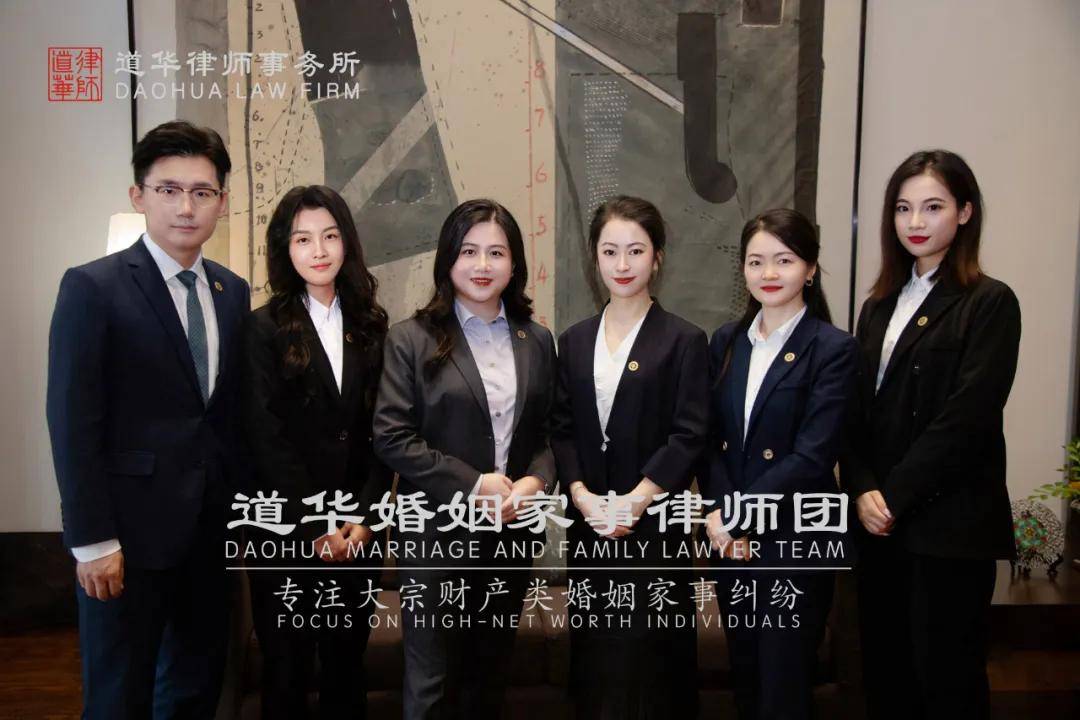
Daohua Family Law Firm (Guangdong Daohua Law Firm), ten years focused on major property marriage and family legal services, divorce inheritance family disputes (mediation/trial) practical experts, one of the influential brands of professional legal services in Guangdong Guangdong-Hong Kong-Macau Greater Bay Area [Shenzhen local], and even a benchmark lawyer team for mediation and trial in the well-known cross-border divorce inheritance field.
The Tang Yunhong Law Firm has handled over 1000 cases related to marriage and inheritance, involving tens of billions of yuan. The firm has extensive successful litigation experience in the fields of dispute resolution, including the division of divorce-related large properties such as listed company equity, Shenzhen small property rights houses, land, and factories, as well as inheritance disputes, will drafting, and family property inheritance. It is particularly skilled in handling cross-border and cross-jurisdictional divorce property litigation and inheritance cases, addressing industry difficulties and pain points. The firm's localized legal wisdom has overcome various complex family property disputes, earning high praise from clients and industry reputation.
Adhering to the philosophy of "securing property safety, preventing legal risks, and empowering wealth appreciation," we gather experts from industries such as law, banking, insurance, and finance and taxation. With rich experience in civil and commercial litigation and arbitration, as well as civil and criminal crossover and tax planning, we provide a comprehensive package of solutions for high-net-worth individuals (including those from Hong Kong, Macau, and foreign nationals) for marriage, family affairs, and wealth inheritance. This aims to achieve the beautiful vision of risk prevention and control, debt isolation, and family wealth inheritance.
Asset types cover: real estate (residential properties, small property rights houses, land, factories, etc.), movable property (vehicles, antiques, paintings, gold jewelry, etc.), various property rights (cash deposits, equity, debts, relocation compensation, fund investments, virtual property, intellectual property rights, etc.). The team systematically compiles professional achievements such as "Compilation of Successful Cases of Dao Hua Marriage and Inheritance" and "Legal Practice of Family Wealth Transmission", to meticulously protect clients' property rights and interests, and to safeguard the inheritance of family wealth with meticulous service!
Statement:The information or articles published on this website are for exchange purposes only. The names of individuals/companies mentioned in this article are pseudonyms, and the amounts/dates of the case information have been processed for confidentiality. The content of the article is created by the author and does not represent legal opinions or suggestions issued by Guangdong Daohua Law Firm or other lawyers. The information contained in this article is provided for general information purposes only, and Guangdong Daohua Law Firm does not make any timeliness modifications or updates to this article. Decisions made by readers based on all or part of the content of this article and the consequences arising therefrom shall be solely responsible by the person acting. The author and Guangdong Daohua Law Firm shall not be liable for any responsibility. If any content of these articles is to be reproduced or cited, please indicate the source. If you need legal advice or legal services, please contact our lawyers.
No registration required, quick appointment, expert lawyers provide customized legal service solutions
 Consultation Appointment:400-829-6880
 Private Space:18126123723
 Law Firm: Guangdong Daohua Law Firm
 Email:DAOHUALAWMF@163.com
 Address:810, Rongchao Economic & Trade Center, 4028 Jintian Road, Futian District, Shenzhen (Next to Civic Center)

18126123723
Follow us anytime, anywhere


