
Navigation
Author: Dao Hua Marriage and Family Law FirmDate: 2026-03-06Reads:times
Marriage and Family Affairs Dispute (Mediation/Litigation) Practical Expert
Ten years of focus on; marriage and family legal services for bulk property matters
Guangdong Dao Hua Law Firm, Tang Yunhong, Dao Hua Family Law Team, Shenzhen's renowned divorce litigation lawyer, professional inheritance and succession dispute lawyer, Guangdong and Shenzhen's top ten family law firms, specializing in: major difficult divorce mediation/court litigation, property small property division, will and inheritance disputes, will notarization, divorce property division, post-divorce property disputes, divorce/marital agreement, custody disputes, will inheritance disputes, legal inheritance disputes, land and property inheritance, rural house demolition inheritance, will drafting, will validity determination, etc. Non-litigation and disputes. Service areas: Futian, Nanshan, Luohu, Longgang, Bao'an, Longhua, Guangming, Pingshan, Dapeng, Yantian.

One, Case Review
Party A, Mr. A, and Party B, Ms. B, were originally married. Later, due to the breakdown of their relationship, they filed for divorce through litigation. During the trial of the divorce case by the original court, Mr. A proposed to divide the stock options under Ms. B's name, but Ms. B denied that the stock options under her name had been exercised. The original court believed that options are uncertain, and holding options alone cannot determine whether they are the actual property of both parties, so it did not handle the stock options in the divorce case but pointed out that Mr. A could file a separate lawsuit after providing evidence that Ms. B had actually exercised the options.
After the divorce, Mr. A found that Ms. B had exercised stock options through Company C, and the shareholders of Company C were the driver of Ms. B's current husband. The statements Ms. B previously made about holding shares on behalf of others and transferring equity were false. Based on this, Mr. A filed a lawsuit for property disputes after the divorce, requesting Ms. B to pay the profits from the exercise of stock options. Mr. A argues that the income Ms. B obtained by exercising options during the marriage should be considered as joint property and should be divided according to law. However, Ms. B disputes this, claiming that stock options have a personal attribute and are the result of her individual efforts, and should not be divided as joint property.
Second, the court trial
The case has been handled by two levels of courts, first instance and second instance. The first instance court supported part of Mr. A's claims and ordered Ms. B to pay Mr. A a portion of the income from the stock options. Ms. B appealed against the first instance judgment, arguing that the stock options should not be regarded as joint property of the couple.
The appellate court believes that according to Article 1062 of the Civil Code of the People's Republic of China, the property such as wages, bonuses, and remuneration for labor obtained by the couple during the continuation of the marriage relationship shall be considered as joint property of the couple. During the continuation of the marriage relationship, Ms. B was granted stock options by the company and the income obtained by exercising the options during the continuation of the marriage relationship shall be deemed as income related to her position and employment, and should be categorized as "wages, bonuses, and remuneration."
The appellate court pointed out that as a new type of property that has emerged with the development of social and economic conditions, stock options are increasingly common in judicial practice. However, neither the previous "Marriage Law of the People's Republic of China" nor the current "Civil Code of the People's Republic of China" has explicitly stipulated how to divide stock options, this new form of property, in divorce disputes. Nevertheless, according to the legislative spirit and fundamental principles of the Civil Code, stock options actually constitute a form of remuneration for the labor input of employees by the company. Therefore, the income from stock options should be within the scope of jointly-owned property as stipulated by our "Civil Code."
In the end, the second-instance court upheld the original judgment and dismissed the appeal. Ms. B is required to pay a portion of the stock option earnings to Mr. A within seven days after the judgment takes effect.
(Case source: Beijing Third Intermediate People's Court)

Case Difficulties
1. The legal determination issue of whether stock options belong to the joint property of husband and wife
Stock options, as a new type of property right, are not explicitly defined in the current "Civil Code" and related laws regarding the nature of such property rights. Therefore, in the process of substantive trial, there has been controversy over its legal nature. Consequently, whether stock options can be identified as joint property of the couple is the legal basis for dividing such property in divorce cases.
2. The party requesting the division of option rights faces significant difficulties in providing evidence and collecting evidence.
Stock options are a system granted by a company to specific individuals, aimed at motivating or rewarding their work performance. In equity incentive plans, it is often stipulated that this right is exclusively for the individual employee, or it is agreed that it may not be transferred, pawned, or disposed of in any other way. In nature, it has a strong personal attribute and confidentiality. In divorce cases, the party requesting the division of option interests as a spouse is legally required to bear certain evidence obligations, therefore, the other party often faces significant difficulties in collecting evidence of stock option information: on the one hand, the party holding the stock options may be unwilling to disclose the option information truthfully; on the other hand, the non-shareholding party often lacks a basic understanding of stock options and does not know how to inquire about relevant information.
3. Valuation and division methods of stock options
Stock options have a strong correlation with corporate equity, and their value and actual returns are often closely related to factors such as the company's stock price and operating conditions, with uncertainty. In practice, they may face various situations: first, the options have not been exercised; second, the options have been exercised but the stocks have not been sold; third, the options have been exercised and the stocks have been sold. Different situations require different methods of division.
At the same time, according to the "Notice on the Issue of Personal Income Tax on the Income from Stock Options" [Cai Shui No. 35 of 2005] stipulated: "Item (ii): The difference between the actual purchase price (exercise price) of the stock obtained from the enterprise by the employee and the fair market value of the purchase day (referring to the closing price of the stock on that day, etc.) is the income obtained by the employee due to their performance and achievements in the enterprise, which is related to their position and employment. It should be calculated and paid as personal income tax according to the provisions applicable to 'wages and salaries income.' For special circumstances where the employee transfers the stock option before the exercise date, the net income from the transfer of the stock option shall be levied as personal income tax on wages and salaries income." According to the provisions, the employee needs to pay the corresponding personal income tax when exercising the stock option, and the tax paid is considered as the cost of exercise, which varies depending on the different situations of exercising the option, and the calculation method of recognizing the option income is also different.
Chapter 4: Insights on Tang Law
Stock options, as an important component of employee compensation, have established a relativelyimprove legal rule system for division in divorce cases. The judgment in this case indicates that the court tends to identify stock options granted and exercised during the marriage as joint property of the couple, reflecting the application of the fair principle in the Civil Code of the People's Republic of China in the field of marriage and family affairs.
Based on the relevant provisions of the Civil Code of the People's Republic of China and the judicial practice of the Dao Hua Law Firm team in the Greater Bay Area, for the division of stock options in divorce cases, corresponding handling methods can be adopted for different situations:
1. Granting within marriage, exercising within marriage:The division of jointly-owned property by married couples should be handled according to general principles. In this case, the granting and exercise of options both occur during the marriage, and the formation of their property value is inextricably linked to their joint life, and it should logically be jointly owned by both parties.
2. Grant before marriage, exercise during marriage:According to the distinction between pre-marital and post-marital property value. For such options, the basis for division is the "corresponding income portion during the marriage relationship." In practice, the proportional method is usually adopted for calculation, i.e., the joint property portion = total option income × (service time during the marriage relationship ÷ total service time). This method recognizes the personal pre-marital property rights of one party while also ensuring the legitimate rights and interests of the spouse in the appreciation of property during the marriage.
3. Grant during marriage, exercise after divorce:Similarly, it should be recognized as part of the joint property of the couple. In this case, the non-shareholding party can wait to exercise the stock options before claiming their rights. As in the handling of the divorce case in this case, since the stock options are uncertain, merely holding the options does not determine that they are the actual property of both parties, so the stock options were not handled in the divorce case. The other party can wait until the conditions for exercising the options are met before filing a lawsuit to request a division. This approach respects the special nature of stock options and also provides the non-shareholding party with the necessary legal remedy.
4. Grant before marriage, exercise after divorce:During the existence of the marriage relationship, the corresponding part shall be identified as joint property of the couple. In this case, the formation of property value spans three stages: before marriage, during marriage, and after divorce, and it is necessary to fairly define the contribution ratio of each stage. It is noteworthy that in such cases, the burden of proof is often borne by the non-shareholding party, who needs to provide evidence to prove the contribution to the formation of option value during the existence of the marriage relationship.
As the social and economic development of the Greater Bay Area continues, the subjects of divorce property division will also become increasingly diverse. As a professional family law firm specializing in Shenzhen and the Greater Bay Area, Guangdong Daohua Law Firm will continue to adhere to the philosophy of "focusing on major property-related marriage and family disputes," keep pace with the development of the capital market, conduct in-depth research on the division rules of various types of new property rights and interests, and contribute to the protection of clients' legitimate rights and interests and the promotion of fair and just family trials.

V. Legal Index
1. The Civil Code of the People's Republic of China
Article 1062:The following property acquired by the couple during the existence of the marriage relationship shall be the joint property of the couple and jointly owned by them:
(1) Salary, bonuses, remuneration for labor;
(2) Income from production, operation, and investment.
(3) Income from intellectual property rights;
(4) Property inherited or gifted, except for the third item of Article 1063 of this Law; (5) other property that should be jointly owned. The couple has an equal right to dispose of the joint property.
Article 1063:The following property is the personal property of one spouse:
(1) The pre-marital property of one party.
(2) Compensation or compensation obtained by one party due to personal injury.
(3) Property specified in a will or gift contract to be solely owned by one party.
(4) Articles of daily use exclusively for one party.
(5) Other property that should be attributed to one party.
Article 1087:In the event of divorce, the joint property of the couple shall be handled by mutual agreement; if an agreement cannot be reached, the People's Court shall make a judgment based on the specific circumstances of the property, in accordance with the principles of considering the rights and interests of the children, the female party, and the innocent party.
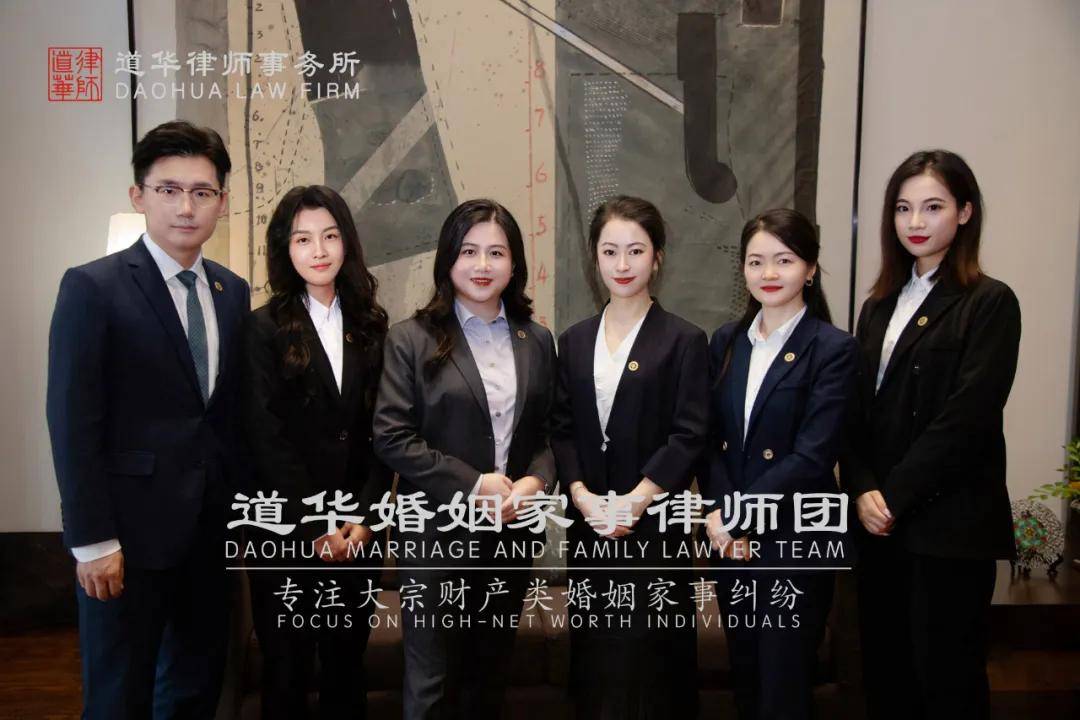
Dao Hua Family Law Firm, ten years focused on major property marriage and family legal services, expert in marriage inheritance and family disputes (mediation/trial), is one of the influential brands in [Shenzhen local] marriage inheritance and wealth management legal services.The team has handled over 1000 cases related to marriage inheritance, and has extensive experience in dispute resolution fields such as complex marriage and family matters, inheritance disputes, will drafting, and family property distribution. Utilizing local wisdom, the team is skilled in handling difficult divorce property division cases involving Shenzhen's small property rights houses, village committee shares, will drafting and notarization, and inheritance disputes, winning unanimous praise from clients.
Adhering to the philosophy of "securing property safety, preventing legal risks, and empowering wealth appreciation," we gather experts from industries such as law, banking, insurance, and finance and taxation. With a wealth of successful cases, we provide a comprehensive package of solutions for high-net-worth individuals (including those from Hong Kong, Macau, and foreign nationals) in marriage, family affairs, and wealth inheritance, aiming to achieve the beautiful vision of risk prevention and control, debt isolation, and family wealth inheritance.Asset types include: real estate (commercial housing, small property rights housing, land use rights, etc.), various property rights (equity, debt, relocation compensation, copyright, invention patents, etc.). The team has completed the compilation of "Daohua Marriage and Inheritance Successful Case Compilation" and "Legal Practice of Family Wealth Inheritance." Both legal practice and theoretical research have achieved remarkable results.
Statement:The information or articles published on this website are for exchange purposes only. The names of individuals/companies mentioned in this article are pseudonyms, and the amounts/dates of case information have been processed for confidentiality. The content of the article is created by the author and does not represent legal opinions or suggestions issued by Guangdong Daohua Law Firm or other lawyers. The information contained in this article is provided for general information purposes only, and Guangdong Daohua Law Firm does not make any timely modifications or updates to this article. Decisions made by readers based on all or part of the content of this article and the consequences arising therefrom shall be solely responsible by the person acting. The author and Guangdong Daohua Law Firm shall not be held liable. If any content of these articles is to be reproduced or cited, please indicate the source. If you need legal advice or legal services, please contact our lawyers.
No registration required, quick appointment, expert lawyers provide customized legal service solutions
 Consultation Appointment:400-829-6880
 Private Space:18126123723
 Law Firm: Guangdong Daohua Law Firm
 Email:DAOHUALAWMF@163.com
 Address:810, Rongchao Economic & Trade Center, 4028 Jintian Road, Futian District, Shenzhen (Next to Civic Center)

18126123723
Follow us anytime, anywhere


