
Navigation
Author: Dao Hua Marriage and Family Law FirmDate: 2026-03-04Reads:times
Marriage and Family Affairs Dispute (Mediation/Litigation) Practical Expert
Ten years of focus on; marriage and family legal services for bulk property matters
Guangdong Dao Hua Law Firm, Tang Yunhong, Dao Hua Family Law Team, Shenzhen's renowned divorce litigation lawyer, professional inheritance and succession lawyer, Guangdong and Shenzhen's top ten family law firms, specializing in: major difficult divorce mediation/court litigation, property small property division, will and inheritance disputes, will notarization, divorce property division, post-divorce property disputes, divorce/marital agreement, custody disputes, will inheritance disputes, legal inheritance disputes, land and property inheritance, rural house demolition inheritance, will drafting, will validity determination, etc. Non-litigation, disputes, etc. Service area: Futian, Nanshan, Luohu, Longgang, Bao'an, Longhua, Guangming, Pingshan, Dapeng, Yantian.

Introduction:In the context of an aging population, diversified family structures, and the awakening of individual rights consciousness, the traditional legal guardianship system is no longer able to fully meet adults' autonomous needs for future life arrangements. Article 33 of the "Civil Code of the People's Republic of China" (hereinafter referred to as the "Civil Code") establishes the system of designated guardianship for adults, granting fully capable adults the right to autonomously appoint guardians through written agreements in advance, providing a solid legal support for the protection of their rights and interests after they lose or partially lose civil conduct capacity. This article will systematically interpret the connotation and application of the designated guardianship system from dimensions such as legislative background, core provisions, and establishment procedures, providing professional legal guidance to readers.
One, the legislative background of designated guardianship.
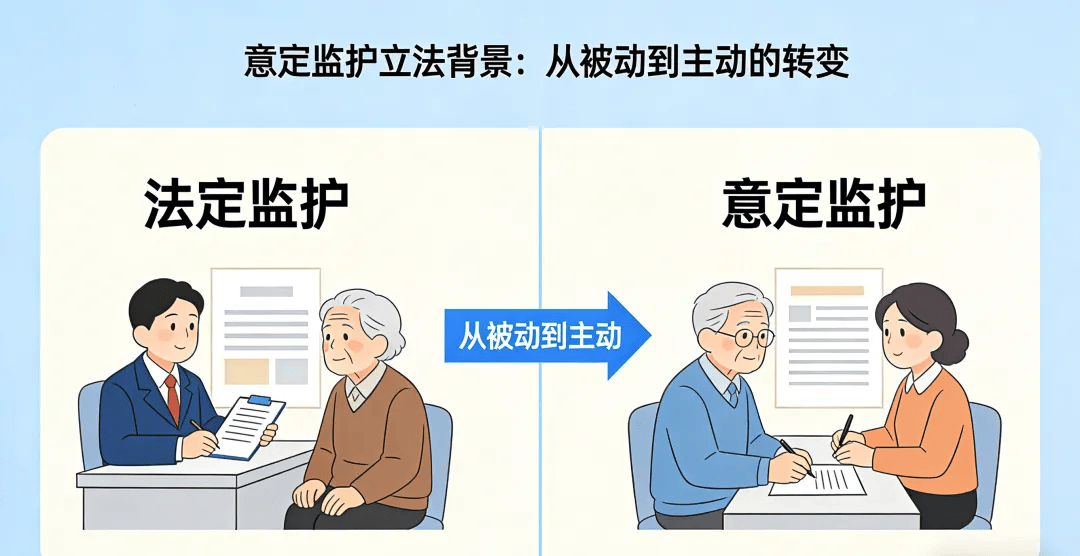
From passive protection to active planning, the evolution of the guardianship system
The traditional guardianship system is centered around legal guardianship, with the scope and responsibilities of guardians directly stipulated by law. It mainly relies on close relatives such as spouses, children, and parents to act as guardians, playing an important role in safeguarding rights and interests within the traditional extended family structure. However, with social changes, its limitations have become increasingly apparent. Firstly, the principle of prioritizing relatives may conflict with the true wishes of the ward, and some elderly individuals may not want their children to act as guardians due to reasons such as filial ingratitude or distant relationships. Secondly, the coverage is limited, and it is difficult for the legal guardianship to provide effective protection for groups such as elderly individuals living alone, childless couples, and adults without close relatives. Thirdly, there is a lack of autonomy, as the ward can only passively accept the appointment by the law and cannot autonomously plan for their future care and property management matters.
With the increasingly urgent practical needs, the legislative process of the system of designated guardianship is continuously advancing. The revised "Law on the Protection of the Rights and Interests of the Elderly" in 2012 first introduced the system of designated guardianship for the elderly, allowing the elderly to negotiate and determine guardians when they have full civil conduct capacity, and to assume guardianship responsibilities when they lose or partially lose civil conduct capacity. The "General Provisions of the Civil Law" implemented in 2017 expanded the scope of application of designated guardianship to all adults with full civil conduct capacity, emphasizing that the establishment of designated guardianship requires written form, and preliminarily established the framework of the system of designated guardianship. The "Civil Code" effective in 2021 further clarified the core rules of designated guardianship, specifying that designated guardianship takes precedence over legal guardianship, fully reflecting the principle of respecting the real intentions of the ward. The "Interpretation of the Supreme People's Court on Certain Issues Concerning the Application of the General Provisions of the Civil Code of the People's Republic of China" supplemented and refined the relevant provisions in the "Civil Code" on the arbitrary termination of designated guardianship and the supervision of designated guardianship, making the application of the system of designated guardianship more operational.
Article 2: Core Legal Provisions and Key Points of Nominal Guardianship
The Civil Code and relevant judicial interpretations have made clear provisions on the subjects, establishment methods, effective conditions, rights and obligations, and other core contents of designated guardianship. Accurately grasping these legal requirements is the prerequisite for the legal establishment and effective performance of designated guardianship.
(1) Core legal basis
Article 33 of the Civil Code stipulates: "A person with full civil capacity may, in advance, negotiate with their close relatives, other individuals or organizations willing to act as guardians, to determine their guardians in writing. In the event that the person loses or partially loses civil capacity, the guardian shall perform the guardianship duties."
At the same time, Articles 34, 35, and 36 of the Civil Code respectively make detailed and specific provisions on the duties of guardians, principles of performance, and changes and revocations, providing a legal basis for the practical application of designated guardianship.
(2) Key Points Analysis
1. Main requirements: Legal requirements for the founder and guardian
The person establishing a designated guardianship must be an adult with full civil legal capacity and must be mentally competent and able to independently recognize the legal consequences of their actions at the time of entering into the agreement. Minors, due to the lack of full civil legal capacity, cannot establish a designated guardianship; adults who have lost or partially lost civil legal capacity, due to the lack of effective capacity for expression of will, cannot establish a designated guardianship either.
The scope of designated guardians does not have identity restrictions, and it is broad, including natural persons such as siblings, friends, and relatives, as well as organizations such as neighborhood committees, village committees, Disabled Persons' Federation, elderly organizations, civil affairs departments, etc. As long as they have full civil conduct capacity and are willing to act as guardians, the guardianship relationship between both parties can be established in writing.
It should be especially noted that designated guardianship has a high personal attribute, being the autonomous planning of the person establishing it. It is not permissible to act as an agent to establish designated guardianship for others, and designated guardianship agreements signed by agents are invalid according to law.
2. Establishment method: Prior negotiation and written form are indispensable.
The establishment of designated guardianship is based on the principle of autonomy of will, and it must meet strict formal and substantial requirements. First, it must be agreed upon through "prior negotiation," and designated guardianship is established on the basis of autonomy of will. The person establishing the guardianship must communicate fully with the guardian regarding guardianship matters to ensure that both parties' expressions of will are genuine and consistent, without fraud, coercion, or major misunderstandings; second, it must be in "written form." The written agreement should be as detailed as possible, not only specifying the trustee as the guardian but also making specific provisions for guardianship powers, scope of responsibilities, and handling plans to avoid subsequent disputes.
3. Effective Conditions: Subject to effective upon condition, rather than immediate upon establishment
The agreement for designated guardianship does not take effect immediately upon signing, but rather becomes effective only when the setter is deemed to have lost or partially lost civil conduct capacity. Once the setter is legally determined to have lost or partially lost civil conduct capacity due to reasons such as old age, illness, or accidents, the agreement will officially take legal effect, and the guardian will begin to fulfill their guardianship duties.
The recognition of a person's civil conduct capacity requires a legal procedure. The designated guardian may apply to the court to recognize the settlor as a person with limited or no civil conduct capacity. At the same time, based on the agreement and notarial documents, etc., the guardian may request the court to appoint themselves as the guardian, further confirming and publicizing their guardian status.
4. Effectiveness priority: Nominal guardianship takes precedence over statutory guardianship
According to the spirit of the Civil Code, a legally valid will-based guardianship agreement has priority over statutory guardianship in applicability. When both will-based guardianship and statutory guardianship coexist, the guardian designated by the founder independently assumes the guardianship responsibilities, rather than the legal relatives designated by law. This rule fully respects the founder's right to independent decision-making and effectively avoids disputes over guardianship rights that may arise due to property, interests, and other issues in statutory guardianship.
5. Guardianship Responsibilities: Most favorable to the ward, respecting the true will
After the effective implementation of designated guardianship, the duties of the guardian are governed by Article 34 of the Civil Code, which primarily includes three categories: first, personal guardianship, which protects the life, health, name rights, portrait rights, and other personal rights of the ward, mainly responsible for their daily life and medical care; second, property guardianship, which manages the ward's property in accordance with the law, including collecting rent, repaying debts, managing investments, etc.; third, agency in civil activities, representing the ward in civil legal acts such as signing contracts and participating in litigation.
The guardian must strictly follow the principle of what is most beneficial to the ward, and shall not arbitrarily dispose of the ward's property except for the purpose of protecting the ward's interests. At the same time, the guardian shall give full respect to the real wishes of the adult ward and ensure and assist the ward in implementing civil legal acts that are appropriate to the ward's intellectual and mental health status. For matters that the ward is capable of handling independently, the guardian shall not interfere.

6. Rights Protection: Termination of Agreement and Revocation of Guardianship Qualification
In accordance with Article 11 of the Interpretation of the Supreme People's Court on Certain Issues Concerning the Application of the General Provisions of the Civil Code of the People's Republic of China, if an adult with full civil conduct capacity enters into a written agreement for designated guardianship with another person, and before the adult loses or partially loses civil conduct capacity, either party to the agreement requests to terminate the agreement, the people's court shall support such request in accordance with law. However, after the adult loses or partially loses civil conduct capacity, if the guardian designated by the agreement requests to terminate the agreement without justifiable reasons, the people's court shall not support such request.
If the guardian appointed by will has any of the statutory situations stipulated in Article 36 of the Civil Code, such as severely harming the physical and mental health of the ward, refusing to perform the duties of guardianship resulting in the ward being in a dangerous and destitute state, etc., the relevant individuals or organizations may apply to the People's Court to revoke their guardianship qualifications to safeguard the rights and interests of the ward. During the transition period of the guardianship relationship, the residents' committee, village committee, relevant organizations, or civil affairs department at the place of residence of the ward shall provide necessary temporary guardianship measures to the parties concerned in a timely manner, such as basic living care, medical assistance, temporary custody of property, etc., until the People's Court legally appoints a new guardian.
7. Legal boundaries: Guardianship responsibilities and inheritance are mutually independent
Guardianship and inheritance belong to different legal categories, and there is no necessary connection between them. The core purpose of guardianship is to protect the personal and property rights of the ward after they lose or partially lose civil conduct capacity, while property inheritance must strictly follow the provisions of the Inheritance Chapter of the Civil Code, and proceed according to the will of the ward or the statutory inheritance order. Even if the designated guardian fulfills their guardianship duties, they do not necessarily acquire the ward's inheritance rights; the guardian's inheritance rights still need to comply with the relevant provisions of the will or statutory inheritance.
When any of the following situations occur, such as the death of the ward, the ward regaining full civil capacity, or the fulfillment of the termination conditions stipulated in the agreement, the designated guardianship relationship shall be terminated in accordance with the law.

Three, the establishment process of designated guardianship: standardized operation, prevent legal risks
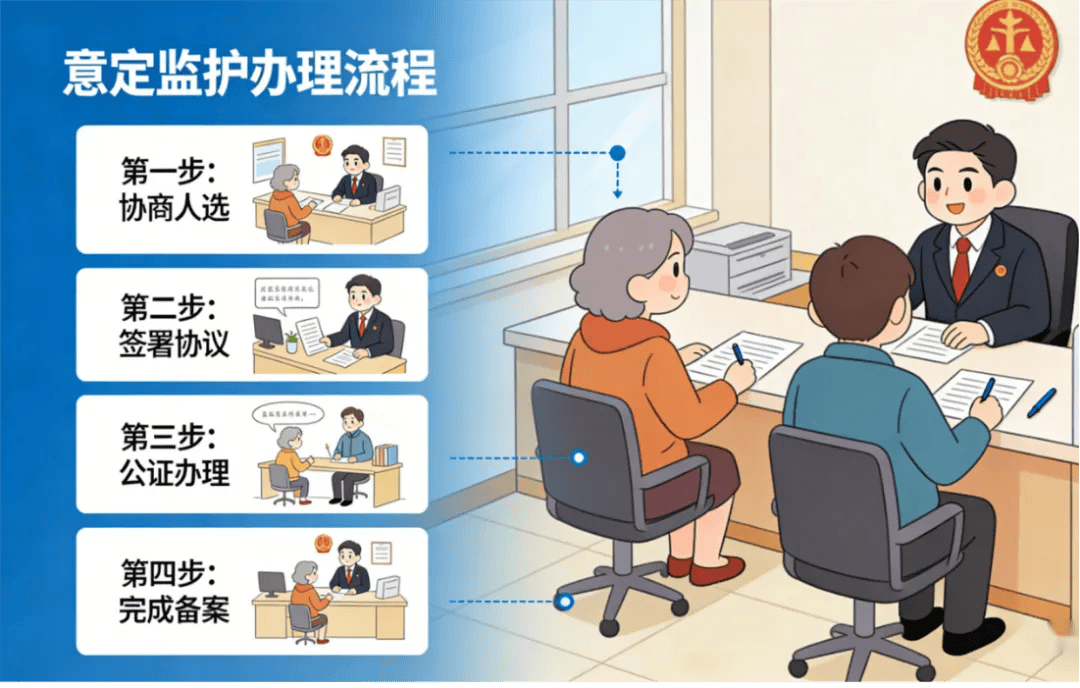
The establishment of designated guardianship must follow a standardized process, from the selection of guardians to the filing of agreements. Every step requires attention to detail control to effectively avoid legal risks in subsequent performance and ensure the validity of the agreement. The specific establishment process is divided into four steps:
Step 1: Select a guardian, fully negotiate
The settlor first needs to pre-determine a suitable designated guardian and fully negotiate with the intended guardian on guardianship matters, clearly defining the core contents such as the conditions for the guardianship to take effect, the scope of responsibilities, remuneration and expenses, supervision mechanisms, and dispute resolution methods, to ensure that both parties have a consistent expression of intent and there are no cases of fraud or coercion.
Second step: Sign a written agreement for designated guardianship
After reaching a consensus, both parties shall sign a written "Agreement on Nominal Guardianship," which is the core document for establishing nominal guardianship. The agreement should at least include the following contents: basic identity information of both parties; conditions for the guardianship to take effect; specific content of guardianship responsibilities such as personal care, property management, and medical decision-making; guardianship period; the compensation and method of payment for the guardian; the entity responsible for the expenses of the ward such as living expenses and medical expenses; clauses for the amendment and termination of the agreement; liability for breach of contract; dispute resolution methods, etc.
It is recommended to abandon clauses such as "all matters shall be decided by the guardian" and strive for specificity and clarity, preventing the guardian from abusing their guardianship rights from the source.
Step 3: Handle notarization
The law does not require mandatory notarization of designated guardianship agreements, but considering aspects such as effectiveness guarantee, procedural standardization, and credibility, notarization is the best option. Notary institutions will conduct strict reviews of the civil capacity of the establishment party, the authenticity of the expression of will, and the legality of the agreement content, and will fix the process of handling through means such as audio and video recordings. The notarized certificate issued has extremely high legal effectiveness and credibility, and can avoid subsequent disputes arising from the effectiveness of the agreement.
When applying for a notary public service, both parties need to prepare their ID cards, household registration books, property ownership certificates (such as real estate ownership certificates, deposit receipts, share certificates, etc.), and the text of the designated guardianship agreement, and go together to the notary office to submit the application. After the notary reviews the existing materials, they may also require additional materials such as marriage certificates, proof of kinship, single declarations, informed consent letters of legal guardians, and hospital diagnosis certificates (to prove the ward's current civil capacity). After the notary verifies that both parties' qualifications and the agreement content are correct, both parties will sign the agreement in the presence of the notary, who will explain the terms of the agreement and legal consequences in detail. After the notary office reviews and confirms that all materials are complete, the notary process can be completed and the notarial certificate can be obtained.
Step 4: Inform and register
Informing and filing are not the effective requirements for the establishment of designated guardianship, but in order to ensure that guardians can smoothly fulfill their guardianship duties, it is recommended that the person establishing the guardianship inform their close relatives, the neighborhood committee/village committee, civil affairs department, or attending physician, among other relevant entities, of the situation of the designated guardianship agreement. Where necessary, they can file with the grassroots organizations for record, which facilitates the functioning of the subsequent supervision mechanism and ensures that relevant entities can timely cooperate with the guardian to fulfill their duties when the effective conditions are met.
Four, the practical application value and social effectiveness of designated guardianship: empowering the system, safeguarding people's livelihoods
As an important innovation in the guardianship system of the Civil Code, the designated guardianship system is centered on the autonomy of private rights, running through three dimensions of private rights protection, social needs response, and institutional modernization transformation, and has both significant practical value and social effectiveness. The system allows adults to independently select guardians and agree on the scope of guardianship when they have full civil conduct capacity, making up for the rigid defects of traditional statutory guardianship; by expanding the scope of guardianship subjects, it responds to the realistic needs brought about by aging and family diversification, and provides personalized rights protection for the elderly and special groups.
At the same time, the system of designated guardianship also has the function of risk governance. Guardians can regulate the behavior of individuals with insufficient capacity through the performance of their supervisory duties, reduce the risk of related criminal and illegal activities; at the level of property management, general agency is implemented for individuals without civil legal capacity, and the right to make important decisions is reserved for individuals with restricted civil legal capacity, to the greatest extent ensuring the property rights and interests of the ward, and achieving the organic unity of individual rights protection and social governance.
As the public awareness of rights continues to rise, the application scenarios of the designated guardianship system will become more extensive. In the future, it is necessary to further resolve issues such as insufficient standardization of agreements and the lack of supervision mechanisms in practice through supplementary measures such as the refinement of judicial interpretations, improvement of notarial norms, and strengthening of supervision mechanisms, so that the designated guardianship system can truly take root and benefit the people, demonstrating the warmth and strength of a rule-of-law society.

V. Legal Index
The Civil Code of the People's Republic of China
Article 33 [Estate Guardian Appointment] A fully capable adult may, through prior consultation with their close relatives, other individuals or organizations willing to act as guardians, determine their own guardian in writing. In the event that the adult loses or partially loses their civil capacity, the guardian shall assume the guardianship responsibilities.
Article 34 [Duties, Rights of Guardians and Temporary Living Care Measures] The duties of guardians are to act on behalf of the ward in civil legal acts, protect the personal rights, property rights, and other legitimate rights and interests of the ward.
The rights arising from the legal performance of guardianship duties by guardians are protected by law.
The guardian who fails to perform their guardianship duties or infringes upon the legitimate rights and interests of the ward shall bear legal liability.
In the event of emergencies or other urgent situations, if the guardian is temporarily unable to fulfill their guardianship duties, and the ward's life is in a state of being unattended, the residents' committee, village committee, or civil affairs department at the ward's place of residence shall arrange necessary temporary living care measures for the ward.
Article 35 [Principles and Requirements for Guardians to Fulfill Their Duties] Guardians shall fulfill their guardianship duties in accordance with the principle that is most beneficial to the ward. Guardians shall not dispose of the ward's property except for the purpose of maintaining the ward's interests.
The guardian of a minor shall perform the duties of guardianship and, when making decisions related to the interests of the ward, shall respect the real wishes of the ward based on the ward's age and mental condition.
The guardian of an adult shall perform the guardianship duties by respecting the real wishes of the ward to the greatest extent possible and ensuring and assisting the ward in implementing civil legal acts that are appropriate to their intellectual and mental health status. The guardian shall not interfere with matters that the ward is capable of handling independently.
Article 36 [Revocation of Guardianship Qualification] If a guardian has any of the following circumstances, the people's court, upon the application of an individual or organization concerned, may revoke their guardianship qualification, arrange for necessary temporary guardianship measures, and appoint a guardian in accordance with the principle of utmost benefit to the ward.
(I) Engaging in acts that seriously harm the physical and mental health of the ward.
(2) Negligent in performing the guardianship duties, or unable to perform the guardianship duties and refuse to delegate part or all of the guardianship duties to others, resulting in the ward being in a dangerous and difficult situation.
(3) Other acts that seriously infringe upon the legitimate rights and interests of the ward.
The provisions of this article include individuals, organizations such as: other persons who have legal guardianship qualifications, residents' committees, village committees, schools, medical institutions, women's federations, disabled persons' federations, organizations for the protection of minors, legally established organizations for the elderly, civil affairs departments, etc.
The organization other than the individual and civil affairs department specified in the preceding paragraph that fails to promptly apply to the People's Court for the revocation of guardianship qualifications shall apply to the People's Court.
Article 37 [Obligations after the Revocation of Guardian Qualification] Those who are legally responsible for the maintenance fees of the ward, such as parents, children, and spouses, shall continue to fulfill their obligations to bear the costs after the People's Court revokes their guardian qualification.
Article 38 [Restoration of Guardianship Qualification] After the parents or children of the ward have had their guardianship qualifications revoked by the People's Court, except for those who commit intentional crimes against the ward, if they genuinely show signs of repentance, upon their application, the People's Court may, in accordance with the ward's true wishes, restore their guardianship qualifications as appropriate. At the same time, the guardianship relationship between the guardian designated by the People's Court and the ward shall terminate.
Article 39 [Termination of Guardianship Relationship] The guardianship relationship shall terminate under any of the following circumstances:
(1) The ward acquires or recovers full civil conduct capacity.
(2) The guardian loses the ability to act as a guardian.
(3) The ward or guardian dies.
(4) Other circumstances where the people's court determines the termination of the guardianship relationship.
After the termination of the guardianship relationship, if the ward still needs guardianship, a guardian shall be determined in accordance with the law.
"Interpretation of the Supreme People's Court on Certain Issues Concerning the Application of the General Provisions of the Civil Code of the People's Republic of China"
Article 11: Where an adult with full civil capacity enters into a written agreement in accordance with Article 33 of the Civil Code to pre-determine their guardian, if either party to the agreement requests to terminate the agreement before the adult loses or partially loses civil capacity, the people's court shall support such request in accordance with law. After the adult loses or partially loses civil capacity, if the guardian designated by the agreement requests to terminate the agreement without justifiable reasons, the people's court shall not support such request.
After the adult loses or partially loses civil conduct capacity, if the guardian designated in the agreement falls under any of the circumstances stipulated in the first paragraph of Article 36 of the Civil Code, and if the second paragraph of the said article provides for individuals or organizations to apply for the revocation of their guardianship qualifications, the people's court shall support it in accordance with the law.
Adhering to the philosophy of "securing property safety, preventing legal risks, and empowering wealth appreciation," we gather experts from industries such as law, banking, insurance, and finance tax, with a wealth of successful cases. We provide a comprehensive package of solutions for high-net-worth individuals (including those from Hong Kong, Macau, and foreign nationals) for marriage, family affairs, and wealth inheritance, to achieve the beautiful vision of risk prevention and control, debt isolation, and family wealth inheritance. Asset types cover: real estate (residential housing, small property rights housing, land use rights, etc.), various property rights and interests (equity, debt, relocation compensation, copyright, invention patents, etc.). The team has completed the compilation of "Daohua Successful Cases of Marriage and Inheritance" and "Legal Practice of Family Wealth Inheritance," and both legal practice and theoretical research have achieved remarkable results.
Statement: The information or articles published on this website are for exchange purposes only. The names of individuals/companies mentioned in this article are pseudonyms, and the amounts/dates of the case information have been processed for confidentiality. The content of the article is created by the author and does not represent legal opinions or suggestions issued by Guangdong Daohua Law Firm or other lawyers. The information contained in this article is provided for general information purposes only, and Guangdong Daohua Law Firm is not responsible for making timely modifications or updates to this article. Decisions made by readers based on all or part of the content of this article and the consequences arising therefrom shall be solely responsible by the person acting. The author and Guangdong Daohua Law Firm shall not be held liable. If any content of this article is to be reproduced or cited, please indicate the source. If you need legal advice or legal services, please contact our lawyers.
No registration required, quick appointment, expert lawyers provide customized legal service solutions
 Consultation Appointment:400-829-6880
 Private Space:18126123723
 Law Firm: Guangdong Daohua Law Firm
 Email:DAOHUALAWMF@163.com
 Address:810, Rongchao Economic & Trade Center, 4028 Jintian Road, Futian District, Shenzhen (Next to Civic Center)

18126123723
Follow us anytime, anywhere


