
Navigation
Author: Dao Hua Marriage and Family Law FirmDate: 2026-04-23Reads:times
Marriage and Family Affairs Dispute (Mediation/Litigation) Practical Expert
Ten years of focus on; marriage and family legal services for bulk property matters
Guangdong Dao Hua Law Firm, Dao Hua Marriage and Family Law Team, Tang Yunhong Lawyer, Top Ten Divorce Lawyers in Shenzhen, Top Ten Inheritance Lawyers, Professional Divorce and Inheritance Litigation Lawyers in the Guangdong-Hong Kong-Macau Greater Bay Area, Renowned Lawyers for Large Family Properties, Numerous Successful Case Wins, Particularly Skilled in Handling: difficult property division/court litigation, listed company equity/fund/share division, real estate, Shenzhen small property rights houses/farmer houses, land, factories, virtual currency assets, Hong Kong divorce property division, marital/divorce property agreements, tax planning, debt isolation, divorce property transfer, cross-border inheritance, will notarization, will/inheritance disputes litigation, will drafting and validity determination, old city renovation and demolition, civil and criminal overlap, cross-border collaboration, etc. Service Areas: Guangdong, Shenzhen, Futian, Hong Kong, Macau, Overseas, Guangzhou, Zhongshan, Zhuhai, Foshan, Huizhou, Dongguan.

One, the basic case situation
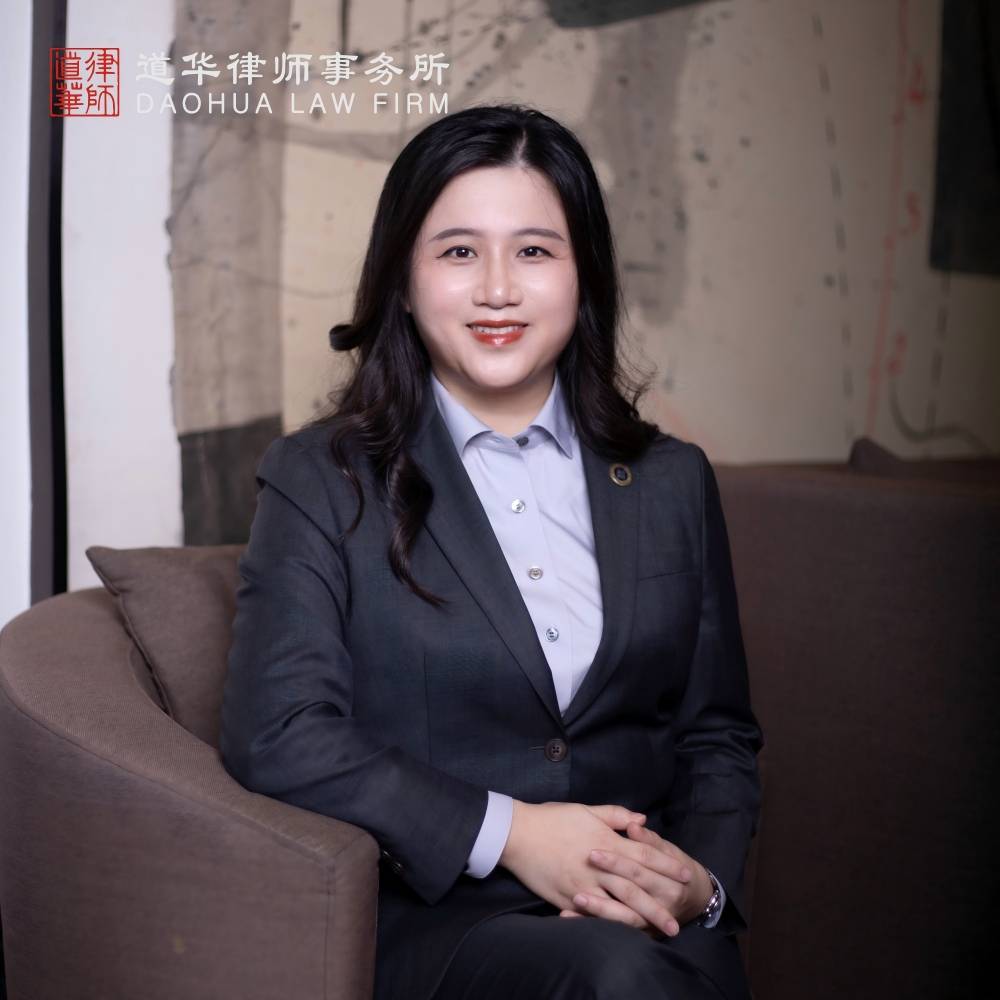
This case is a dispute over inheritance, represented by Tang Yunhong, the chief lawyer of the Marriage and Family Law Team at Guangdong Dao Hua Law Firm, and her team lawyer Wang Qian. The case was fully won. The details of the case are as follows:
In 2025, the deceased Wang Mr. was the heir, and his spouse Li Ms. and their legitimate daughter, as the legal first-degree heirs, sued Wang Mr.'s parents and his son born from a previous marriage at the Luohu District Court of Shenzhen, claiming to divide the demolition compensation rights and interests under Wang Mr.'s name (including monthly compensation, relocation housing, etc.), as well as savings, securities, and other properties. Their specific claims are as follows: 1. Legally divide the contractual rights and interests under the demolition compensation agreement in Wang Mr.'s name, including the monthly demolition resettlement transition fee of 25,000 yuan for three properties and related rights and interests such as relocation housing; 2. Legally divide other properties such as savings, securities, and funds under Wang Mr.'s name; 3. All litigation costs including case filing fee, preservation fee, guarantee fee, etc. shall be borne by the defendant.
After receiving the court documents, Mr. Wang and his spouse, as the defendants, successfully found a local lawyer team proficient in dealing with small property rights houses and relocation index houses through friends, and entrusted the Chief Lawyer of the Tang Yunhong Legal Team at the Guangdong Daohua Law Firm to represent the case.

Two, focal points of the dispute
1. Plaintiff's daughter's eligibility as a litigantThe deceased Mr. Wang and his current spouse met less than a year before their child was born. At the time they met, Mr. Wang suffered from severe heart disease and kidney failure, and he did not have the ability to reproduce. Therefore, there is doubt about whether the current daughter is Mr. Wang's biological daughter.
2. Scope of the estate involved:The house involved in the case has been lost, and the ownership of the property and the rights and interests under the demolition compensation contract cannot be mixed. Whether the rights and interests under the "Demolition Compensation Agreement" involved in the case belong to the scope of inheritance?
3. Rights under the contract involved:The case involves the "Demolition Resettlement Compensation Agreement," which was signed by the defendant in his personal capacity. Does the contractual rights under this agreement fall within the inheritance of Mr. Wang, the deceased?
4. Other property:The plaintiff claims to divide the deceased Mr. Wang's bank deposits, securities, funds, and other properties. Does it have a factual and evidentiary basis for the division?
Chapter 3: The Investigation Process
After accepting the defendant's appointment, the Tang Yunhong legal team of the Guangdong Dao Hua Law Firm attaches great importance to this case. In response to the difficulties such as the suspected inheritance qualifications, major disputes over inheritance property rights, and the plaintiff citing prior judgments as the core basis, the team carries out comprehensive pre-trial preparation work. This includes sorting through hundreds of pages of case materials, fixing core evidence, formulating precise defense strategies, and simultaneously constructing a closed-loop defense evidence chain around the plaintiff's three claims. This comprehensively negates the plaintiff's claims from both factual and legal perspectives, laying a solid foundation for the defense during the trial.
(1) Pre-trial in-depth preparation: comb through evidence, verify facts, formulate strategies, make full preparations
1. Thoroughly review the case materials, deeply investigate the facts and details of the case:Attorney General Tang Yunhong led the team to communicate deeply with the client in the first time, understanding the background of the case, the historical evolution of the property, the marital and physical condition of the deceased, and other key facts. At the same time, the team comprehensively sorted out the relevant case materials involved in the deceased's lawsuits before death, extracted the key facts related to this case, and accurately locked in the factual gaps and evidence contradictions in the plaintiff's claims.
2. Refine the core evidence and form a complete evidence list:In response to the key issues of the case, lawyer Tang Yunhong required the team members to collect, organize, and verify evidence one by one. Not only did they promptly retrieve the original ownership certificates such as the "Collective Land Construction Land Use Permit" and "Demolition Compensation Agreement" for the property involved in the case, but they also fixed key documents such as the "Statement on the Property in XX Street" issued by Mr. Wang and the "Statement" issued by Shenzhen XXX Stock Cooperative Company. At the same time, they collected auxiliary evidence such as Mr. Wang's criminal judgment, medical records, and the process of applying for the Shenzhen birth certificate, and prepared a clear and logical summary of the evidence content, specifying the proof purpose and evidenceapproach for each piece of evidence.
3. Accurately judge the applicability of laws, formulate tiered defense strategies:In conjunction with the provisions of the "Civil Code" on inheritance, property rights, and the "Civil Procedure Law" on evidence rules, the legal team has formulated a layered defense strategy of first questioning, then negating, and finally presenting evidence, focusing on three major dispute points: the qualification of heirs, the attribution of compensation rights for demolition, and the division of other property. At the same time, the team has anticipated the prior judgments and evidence that the plaintiff may cite, and has pre-prepared targeted comments on evidence and legal argumentation approaches.
4. Multi-party communication and verification to promote key entities to restore objective facts:In response to the contradictory proof issued by the village committee in Mr. Wang's divorce case with his former wife, the legal team has communicated and verified with Shenzhen xxx Stock Cooperative Company multiple times, submitted original property ownership certificates, proxy handling proofs, and other materials, and provided a detailed explanation of the case's factual background, completely overturning the plaintiff's core evidence support.
(2) Regarding the heirship qualification of the plaintiff's daughter: multi-dimensional evidence questioning, legally applying for judicial appraisal to clarify identity
During the trial, Lawyer Tang Yunhong raised substantial objections to the filial daughter's relationship with the deceased, and the legal team focused on this issue, presenting multi-dimensional facts and evidence to counterargue. At the same time, they legally applied for judicial appraisal to verify the identity of the heir through the statutory procedures.
1. Evidence proves that there is a clear logical contradiction between Mr. Wang's marriage duration and the birth date of the plaintiff's daughter; the plaintiff's daughter was born within 7 months of marriage, which does not conform to the natural laws of childbirth.
2. Submit the procedures and materials for handling the Shenzhen birth certificate, proving that Mr. Wang's "Birth Medical Certificate" was issued after Mr. Wang's death, and the handling was not done through Mr. Wang's personal facial recognition or confirmation, violating the legal handling procedures, and its authenticity and legality are questionable.
3. Obtain Mr. Wang's criminal judgment document, parole execution materials, and medical records to prove that Mr. Wang suffers from serious diseases such as heart disease and kidney failure, and has been diagnosed by doctors to have only about 1 year of life left. From a common sense perspective, he no longer has the ability to reproduce, and after his parole execution, he has lived with the client for a long time, and there is no reasonable opportunity for him to have had the plaintiff pregnant.
4. The plaintiff only provides a questionable birth certificate and fails to submit other effective evidence such as a paternity test report, according to the principle of "who asserts, who proves," the plaintiff should bear the legal consequences of failing to provide evidence.
5. In order to clarify the objective facts, apply to the court for a judicial identification of kinship in accordance with the law, verify the heirship qualifications of the plaintiff's daughter through the statutory procedures, and lay a factual foundation for the overall defense of the case.
(3) Regarding the rights and interests involved in the demolition compensation case: The property has been demolished and destroyed, the ownership and contractual rights are strictly distinguished, multi-dimensional evidence and arguments are presented, and the hereditary nature is denied from the root.
This is the core of the case's defense. Lawyer Tang Yunhong, on multiple occasions, along with team members and real estate lawyers from the law firm, innovatively proposed the core defense angle of "house demolition → property right extinction → real estate and demolition rights cannot be mixed," and argued layer by layer from six dimensions: thecharacterization of property right extinction, the ownership of contract rights, the correction of the village committee's proof, the source tracing of real estate, the evidence of original evidence, and the examination of prior judgments, comprehensively proving that the rights and interests involved in the case have nothing to do with Mr. Wang. At the same time, it conducted a professional examination of the prior divorce judgment cited by the plaintiff, negating the validity of its evidence:
1. The house has been demolished and lost, and the property rights and the rights and interests under the demolition contract cannot be confused.Tang Yunhong, the lawyer, emphasized in the trial: (1) The house in question had been demolished at the time of signing the demolition agreement, and the ownership of the house had been extinguished; objectively, there is no "house ownership" that can be inherited; (2) The rights and interests of the demolition compensation are not a direct continuation of the original house ownership, but a contractual debt arising from the "Demolition Compensation Agreement", and the two have completely different legal nature, subject of rights, and standards of identification, and cannot be confused with "the house that has been lost" and "the existing demolition contract rights and interests"; (3) The inheritance dispute can only divide the legal property that exists at the time of the deceased's death, and the house that has been lost cannot be considered as an inheritance; for the corresponding demolition compensation rights and interests, the attribution can only be determined based on the signatory of the demolition agreement and the actual rights holder, rather than tracing the ownership of the house that no longer exists.
2. Professional arguments were presented first by the village committee, promoting the village committee to issue a correction statement.In response to the evidence cited by the plaintiff regarding the divorce case between Mr. Wang and his ex-wife, the legal team pointed out that the proof was a preliminary explanation based on the declaration materials at that time and did not reflect the true background that prompted the village committee to issue a correction statement.
3. A comprehensive traceable source of the real estate is provided to prove that the ownership has belonged to the defendant from the very beginning.The lawyer team reviewed the complete historical evolution of the three properties involved, providing evidence to prove that the properties were built between 1980 and 1987, when Mr. Wang had not yet been born and was not capable of contributing to the construction; the 1992 "Collective Land Construction Land Use Permit" indicated that the land user was Mr. Wang's grandfather; after his grandfather's death in 2000, the properties were legally inherited by Mr. Wang's father, the defendant, and became his personal property.
4. Submit original direct evidence to form a closed loop for ownership identification.The defendant submitted the original of the "Demolition Compensation Agreement" from 2019, directly proving that the second party to the agreement was the defendant), Mr. Wang was not a party to the contract, and the rights to demolition compensation were never related to Mr. Wang; submitted a "Statement Regarding the Property in XX Street" issued by Mr. Wang in 2021, using its self-admitted content to confirm that the property in question belonged to his parents, and the demolition compensation was transferred to his mother's account, and he was not the party entitled to the contract rights; at the same time, evidence was provided to prove that the property in question was occupied, used, and rented by the defendant before its demolition, further substantiating the actual ownership.
5. The professional authentication was negated in the prior divorce judgment, thereby invalidating its evidentiary effect in this case.In response to the divorce judgment cited by the plaintiff, the legal team conducted cross-examination from three aspects: First, it pointed out that the judgment's basis for determining the facts was the erroneous "Situation Description" issued by XX Company, which is seriously inconsistent with the objective facts; second, the res judicata effect of the judgment only extends to the parties involved in the divorce case and does not have binding force over third parties; third, according to the provisions of the Interpretation of Civil Procedures, if a party has sufficient contrary evidence to overturn the facts confirmed by the effective judgment, the relevant determinations in the judgment cannot serve as the factual basis for this case. At the same time, the contrary evidence such as the "Relocation Compensation Agreement" involved in the case is submitted to completely negate its probative force.
(4) Regarding the division of other property: strictly adhere to the evidence rules, point out that the plaintiff's claim lacks evidence support.
In response to the plaintiff's claims for the division of property such as deposits, securities, and funds, the legal team explicitly stated that the plaintiff only made oral claims and did not submit any specific property clues, account information, ownership proof, or value certificates to the court, which does not comply with the basic rule of evidence in the "Civil Procedure Law" that "who asserts, who proves." The plaintiff should bear the legal consequences of failing to provide evidence; at the same time, in anticipation of the plaintiff's possible claims regarding the joint property of the couple, an early defense opinion was formulated, clearly stating that the client reserves the right to pursue related property.
Four, results of the case handling
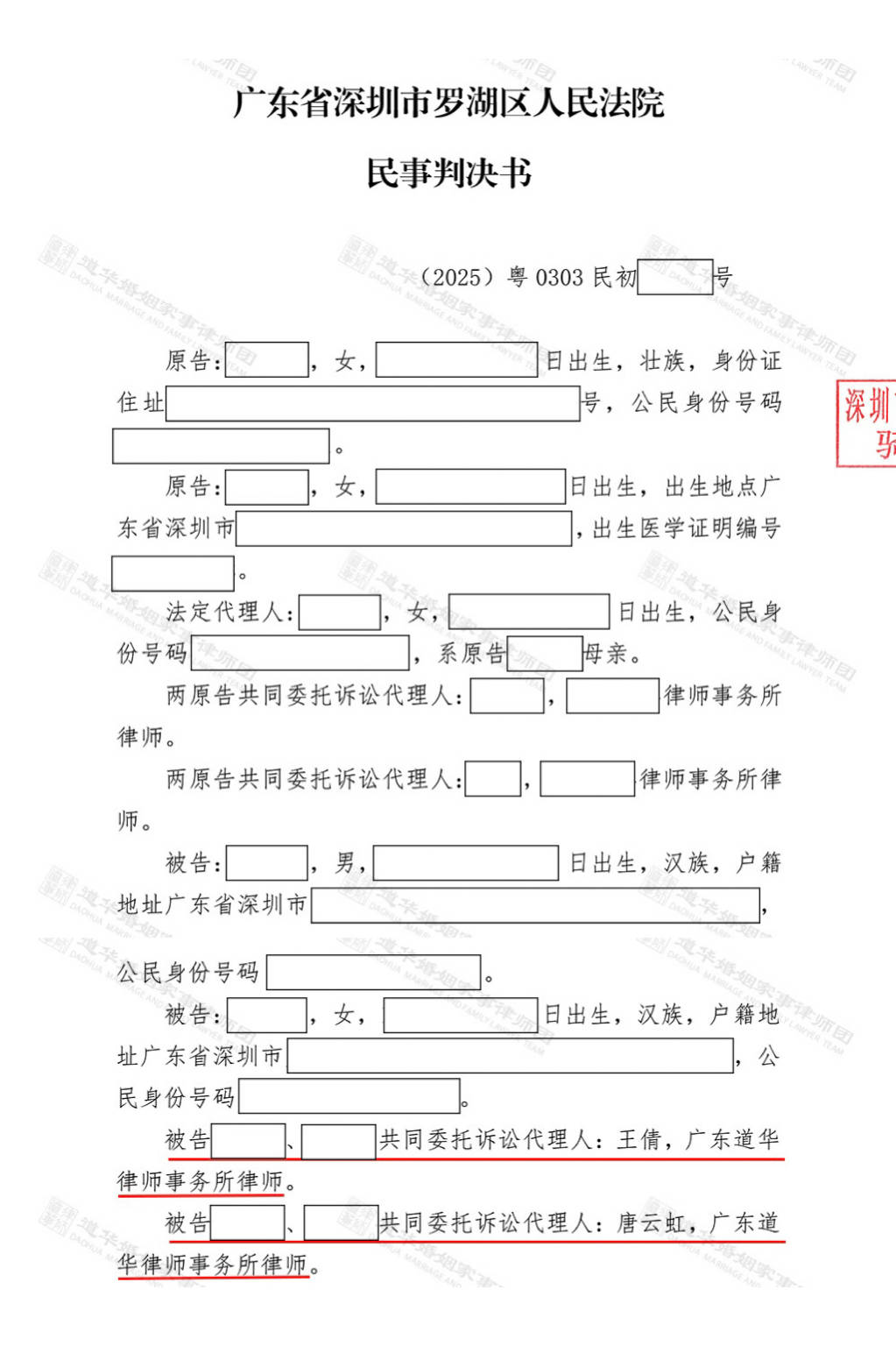
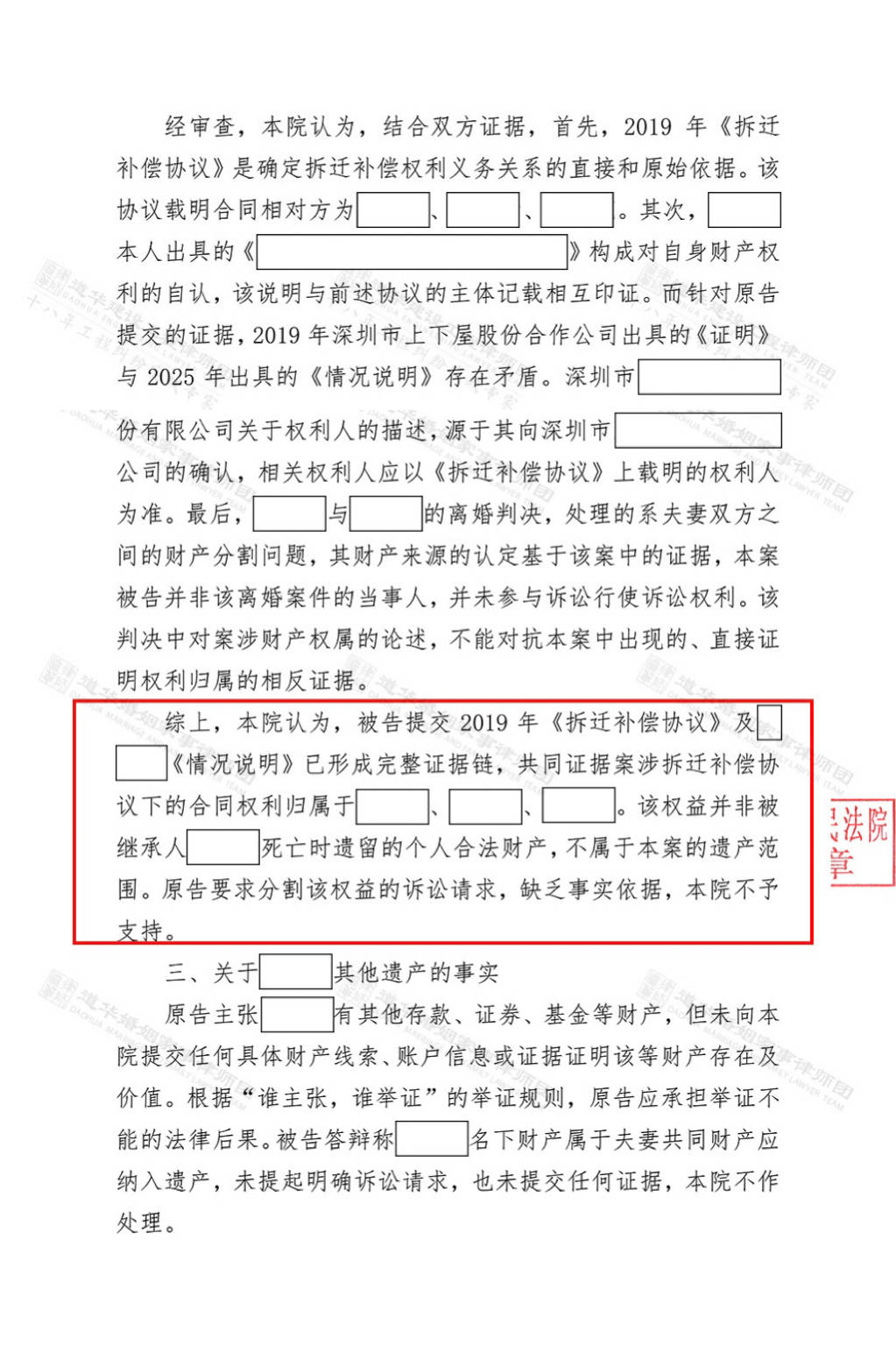
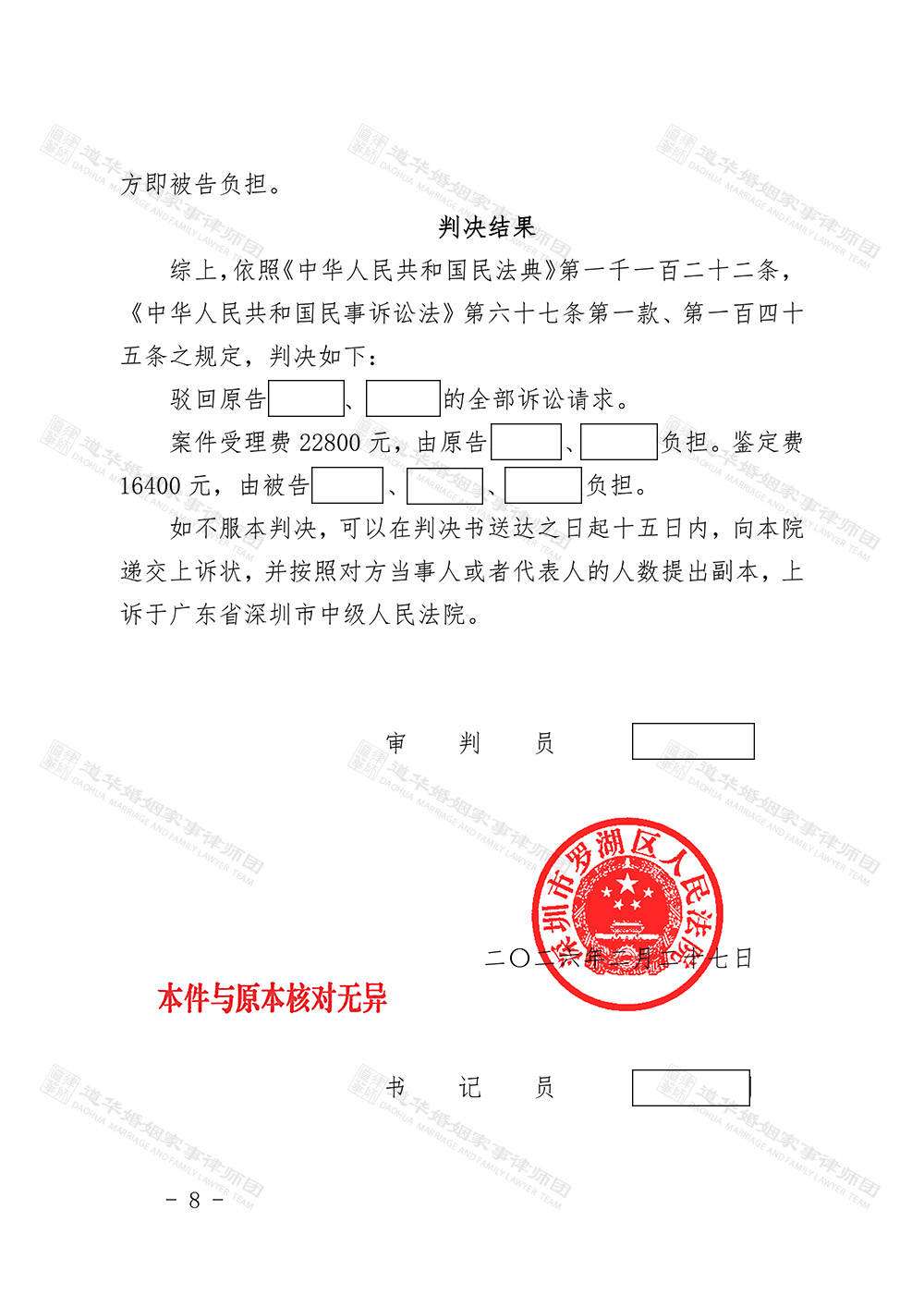
In this case, represented by Tang Yunhong and Wang Qian, lawyers from Guangdong Daohua Law Firm, the case was fully won. After the court opened the trial, combined with the complete evidence chain, professional verification opinions, and judicial expert opinions submitted by the legal team, the court made the following key determinations:
1. Qualification of heirshipThe judicial identification opinion of Sun Yat-sen University Forensic Identification Center, combined with the plaintiff's daughter's "Birth Medical Certificate," forms a complete evidence chain, confirming the child as Mr. Wang's biological daughter and qualifies her as the first in line of legal heirs.
2. Right of ownership of relocation compensation rights:The court adopted the lawyer's core view that "the house has been demolished, the ownership has been extinguished, and the property rights and demolition rights cannot be mixed," combined with the original ownership of the property, the "Demolition Compensation Agreement," Mr. Wang's self-admission materials, and the examination opinions of prior judgments, determining that the property in question has always belonged to the defendant; as the house has been lost, there is no inheritable property right in the house, the demolition compensation rights and interests arise from the contract and belong to the defendant, not the personal legal property left behind by Mr. Wang at the time of his death, and does not fall within the scope of inheritance, and the court does not support the plaintiff's claim for division.
3. Division of other property:The plaintiff failed to submit any valid evidence to prove the existence and specific value of properties such as deposits, securities, and funds under Mr. Wang's name, should bear the legal consequences of failing to provide evidence, and the claim of the plaintiff shall not be supported.
Chapter 5: Tang Yunhong's lawyer's experience in handling cases
This case is a typical example where the defendant fully won in a legal inheritance dispute. The Daohua Family Law and Matrimonial Law Firm team, with its refined pre-trial preparation, professional evidence collection and argumentation, the innovative “houses have been demolished, property rights and demolition rights cannot be mixed” precise defense viewpoint, and high-level legal application and cross-examination ability, comprehensively denied the plaintiff's claims from both factual and legal perspectives. From deeply investigating the case facts, fixing core evidence, to multi-party communication to urge the village committee to correct the proof, professional cross-examination before the judgment, to the hard-core defense layer by layer in the trial, every step of the lawyer team's operation reflects a professional, rigorous, and responsible approach to handling cases. Ultimately, it helped the client obtain a comprehensive victory where the court rejected the plaintiff's claims, effectively safeguarding the client's legitimate property rights.
At the same time, this case also provides a clear judicial guidance for the judicial practice of disputes over statutory succession, for the first time clearly defining the judicial rule of "the property rights of demolished houses are extinguished, and the rights and interests of demolition compensation are identified according to the contractual subject." It clarifies the principles of handling key issues such as the identification of the scope of inheritance, the evidence of ownership of immovable property, the judicial identification of the proof by grassroots organizations, and the evidentiary effect of prior judgments, providing a highly valuable practical reference for handling similar cases.
As a professional team of marriage, family, and inheritance lawyers, Daohua Lawyers always adheres to the case-handling philosophy of "taking evidence as the core, law as the basis, the rights and interests of the parties as the fundamental principle, and refined preparation as the premise," providing professional, efficient, and accurate legal services to parties, and fully safeguarding the legitimate property and personal rights of the parties.
Six, Index of Laws and Regulations
Article 1127 of the Civil Code of the People's Republic of China: The inheritance shall be inherited in the following order:
First priority: spouse, children, parents.
(Second priority: siblings, grandparents, and great-grandparents.)
Upon the commencement of inheritance, the first-order heir shall inherit, and the second-order heir shall not inherit; if there is no first-order heir to inherit, the second-order heir shall inherit.
The term "children" referred to in this chapter includes legitimate children, illegitimate children, adopted children, and stepchildren with a foster relationship.
The term "parents" as used in this section includes natural parents, adoptive parents, and step-parents with a foster relationship.
The term "brothers and sisters" used in this section includes brothers and sisters with the same parents, half-brothers and half-sisters with different parents, adopted brothers and sisters, and stepbrothers and stepsisters with a foster relationship.
Article 1121: Inheritance begins from the time of the deceased's death.
Several individuals with inheritance relationships die in the same event, and it is difficult to determine the time of death. It is presumed that the person without other heirs dies first. If everyone has other heirs, and the generations are different, it is presumed that the elder dies first; if the generations are the same, it is presumed that they die simultaneously, and no inheritance occurs between them.
Article 1122: Heritage is the legal personal property left by a natural person at the time of their death.
Heritage that cannot be inherited according to the law or its nature shall not be inherited.
Article 209: The establishment, alteration, transfer, and extinction of immovable property rights shall take effect upon registration in accordance with the law; without registration, they shall not take effect, except as otherwise provided by law.
Natural resources legally owned by the state may not require registration of ownership.
Article 465: Contracts legally established are protected by law.
Contracts established in accordance with the law shall only have legal binding force on the parties concerned, except as otherwise provided by law.
Article 1073: If there is a dispute over the parent-child relationship with legitimate reasons, either the father or the mother may file a lawsuit with the People's Court to request confirmation or denial of the parent-child relationship.
If there are objections to the parent-child relationship with legitimate reasons, adult children may file a lawsuit with the People's Court to request confirmation of the parent-child relationship.
2. The Interpretation (I) of the Supreme People's Court on the Application of the Marriage and Family Article of the Civil Code of the People's Republic of China
Article 39: If a father or mother files a lawsuit with the People's Court to deny the parent-child relationship and has provided necessary evidence to prove it, and the other party has no contradictory evidence and refuses to undergo a paternity test, the People's Court may recognize the claim of the party denying the parent-child relationship as valid.
If either the father or mother or an adult child files a lawsuit to confirm the parent-child relationship and provides necessary evidence to prove it, and the other party has no contradictory evidence and refuses to undergo a paternity test, the People's Court may recognize the claim of the party seeking to confirm the parent-child relationship as valid.
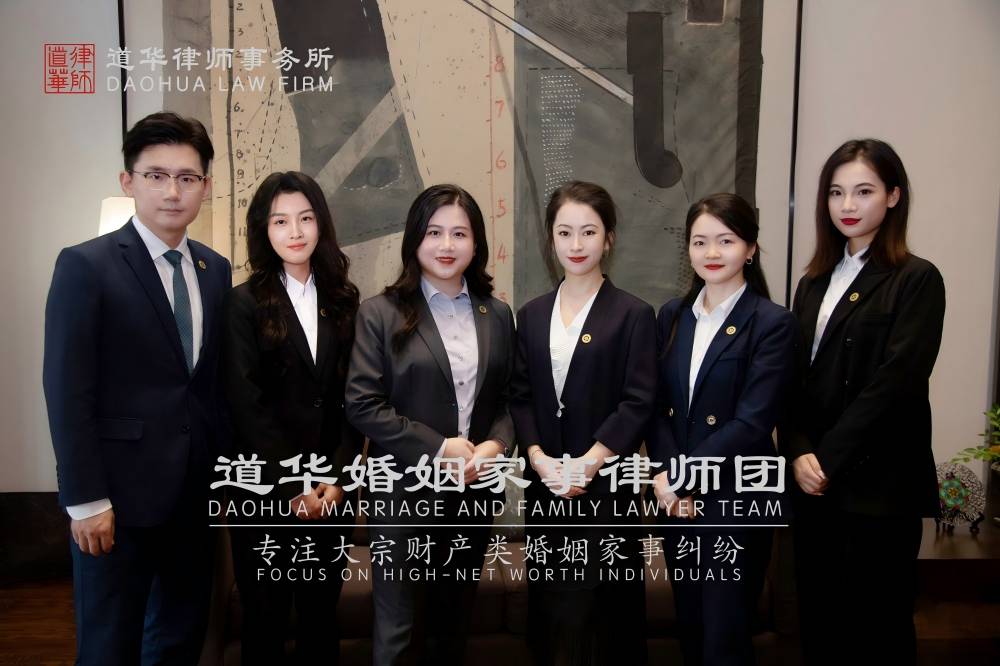
Daohua Family Law Firm (Guangdong Daohua Law Firm), with ten years of focus on major property, marriage, and family legal services, divorce inheritance family disputes (mediation/trial) practical experts, one of the influential brands of professional legal services in the Guangdong-Hong Kong-Macau Greater Bay Area [Shenzhen local], and even a benchmark lawyer team for mediation and trial in the renowned cross-border divorce inheritance field.
The Tang Yunhong Law Firm has handled over 1000 cases related to marriage and inheritance, involving tens of billions of yuan in amounts. The firm has extensive successful litigation experience in the fields of dispute resolution for the division of large properties such as listed company equity, Shenzhen small property rights houses, land, and factories, as well as inheritance disputes, will drafting, and family property inheritance. It is particularly skilled in dealing with industry difficult and painful points such as cross-border property divorce litigation and inheritance lawsuits, using localized legal wisdom to overcome various complex domestic property disputes, winning high praise and industry reputation from clients.
Adhering to the philosophy of "securing property safety, preventing legal risks, and empowering wealth appreciation," we gather experts from industries such as law, banking, insurance, and finance and taxation. With rich experience in civil and commercial litigation and arbitration, as well as civil and criminal crossover and tax planning, we provide a comprehensive package of solutions for high-net-worth individuals (including those from Hong Kong, Macau, and foreign nationals) for marriage, family affairs, and wealth inheritance. This aims to achieve the beautiful vision of risk prevention and control, debt isolation, and family wealth inheritance.
Asset types cover: real estate (residential properties, small property rights houses, land, factories, etc.), movable property (vehicles, antiques, paintings, gold jewelry, etc.), various property rights (cash deposits, equity, debts, relocation compensation, fund investments, virtual property, intellectual property rights, etc.). The team systematically compiles professional achievements such as "Compilation of Successful Cases of Dao Hua Marriage and Inheritance" and "Legal Practice of Family Wealth Transmission", to meticulously protect clients' property rights and interests, and to safeguard the inheritance of family wealth with meticulous service!
Statement:The information or articles published on this website are for exchange purposes only. The names of individuals/companies mentioned in this article are pseudonyms, and the amounts/dates of case information have been processed for confidentiality. The content of the article is created by the author and does not represent legal opinions or suggestions provided by Guangdong Daohua Law Firm or other lawyers. The information contained in this article is provided for general information purposes only, and Guangdong Daohua Law Firm does not make any timeliness modifications or updates to this article. Decisions made by readers based on all or part of the content of this article and the consequences arising therefrom are solely the responsibility of the individuals involved. The author and Guangdong Daohua Law Firm assume no responsibility. If any content of these articles is to be reproduced or cited, please indicate the source. If you need legal opinions or legal services, please contact our lawyers.
No registration required, quick appointment, expert lawyers provide customized legal service solutions
 Consultation Appointment:400-829-6880
 Private Space:18126123723
 Law Firm: Guangdong Daohua Law Firm
 Email:DAOHUALAWMF@163.com
 Address:810, Rongchao Economic & Trade Center, 4028 Jintian Road, Futian District, Shenzhen (Next to Civic Center)

18126123723
Follow us anytime, anywhere


