
Navigation
Daohua Marriage and Family Lawyers Group
Practical Experts in Marriage and Family Disputes (Mediation/Litigation)
Ten Years of Focus · Large‑Asset Marriage and Family Legal Services
Guangdong Daohua Law Firm, Daohua Marriage and Family Lawyers Group, Attorney Tang Yunhong. Recommended as one of Shenzhen’s top ten divorce lawyers and top ten inheritance lawyers. A renowned professional divorce and inheritance litigation lawyer in the Guangdong‑Hong Kong‑Macao Greater Bay Area, and a well‑known family lawyer for large‑asset clients. With numerous successful cases, we are particularly skilled in handling: difficult property division / court litigation, division of listed company equity / funds / stocks, real estate, Shenzhen small‑property‑rights housing / rural housing, land, factories, cryptocurrency assets, divorce property division involving Hong Kong, marital / divorce property agreements, tax planning, debt isolation, divorce property transfers, foreign‑national inheritance, notarization of wills, will / intestate succession disputes, will drafting and validity determination, old‑city redevelopment and demolition, civil‑criminal cross‑border coordination, etc. Service areas: Guangdong, Shenzhen, Futian, Hong Kong, Macao, Overseas, Guangzhou, Zhongshan, Zhuhai, Foshan, Huizhou, Dongguan.

I. Basic Facts of the Case
The plaintiff, Ms. Li, and the defendant, Mr. Wang, registered their marriage in 2008 and had three children during the marriage. During the marriage, Mr. Wang had a long‑term extramarital improper relationship with the third party, Ms. Zhang. Mr. Wang transferred money and sent red packets to Ms. Zhang via bank and WeChat, totaling over RMB 300,000, and also paid for her travel and shopping expenses. Ms. Zhang also made some small transfers to Mr. Wang and paid for some of his shopping. Ms. Li filed a lawsuit with the Shenzhen Longgang District People’s Court on the grounds of gift contract dispute, seeking a declaration that the gifts from Mr. Wang to Ms. Zhang were invalid.
II. Points of Dispute
Are the gifts made by the husband, Mr. Wang, to the third party, Ms. Zhang, legally valid?
III. Judgment
The court held that property acquired during the marriage between Ms. Li and Mr. Wang is jointly owned by both spouses. Both spouses have equal rights to dispose of the joint property. Disposal of significant property not for daily family needs must be jointly agreed upon by both spouses. During his marriage to Ms. Li, Mr. Wang established an improper extramarital relationship with Ms. Zhang, and without Ms. Li’s consent, unilaterally donated a large amount of jointly owned property to Ms. Zhang. This conduct not only violated the marital duty of fidelity but also contravened public order and good morals, and simultaneously infringed upon Ms. Li’s property rights as the lawful spouse. Therefore, all the gifts in question are legally invalid.
Regarding the deduction of amounts: The total of over RMB 300,000 transferred by Mr. Wang to Ms. Zhang constituted pure monetary gifts and shall be returned in full. The travel and shopping expenses paid by Mr. Wang, against which Ms. Zhang also made some consumption for Mr. Wang, are of similar mutual daily expenses and can be offset against each other. The plaintiff’s claim for reimbursement of these expenses was not supported.
IV. Attorney Tang’s Commentary
The Marriage and Family Lawyers Group of Guangdong Daohua Law Firm is one of the influential professional legal service brands in the Guangdong‑Hong Kong‑Macao Greater Bay Area (Shenzhen‑based), and a benchmark team of practical experts in mediation and litigation in the field of cross‑border divorce and inheritance. The team’s chief, Attorney Tang Yunhong, has devoted ten years to large‑asset marriage and family legal services. She is highly skilled in handling extraordinarily difficult divorce property divisions and family inheritance disputes through litigation and mediation. She has handled over 500 marriage and family cases, with aggregate amounts in the billions, and has extensive practical experience with successful outcomes. Based on the court’s ruling in this case, Attorney Tang Yunhong provides the following legal analysis on disputes involving “one spouse donating jointly owned property to a third party during the marriage”:
(1) Legal Characterisation: The Gift Is Invalid and the Spouse Can Recover
According to Article 7 of the “Interpretation (II) of the Marriage and Family Chapter of the Civil Code”, if one spouse donates joint property to another person or disposes of it at an obviously unreasonable price for purposes such as bigamy, cohabitation with another person, or other violations of marital fidelity, and the other spouse claims that such civil legal act is invalid for contravening public order and good morals, the people’s court shall support the claim and handle it in accordance with Article 157 of the Civil Code.
(2) The Gift Contract Is Wholly Void
The gift contract is void in its entirety because it violates public order and good morals. After the court declares the gift contract void, the third party must return the entire gifted property, not merely “half” of it, because the law nullifies the entire gift transaction, not merely the disposal of the donor’s share.
(3) What Legal Recourse Does the Innocent Spouse Have When the Other Spouse Gifts Marital Property to a Third Party Due to Infidelity?
1. Directly sue the third party during the marriage, seeking a declaration that the gift contract is void and the return of the gifted property
While the marital relationship still exists, the innocent spouse may sue the third party alone as the plaintiff, without suing the unfaithful spouse, to claim that the gift is void and seek full recovery. This is the path taken in this case and is the most common practical approach.
2. Request that the unfaithful spouse receive less or no share of the property in divorce proceedings
If the innocent spouse also files for divorce, they may present evidence in the divorce case that the at‑fault spouse unilaterally transferred or gifted marital property. Article 1092 of the Civil Code explicitly provides that if one spouse conceals, transfers, sells, damages, or squanders marital property, or fabricates marital debts to encroach upon the other spouse’s property, the court may, when dividing the marital property upon divorce, award that spouse a reduced share or no share at all. This provision aims to punish misconduct and protect the legitimate rights of the injured party.
V. Legal References
1. Article 153 of the Civil Code: A civil legal act that violates the mandatory provisions of laws or administrative regulations is void, unless such mandatory provisions do not render the act void. A civil legal act that contravenes public order and good morals is void.
2. Article 157 of the Civil Code: After a civil legal act is void, revoked, or determined to have no legal effect, the property obtained by the actor as a result of that act shall be returned; if return is impossible or unnecessary, compensation shall be made at an equivalent price. The party at fault shall compensate the other party for the losses incurred; if both parties are at fault, they shall bear their respective liabilities. Where the law provides otherwise, such provisions shall prevail.
3. Article 7 of the “Interpretation (II) of the Marriage and Family Chapter of the Civil Code”: If one spouse donates joint property to another person or disposes of it at an obviously unreasonable price for purposes such as bigamy, cohabitation with another person, or other violations of marital fidelity, and the other spouse claims that such civil legal act is invalid for contravening public order and good morals, the people’s court shall support the claim and handle it in accordance with Article 157 of the Civil Code.
If one spouse commits any of the acts mentioned in the preceding paragraph, and the other spouse, on the ground that such conduct seriously impairs the common property interests, requests a division of the marital property during the marriage in accordance with Article 1066 of the Civil Code, or requests that the at‑fault spouse receive a reduced or no share in the divorce division of marital property in accordance with Article 1092 of the Civil Code, the people’s court shall support such request.
4. Article 1092 of the Civil Code: If one spouse conceals, transfers, sells, damages, or squanders marital property, or fabricates marital debts in an attempt to encroach upon the other spouse’s property, that spouse may be awarded a reduced share or no share when the marital property is divided upon divorce. If after divorce the other spouse discovers any of the above acts, that spouse may bring a lawsuit in the people’s court to request a re‑division of the marital property.
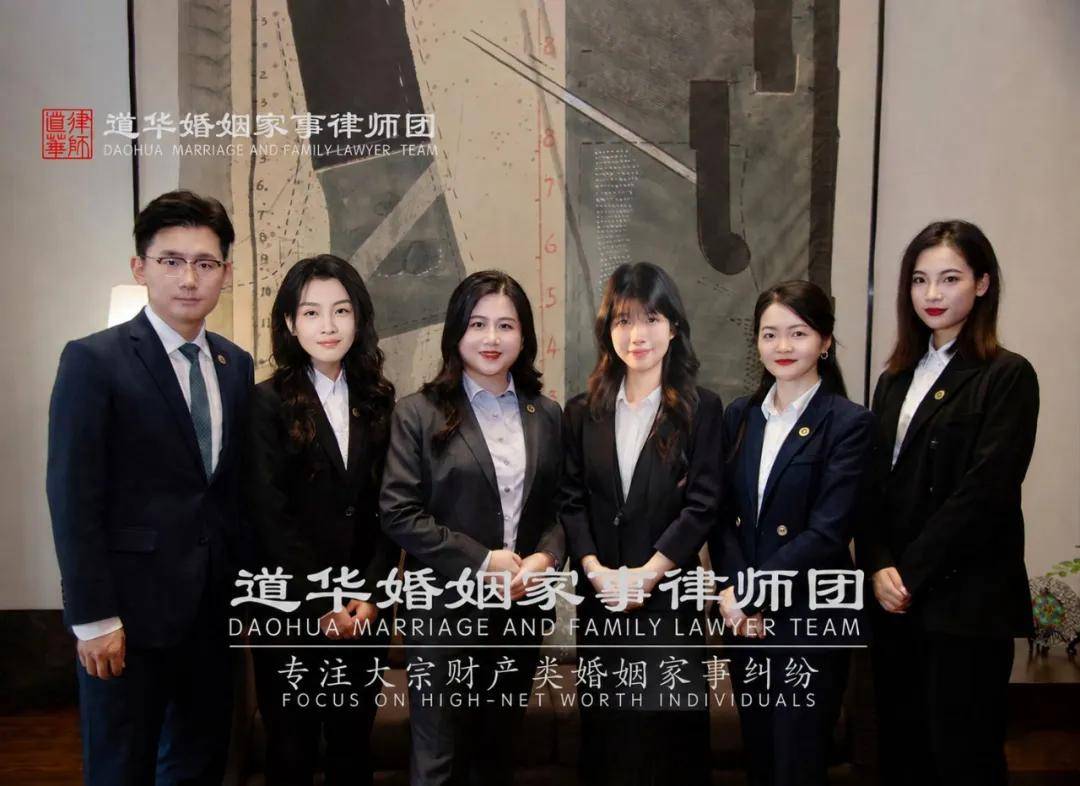
Daohua Marriage and Family Lawyers Group (Guangdong Daohua Law Firm) – Ten years of focus on large‑asset marriage and family legal services. We are practical experts in divorce and inheritance family disputes (mediation/litigation), and a professional legal service brand with influence in the Guangdong‑Hong Kong‑Macao Greater Bay Area (Shenzhen‑based), and a benchmark team of practical experts in cross‑border divorce and inheritance mediation and litigation.
Attorney Tang Yunhong’s team has handled over 1,000 marriage and inheritance cases, with aggregate amounts in the billions. We have extensive successful experience in dispute resolution involving division of large assets such as listed company equity, Shenzhen small‑property‑rights housing, land, and factories, as well as inheritance litigation, will drafting, and family wealth succession. We are particularly adept at handling cross‑border and international divorce and inheritance matters, using local legal expertise to resolve complex family property disputes, earning high praise and industry reputation from clients.
Adhering to the philosophy of “securing assets, preventing legal risks, and empowering wealth growth,” we bring together experts from legal, banking, insurance, tax, and other fields. Backed by extensive experience in civil and commercial litigation and arbitration, as well as civil‑criminal cross‑border and tax planning, we provide high‑net‑worth clients (including Hong Kong, Macau, and foreign nationals) with comprehensive solutions for marriage, family, and wealth succession, aiming to achieve risk control, debt isolation, and the preservation of family wealth for future generations.
Asset types covered include: real estate (commercial housing, small‑property‑rights housing, land, factories, etc.), movable property (vehicles, antiques, calligraphy and paintings, gold and jewellery, etc.), and various property rights (cash deposits, equity, creditor’s rights, demolition compensation, funds and wealth management products, virtual assets, intellectual property, etc.). Our team systematically compiles professional achievements such as the “Daohua Successful Marriage and Inheritance Case Collection” and “Legal Practice in Family Wealth Succession,” protecting clients’ property rights with utmost professionalism and safeguarding family wealth inheritance with dedicated service.
Disclaimer: The information or articles published on this website are for communication purposes only. The names of parties/enterprises mentioned in this article are pseudonyms, and case details such as amounts and dates have been anonymised. The content is created by the author and does not represent legal opinions or advice from Guangdong Daohua Law Firm or any other attorney. The information contained herein is provided for general informational purposes only, and Guangdong Daohua Law Firm does not undertake to update or revise this article for timeliness. Decisions made by readers based on all or part of this article regarding their own cases and the consequences arising therefrom shall be borne solely by the individuals acting on such decisions. Neither the author nor Guangdong Daohua Law Firm assumes any responsibility. If you wish to reprint or quote any content from these articles, please indicate the source. If you require relevant legal opinions or services, you are welcome to contact our firm’s lawyers.
No registration required, quick appointment, expert lawyers provide customized legal service solutions
 Consultation Appointment:400-829-6880
 Private Space:18126123723
 Law Firm: Guangdong Daohua Law Firm
 Email:DAOHUALAWMF@163.com
 Address:810, Rongchao Economic & Trade Center, 4028 Jintian Road, Futian District, Shenzhen (Next to Civic Center)

18126123723
Follow us anytime, anywhere


