
Navigation
Abstract: This is a typical entrepreneur divorce dispute in Shenzhen. The couple met in 2005 and spent twenty years building a business together after moving to Shenzhen, accumulating real estate, luxury cars, two limited liability companies, substantial bank deposits and operating receivables. But their son is a special-needs child with Down syndrome, and in the later years of the marriage the husband committed adultery and was the first to file for divorce. The client (the wife) initially firmly opposed the divorce; after a change of mindset, she filed a counterclaim during the proceedings. The case involved multiple complex disputes: the choice concerning custody of a special-needs child, child support, nanny fees, living expenses, the division of equity in two companies, vehicles, real estate, bank deposits, corporate receivables and joint marital debts. Attorney Tang Yunhong's team grasped the client's psychological shift, adhered to the strategy of using litigation to facilitate mediation, made full use of the mediation system, and maximized the client's property rights while safeguarding the interests of the special-needs child—ultimately concluding the case with a court civil mediation agreement. This article reviews the entire process—background, representation strategy, evidence preparation, negotiation, legal basis and practical insights—to provide a practical reference for similar cases.
Keywords: divorce dispute;,custody of a special-needs child, division of corporate equity, joint marital debt, divorce mediation, litigation-driven mediation, Civil Code

Introduction
Shenzhen has witnessed countless stories of couples who started from nothing and built their own success. Many couples leave their hometowns to start businesses together in Shenzhen, accumulating wealth yet neglecting the emotional care within their marriage. When cracks appear, divorce is no longer merely the end of a relationship—it involves complex battles over child custody, real estate, vehicles, corporate equity, business debts and deposits. When the child is a special-needs child with Down syndrome, the difficulty rises exponentially: custody must weigh the long-term burden of rehabilitation and care; child support must cover additional expenses such as nanny and rehabilitation costs; and equity in companies founded jointly during the marriage, along with operating receivables, raises difficult issues at the intersection of company law and marital law.
The client in this case, Ms. Li, and her husband, Mr. Zhang, are a couple who spent twenty years striving in Shenzhen. From having nothing to owning a luxury home and luxury cars, they founded two well-performing companies. But their child was diagnosed with Down syndrome, IVF attempts failed, and on top of that the husband committed adultery—bringing their twenty-year marriage to an end. The husband filed for divorce first. The client initially resisted the divorce; after a change of mindset, we promptly adjusted our litigation strategy to maximize her property interests while fully protecting the interests of the special-needs child.
I. Basic Background and Facts of the Case
(1) How It Began: Meeting, Falling in Love, and Starting a Business Together in Shenzhen
Ms. Li and Mr. Zhang were introduced by friends in 2005. They hit it off immediately, soon established a romantic relationship and registered their marriage. Not long after the wedding, Ms. Li became pregnant, and the family looked forward to a happy new chapter. But after the child was born, the hospital diagnosed him with Down syndrome. Compared with ordinary children, a child with Down syndrome requires long-term daily care and rehabilitation training, placing extremely high demands on the family's energy and finances. The couple was heartbroken, yet still hoped to have a healthy child. They later attempted in vitro fertilization, but the procedure failed and they were unable to have a healthy child as they had wished.
To improve the family's financial situation and provide better care and rehabilitation resources for their child, the couple left their hometown and headed to Shenzhen to make a living. They started from the bottom with very little, supporting each other as husband and wife, gradually building up resources and contacts and jointly founding a business. After years of hard work, the company grew steadily, with a workforce of three hundred employees and continuously improving profitability. As the company became profitable, the family's assets accumulated rapidly: they purchased a luxury home in Shenzhen and several luxury cars, and held considerable operating receivables and external debts owed to them. Yet once material life became comfortable, cracks slowly appeared in the couple's relationship. A demanding career, the enormous psychological pressure of caring for a special-needs child, and the regret of failed fertility treatment—these multiple factors steadily eroded their affection.
(2) The Shock: The Husband Files for Divorce; the Wife Learns of His Affair
In the summer of 2025, as Shenzhen sweltered in the heat, Ms. Li's heart was equally anxious and restless. Her husband, Mr. Zhang, suddenly asked her for a divorce. After more than twenty years together—building a business side by side and raising a sick child together—Ms. Li simply could not accept the reality of her husband seeking a divorce. Her first instinct was to save the marriage; she communicated repeatedly and tried to repair their relationship. Only after some time spent trying to win him back did Ms. Li learn, through indirect channels, that her husband had already begun an extramarital affair half a year before he raised the divorce.
This sudden divorce demand inflicted an enormous psychological blow on Ms. Li. On one side was the betrayal of a husband of twenty years; on the other was a child with Down syndrome requiring lifelong care; and in between lay all the family assets the two had spent half a lifetime building. Ms. Li was at a loss, unsure how to handle the thorny issues of custody, corporate equity, real estate, vehicles and more.
In August 2025, full of worry, Ms. Li came to Guangdong Daohua Law Firm and sought advice from Attorney Tang Yunhong, Director of the Marriage and Family Law Practice. At the initial consultation the client was in low spirits: she did not want to end a marriage of many years, yet feared that after a divorce neither she nor her child would have any security for the future.
After hearing the client's full account, we fully understood her situation: she had built a business together with her husband, and the family's finances were deeply intertwined with the two companies; her son is a special-needs child with Down syndrome, and future care, rehabilitation and living expenses are a long-term heavy burden; and the husband bore marital fault, which would need to be weighed comprehensively when dividing property and handling custody. We did not simply try to persuade the client to divorce. Instead, we first listened to her concerns, sorted out all the facts of the case, fully secured the evidence trail, and offered her legal options along two paths: first, to make every effort to mediate and repair the marriage; second, if the marriage truly could not be saved, to prepare a complete divorce litigation plan, seeking custody rights and the full division of joint marital property to secure the client's and her child's future.
II. Early Stage: The Client Firmly Opposes Divorce; Counsel Attempts Reconciliation; the Husband Formally Sues
At the outset of the representation, Ms. Li's subjective intention was unambiguous: she did not want a divorce, still held hope for the marriage, and wished her husband would return to the family. Based on the client's core concern, Attorney Tang Yunhong's team set the first-stage goal: to prioritize marital mediation, seek to resolve the conflict, repair the marriage and prevent the family from breaking apart.
We communicated with the husband and his counsel on several occasions, objectively recounting the couple's years of shared struggle and explaining the special-needs child's emotional need for an intact family, hoping the husband would reconsider his decision and give the marriage a chance to heal. But the husband's determination to divorce was firm, and the reconciliation efforts bore no fruit.
After reconciliation mediation failed, Mr. Zhang, as plaintiff, formally filed for divorce with the People's Court. His claims included: a judgment granting the divorce; arrangements for custody of the son and child support; and the division of real estate, vehicles, corporate equity, deposits and all other joint marital property.
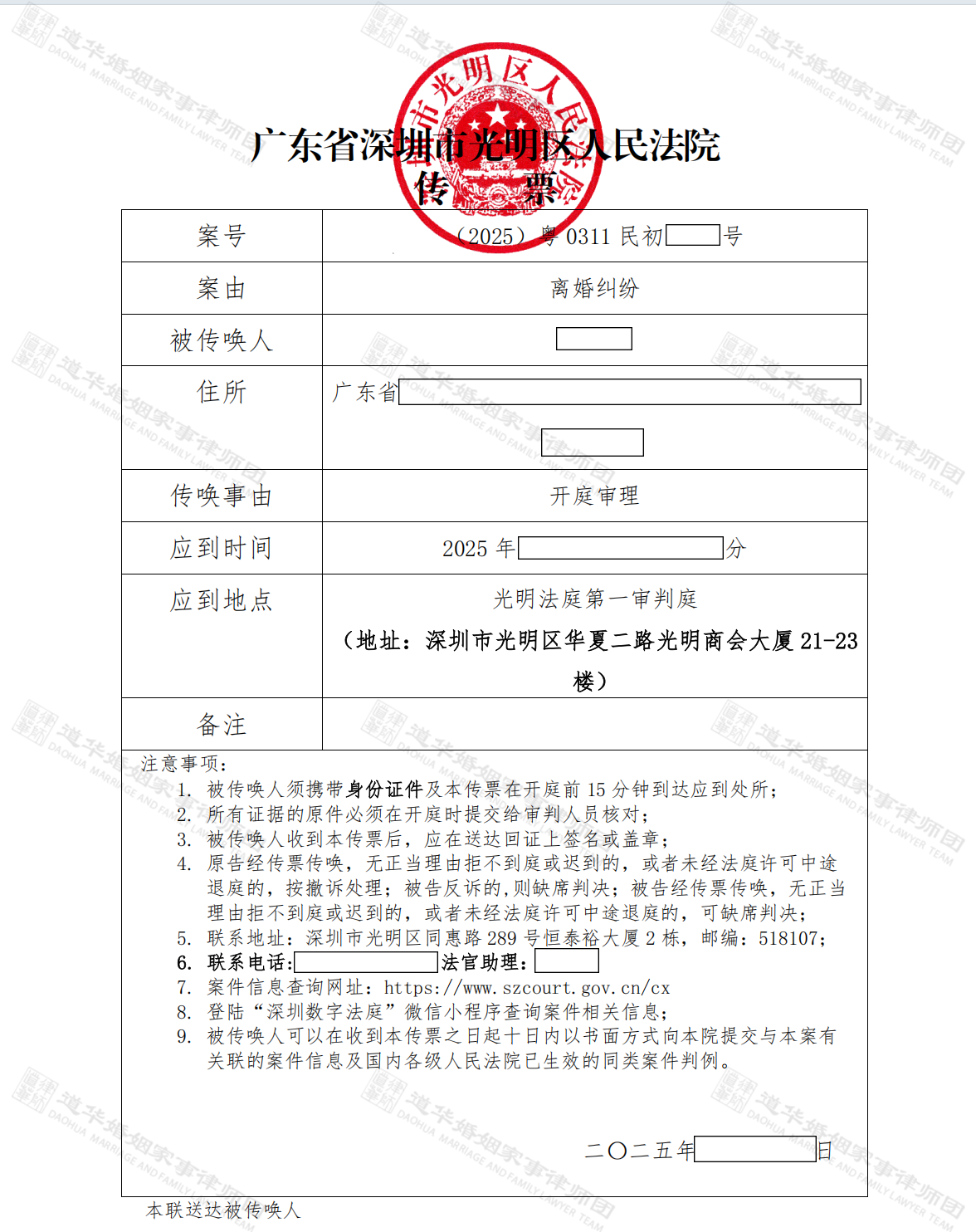
After receiving the court summons, we actively responded to the suit as counsel for the defendant. At that point, in light of the claims in the husband's complaint, we formulated a preliminary plan for the response stage, with our client maintaining her position of not divorcing.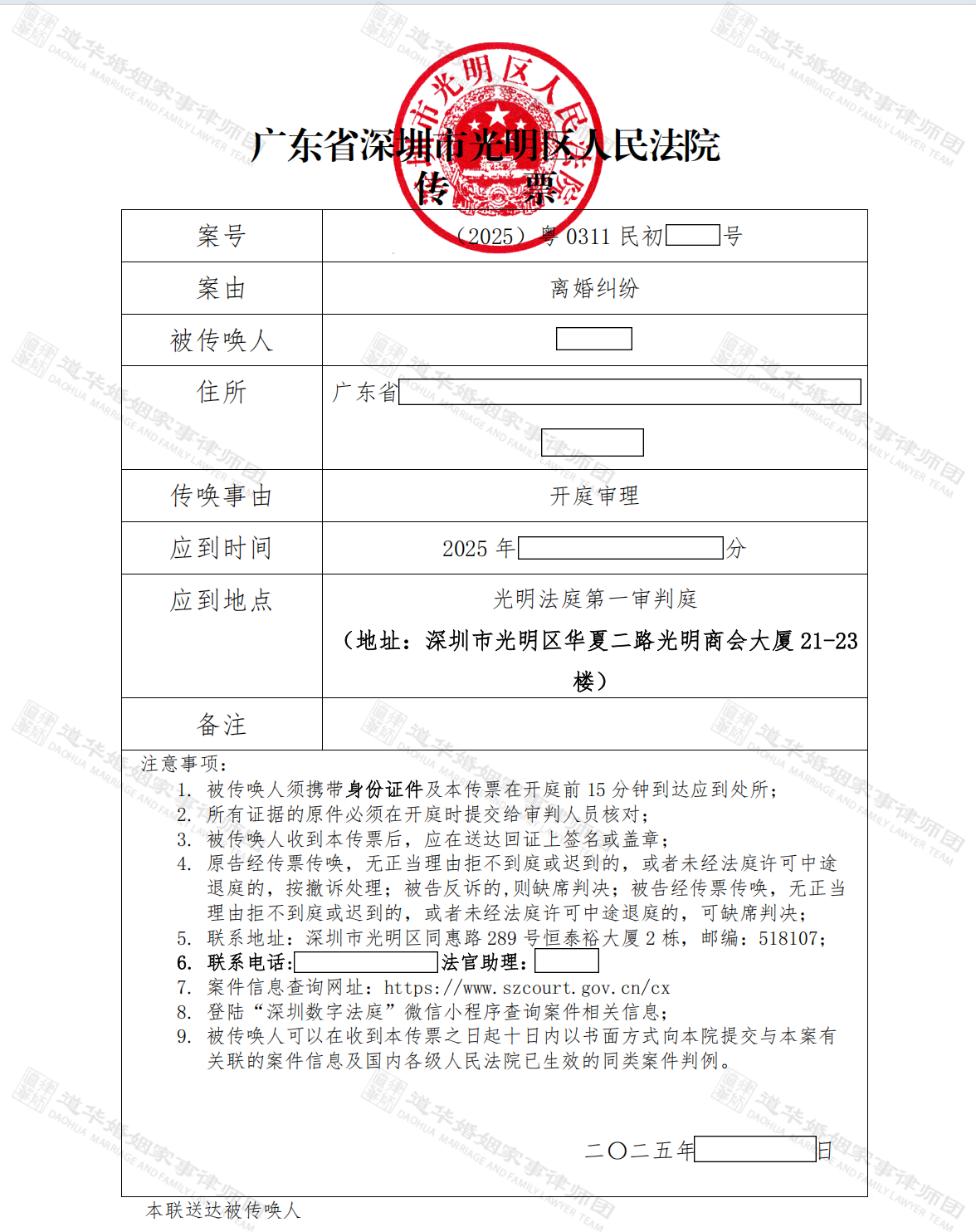
III. A Major Strategic Shift: The Client's Change of Mind; We File a Divorce Counterclaim and Seek Full Division of Property
As the proceedings advanced, hearings and evidence exchanges unfolded one after another. In court the conflict between the parties was sharp: the husband insisted on divorce, and the two sides were in bitter dispute over the child's custody, the value of corporate equity, the ownership of debts, and the amount of deposits. During the court proceedings, Ms. Li continually re-examined this battered marriage. After a year of psychological adjustment, the client's mindset underwent a major shift. She gradually came to terms with things, no longer clinging to the hope of saving a marriage that had already broken down. She accepted the reality of divorce and hoped to bring the marital relationship to a complete end through litigation, dividing all joint marital property in full and protecting her own property rights.
This fundamental shift in the client's mindset was a crucial turning point in the case. In family cases, the parties' subjective wishes directly determine the strategy of representation. Once the client clearly agreed to divorce, Attorney Tang Yunhong's team immediately re-evaluated the entire case and adjusted the whole litigation plan, filing a divorce counterclaim with the court. No longer making the refusal to divorce the primary goal, we instead submitted complete claims concerning the divorce, the child's custody, and all joint marital property (equity, receivables, external debts, bank deposits, nanny fees and living expenses). The core of the case shifted to: on the premise of divorce, clarifying all jointly owned marital property, fairly handling the support obligations for the special-needs child, and maximizing the client's interests.
We compiled a complete inventory of the property in this case, clarified the legal relationships, and defined the claims in our counterclaim:
1. Consent to the divorce between the plaintiff and the defendant;
2. That custody of the son be changed to the husband, with the wife paying child support of RMB 3,000 per month until the child reaches the age of eighteen;
A Lawyer's Reflection: Caring for a child with Down syndrome requires a great deal of money and time. In this case the husband controlled both companies and had greater financial strength, with better material conditions to bear the child's long-term rehabilitation and care expenses. After careful consideration, and weighing her own energy and financial pressure, the client agreed that the child should be raised directly by the husband, with the wife paying statutory child support while retaining full visitation rights and continuing to fulfill her duties as the child's mother. Custody is not a simple contest. In special-needs child cases, the core criterion should be the child's actual living and care conditions—it is not mechanically assumed that the mother must raise the child. Everything is governed by the principle of the best interests of the minor.
1. That the company's receivables be divided equally, with the plaintiff paying the defendant a compensatory sum in lieu of the receivables;
Legal Difficulty: Company receivables are debts arising from the couple's joint business operations. How should company receivables be handled in a divorce case? Debts formed during the marriage that are determinable and realizable constitute joint marital property and should be divided. In this case the receivables arose from the operations of two companies founded jointly by the couple during the marriage and constitute income from jointly owned marital property; we argued for an equal division of these operating debts.
1. That the couple's joint external debts be divided equally, with the plaintiff paying the defendant a compensatory sum in lieu of the debts;
2. That the couple's joint bank deposits held in both names be divided, with the plaintiff paying the defendant a compensatory sum in lieu of the deposits;
Practical Difficulty: The husband actually ran the companies and controlled the bulk of the funds; the great majority of the bank account balances were held in his name. We obtained a court investigation order to retrieve both parties' bank statements, securing evidence of the deposits and preventing the husband from transferring marital deposits.
1. That the plaintiff be ordered to pay the nanny fees for the son;
Practical Consideration: A child with Down syndrome requires day-to-day care by a nanny. These nanny fees were actually incurred during the marriage for the care of a special-needs child and should be borne jointly by both spouses; we argued that the husband should bear this portion of the expenses.
Once the above counterclaim was submitted to the court, all the disputed issues in the case formally surfaced:
First, the child custody issue: custody of a special-needs child with Down syndrome and the standard for child support; the real-world pressure of future rehabilitation and care for a special-needs child;
Second, the equity and assets issue: two limited liability companies, both established through the couple's joint business venture after marriage—how should the equity be divided, balancing the Marriage and Family Book of the Civil Code with the personal-cohesion (human-relationship) character of a limited liability company under the Company Law;
Third, the debt and receivables issue: whether company operating receivables and the couple's ordinary external debts constitute joint marital property, and how they should be divided;
Fourth, movable deposits: the identification and division of substantial bank deposits in both parties' names, guarding against the transfer of joint marital property;
Fifth, other special expenses: the child's nanny fees and compensation for the wife's living expenses during the transition period after divorce.
IV. How the Case Was Handled
The property in this case was of complex types, involving personal relations, marriage and family law and company law in an interlocking manner, and compounded by the raising of a special-needs child. Attorney Tang Yunhong's team identified four approaches that ran through the entire representation.
Approach One: Respect the Client's Psychological Shifts and Adjust Litigation Strategy Dynamically—Never Take a Rigid Approach to Family Cases
Family cases differ from ordinary commercial cases: the parties' emotions and perceptions change as the litigation proceeds. Initially the client firmly opposed divorce, and all work revolved around mediation for reconciliation and defending against divorce. After a year of litigation, the client's mindset changed and she accepted the fact of divorce. We did not cling to our original response plan; instead we immediately re-organized all the evidence, changed the direction of the litigation, filed a divorce counterclaim, and sought the full division of property rights. A lawyer must not impose his or her own values on the client, and must not one-sidedly push the client to fight for custody. Especially when a special-needs child is involved, the lawyer should fully consider the rational choice the client makes after weighing his or her own energy and financial circumstances, and then offer professional advice in light of the law.
Approach Two: Exhaust Every Investigative Means to Fully Secure Evidence of All Joint Marital Property, Leaving No Equity, Receivables or External Debts Unaccounted For
The greatest difficulty in this case was that the vast majority of the operating assets were in the husband's hands. He actually controlled the two companies and held the company's finances, receivables and bank accounts. Although the wife had participated in building the business, she did not hold the company's complete financial records. Had the evidence been incomplete, a large amount of joint marital property could have remained unverified and undivided, directly harming the client's rights.
During the representation we pursued multi-dimensional evidence collection:
1. Retrieving the industrial and commercial archives to secure the companies' registration information and prove that both companies were established through the couple's joint venture after marriage, so that the equity constitutes joint marital property;
2. Applying to the court for an investigation order to retrieve all bank account statements of both parties, sort out the deposit details in both names, and secure evidence of the large deposits held in the husband's name;
3. Collecting company business contracts and reconciliation materials to establish the amount of the company's receivables;
4. Collecting IOUs and transfer records to establish the couple's joint external debts;
5. Collecting the child's medical records and diagnosis reports, the nanny employment agreement and nanny fee transfer records, to prove that the child is a special-needs child with Down syndrome requiring daily nanny care and to substantiate the actual expenditure on nanny fees.
Approach Three: Make Good Use of Litigation to Facilitate Mediation and Prioritize Settling by Mediation, Avoiding the Multiple Secondary Risks of a Judgment
In entrepreneur divorce cases, simply waiting for a court judgment gives rise to many practical risks: the valuation and audit of corporate equity is time-consuming, prolonging the litigation; a judgment dividing the equity of a limited liability company would undermine the company's personal-cohesion character and affect normal operations; and in this case there is a special-needs child with Down syndrome, for whom an adversarial judgment would be detrimental to the child's subsequent visitation and care and would easily escalate conflict.
We therefore insisted on using litigation to facilitate mediation: with a complete chain of evidence supporting us, we carried out multiple rounds of negotiation through the court's mediation platform. Mediation is not unbounded compromise; it is built on sufficient evidence and aims at a package solution that resolves the divorce, custody, child support, equity, vehicles, real estate, deposits, receivables, external debts, nanny fees and living expenses all at once. A mediation agreement is enforceable, avoiding a subsequent series of lawsuits.
Approach Four: Handle Custody of a Special-Needs Child in Strict Accordance with the Principle of the Best Interests of the Minor
Many people hold a fixed notion that in divorce cases the child should be awarded to the mother. But the son in this case is a special-needs child with Down syndrome, requiring long-term and substantial rehabilitation and nursing expenses. Custody does not simply turn on gender; it requires a comprehensive assessment of financial capacity, care conditions and rehabilitation resources. Article 1084 of the Civil Code establishes the principle of the best interests of the minor: where the child is over two years old and the parents cannot agree, the court shall decide in light of the specific circumstances of both parties.
After careful consideration, the client in this case agreed that the child should be raised directly by the husband, who is in a stronger financial position, with the wife bearing statutory child support and retaining visitation rights. This is not an abandonment of a mother's responsibility, but a rational weighing of real-world conditions to maximize the future quality of life of the special-needs child. During the negotiation and mediation we also focused on: the term of child support payments, the child's nanny and rehabilitation expenses, and the implementation of the wife's visitation rights—ensuring that even with custody awarded to the husband, the wife still fully exercises her rights of guardianship and visitation.

V. Mediation and Negotiation; the Case Concludes by Mediation
This case went through multiple rounds of mediation and negotiation. At the outset the husband resisted the division of receivables, external debts and large deposits, arguing that the company's operating risks were high, that receivables might not be collected, and that they should not be divided in a divorce case; he also refused to bear the nanny fees and living expenses.
Our lawyers rebutted each point by reference to the law:
1. Both companies were established through the couple's joint efforts after marriage, and the operating receivables are marital income determined during the marriage, constituting joint marital property. Referring to the Beijing High People's Court's reference opinions on marriage disputes, debts formed during the marriage that are determinable and realizable—and actually obtained after divorce—constitute marital property and should be divided;
2. Nanny fees incurred during the marriage for the care of a special-needs child are a joint family expense and should reasonably be borne by both parties;
3. The husband committed the serious marital fault of adultery. Under Article 1091 of the Civil Code, where there is other major fault, the faultless party is entitled to claim damages, and the division of property should follow the principle of protecting the interests of the wife and the faultless party (Article 1087 of the Civil Code);
4. If both parties refused mediation, the court would formally commence judicial audit and equity valuation procedures, further prolonging the litigation and adversely affecting the company's operations.
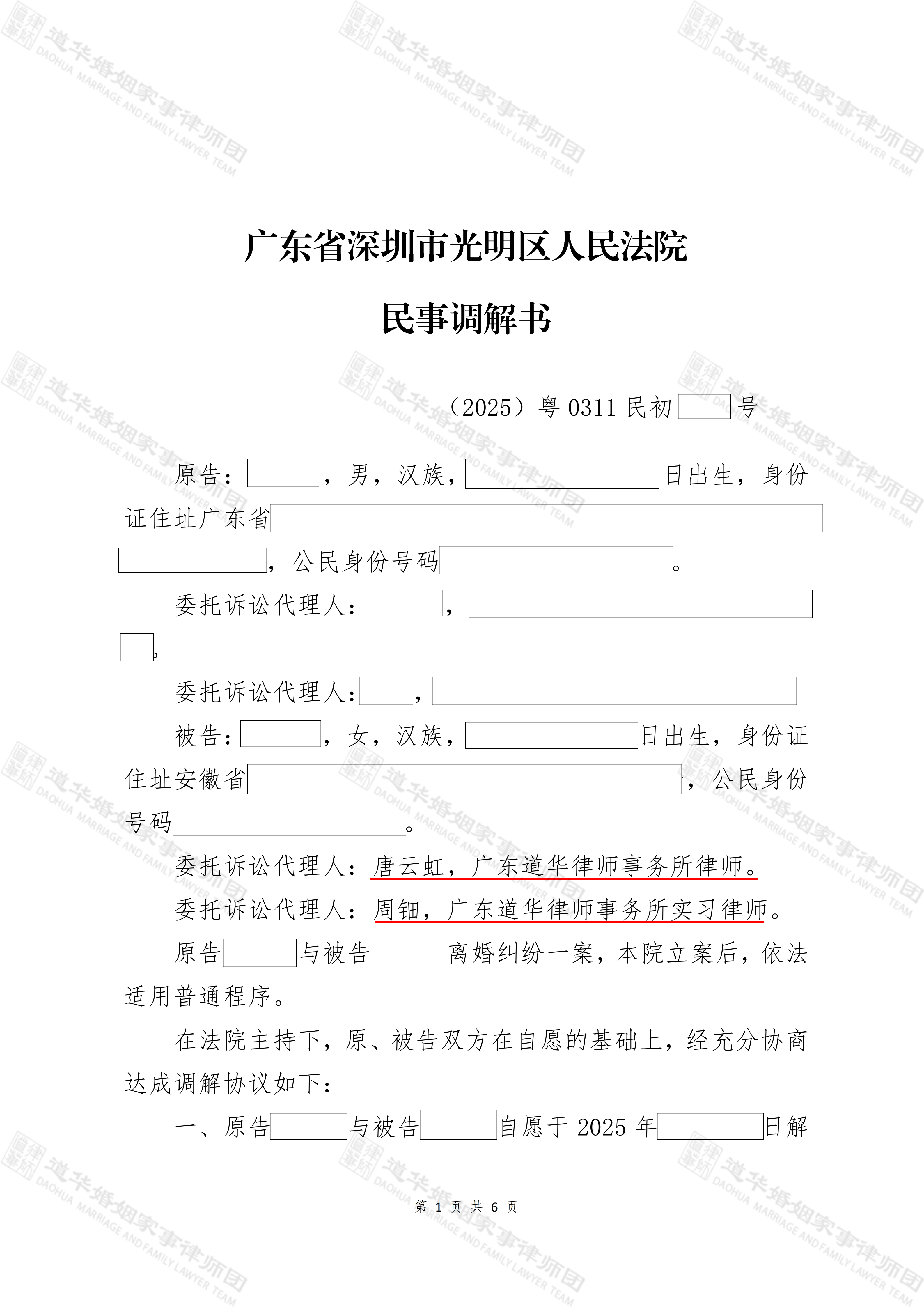
Under the presiding judge, and after multiple rounds of negotiation, the parties weighed the pros and cons of litigation and ultimately reached a complete mediation settlement on all divorce disputes. The People's Court issued a civil mediation agreement, bringing all disputes to a conclusion at once.
The final mediated outcome dealt comprehensively with the equity, receivables, external debts, deposits, nanny fees for the special-needs child and living expenses. It properly arranged for the care of the child with Down syndrome while fully protecting our client's property rights, achieving the maximization of her interests on the premise of accepting divorce and avoiding protracted hearings, audits and equity valuations—truly bringing the matter to a complete and final resolution.
VII. Attorney Tang's Commentary
This is a highly typical Shenzhen divorce case involving a couple who built a business together, compounded by the raising of a special-needs child. Having concluded the case, there are many practical reflections that can offer guidance to parties facing similar difficulties.
Insight One: In an Entrepreneur's Marriage, Family Assets and Company Assets Easily Become Commingled—Evidence Should Be Preserved with Care
Many couples build businesses together: company income is used for family life, yet the spouse who is not involved in operations does not participate in day-to-day financial management, and company contracts, bank statements and receivable vouchers are all held by the other spouse—making it difficult to prove one's case in a divorce. It is advisable that during the marriage the non-operating spouse consciously retain company registration materials, major business contracts and dividend records. Upon discovering cracks in the marriage, one should engage a lawyer as early as possible and use an investigation order to retrieve bank statements and company financial records, preventing the other party from concealing or transferring deposits, equity or receivables.
Insight Two: In Divorce Cases Involving Special-Needs or Disabled Children, Custody Must Not Be Approached with a Rigid "Must Fight for It" Mindset
It is commonly assumed that a sick child should live with the mother, but children with Down syndrome and other special needs or disabilities require rehabilitation, care and nannies for life, imposing enormous financial pressure. The legal standard for custody is the best interests of the minor—not a mechanical award to the mother. Parties should objectively assess their own physical, emotional and financial capacity and choose custody rationally. Not raising the child directly does not mean giving up guardianship; one still enjoys visitation rights and fulfills parental duties. Blindly fighting for custody while being unable to bear the caregiving pressure is instead detrimental to the growth of a special-needs child. In this case, after careful consideration, the client placed the child in the direct care of the husband, who is in a stronger financial position, while bearing child support herself and retaining visitation rights—a rational choice.
Insight Three: Using Litigation to Facilitate Mediation in a Divorce Case Is Not a Compromise—It Is One of the Best Solutions for Complex Property Cases
Many parties believe that winning means obtaining a judgment. But for divorce cases involving multiple companies and large debts and claims, a judgment brings audits, valuations and appeals, with litigation lasting two to three years, and the company's continued entanglement in litigation disrupts its operations. A mediation agreement has the same binding legal force as a judgment, and mediation can resolve the divorce, custody, equity, deposits, debts and compensation in a single package, specifying the timing of transfers and payments and liability for breach, thereby bringing the matter to a complete and final resolution. But mediation must be built on sufficient evidence—only by first securing complete evidence and then negotiating can one obtain a favorable outcome.
Insight Four: Marital Adultery Does Not Mean Leaving the Marriage with Nothing, but It Is an Important Factor in Dividing Property
Many parties believe that if the other side commits adultery the court can order them to leave with nothing. In judicial practice, adultery alone, absent the transfer of assets, very rarely results in an order to leave the marriage with nothing. But adultery falls within "other major fault" under Article 1091 of the Civil Code: when dividing joint marital property the court should protect the faultless party, who may also claim divorce damages. Fault is an important bargaining chip in negotiation and mediation, and a lawyer can use the facts of fault to push the other side to make concessions in the division of property.
Insight Five: When Dividing Company Receivables in a Divorce, the Risk of Collection Should Be Anticipated
Receivables are merely book claims and carry the risk of customer default and bad debt. If a divorce judgment directly divides the claim, and the money cannot later be collected, a separate lawsuit against the debtor is required. Therefore, in mediation one should prioritize obtaining a compensatory payment from the party who actually operates the company, shifting the collection risk to the operating party—which is more favorable to the non-operating party. The mediation plan in this case reflects this approach.
Insight Six: A Family Lawyer Must Balance Legal Expertise with Psychological Support, Adjusting Strategy as the Client's Mindset Changes
Family cases differ from ordinary commercial cases: the parties' emotions fluctuate greatly, and in this case the client went from firmly refusing divorce to accepting it over the course of a year. A lawyer cannot apply a single plan throughout the entire case; one must continuously monitor the client's psychological changes and adjust the strategy of representation according to the client's true wishes. The law is a tool; the ultimate goal is to realize the client's genuine concerns within the legal framework while protecting the interests of minors.
VIII. Conclusion
Twenty years of striving side by side—from having nothing to accumulating substantial wealth—could not withstand the cracks in the marriage. Divorce is a heavy outcome for any family, and its impact is all the more profound when there is a special-needs child at home. In this case we did our utmost in the early stage to bring about a repair of the marriage; when the marriage could not be saved, we helped the client face divorce rationally. Through complete evidence organization and multiple rounds of mediation and negotiation, we maximized her property rights while protecting the interests of the special-needs child. A marriage and family case is not the mechanical application of legal provisions; it is an interweaving of legal principle and human feeling. Facing complex cases such as an entrepreneur's divorce and the raising of a special-needs child, a lawyer must not only master marriage and family law but also understand company law and the realities of business operations, and must empathize with the client's emotional predicament. Mediation is not muddling through; it is finding a balance of interests among multiple parties on the basis of evidence—protecting the client's lawful property rights while minimizing, as far as possible, the harm that divorce inflicts on a special-needs child, truly bringing the matter to a complete and final resolution.
VI. Index of Laws and Regulations Involved
(1) Custody and Child Support
1. Article 1084 of the Civil Code: The relationship between parents and children is not extinguished by divorce. After divorce, children under two years of age are in principle raised directly by the mother; where the child is over two years old and the parents cannot agree, the court shall decide in accordance with the principle of the best interests of the minor; where the child is over eight years old, his or her true wishes shall be respected.
1. Article 46 of the Interpretation (I) of the Supreme People's Court on the Application of the Marriage and Family Book of the Civil Code: For minor children over two years old where both parents seek direct custody, priority consideration may be given to circumstances such as one party having undergone sterilization or lost the ability to bear children, the child having lived with one party for a longer period, one party having no other children while the other does, or the child's living with one party being conducive to his or her upbringing.
1. Article 1085 of the Civil Code: Where after divorce the child is raised directly by one party, the other party shall bear part or all of the child support; if no agreement is reached, the court shall decide. This does not prevent the child from making a reasonable request for an amount exceeding the original sum when necessary.
1. Article 49 of the Interpretation (I) of the Supreme People's Court on the Application of the Marriage and Family Book of the Civil Code: The amount of child support is determined according to the child's actual needs, the parents' ability to pay and the local actual standard of living. Where there is a regular income, support is generally paid at a ratio of 20% to 30% of total monthly income; where there are two or more children, the ratio may be appropriately increased but generally shall not exceed 50% of total monthly income.
Attorney's Note: As to the raising of special-needs children, the law contains no separate provision for children with Down syndrome; the core of the adjudication remains the principle of the best interests of the minor. In addition to basic living costs, child support should also take into account the special actual expenses of rehabilitation, nursing and nanny care.
(2) Legal Basis for the Division of Joint Marital Property and Equity
1. Article 1062 of the Civil Code: During the marriage, wages and bonuses, income from production and business operations and investments, income from intellectual property rights, and property inherited or gifted (except where it is determined to belong to one party alone) constitute joint marital property, over which both parties have equal rights of disposal.
1. Article 1087 of the Civil Code: At divorce, joint marital property shall be dealt with by agreement between the parties; where no agreement is reached, the court shall decide according to the specific circumstances of the property and in accordance with the principle of protecting the interests of the child, the wife and the faultless party.
1. Article 1091 of the Civil Code: Where a divorce results from bigamy, cohabitation with another person, domestic violence, abuse or abandonment of family members, or other major fault, the faultless party is entitled to claim damages.
In this case the husband committed adultery during the marriage, falling within "other major fault" under Article 1091; the division of property should therefore protect the interests of the faultless wife.
(3) Reference for the Division of Marital Debts and Receivables
Article 42 of the Reference Opinions of the First Civil Division of the Beijing High People's Court on Several Difficult Issues in the Trial of Marriage Disputes [Determination of the Time and Nature of Debts]: A determinable and realizable debt held by one party before marriage, if actually obtained after marriage, shall be recognized as premarital property; a debt arising during the marriage that is determinable and realizable, if actually obtained after divorce, shall be recognized as marital property.
Practical Tip: Receivables are not the same as cash and carry the risk of bad debt. In mediation, the party holding the company can pay a compensatory sum, shifting the future collection risk to the operating party—this is the value of the mediation plan in this case.
(4) Practical Notes on the Division at Divorce of Equity in a Limited Liability Company
Equity in a limited liability company acquired with joint marital property has both a property character and the personal-cohesion character under the Company Law. At divorce, the equity share may be divided, or one party may hold the equity and pay the other compensation in lieu thereof. Where the parties cannot agree on the value of the equity in litigation, a judicial audit and valuation must be initiated, which is time-consuming and costly. Settling by mediation avoids the audit and valuation, and the parties directly agree on the ownership of the equity and the compensatory sum—the preferred path for entrepreneur divorce cases.

No registration required, quick appointment, expert lawyers provide customized legal service solutions
 Consultation Appointment:400-829-6880
 Private Space:18126123723
 Law Firm: Guangdong Daohua Law Firm
 Email:DAOHUALAWMF@163.com
 Address:810, Rongchao Economic & Trade Center, 4028 Jintian Road, Futian District, Shenzhen (Next to Civic Center)

18126123723
Follow us anytime, anywhere


