
Navigation
Author: Dao Hua Marriage and Family Law FirmDate: 2026-01-20Reads:times
Marriage and Family Affairs Dispute (Mediation/Litigation) Practical Expert
Ten years of focus on; marriage and family legal services for bulk property matters
Guangdong Dao Hua Law Firm, Tang Yunhong, Dao Hua Family Law TeamShenzhen's renowned divorce litigation lawyerSpecialist inheritance dispute lawyer, Top 10 marriage and family law firms in Guangdong and Shenzhen, professionally handling: major difficult divorce mediation/court litigation, property small property division, will and inheritance disputes, will notarization, divorce property division, post-divorce property disputes, divorce/marital agreement, custody disputes, will inheritance disputes, statutory inheritance disputes, land and property inheritance, rural house demolition inheritance, will drafting, will validity determination, etc. Non-litigation and disputes. Service areas: Futian, Nanshan, Luohu, Longgang, Bao'an, Longhua, Guangming, Pingshan, Dapeng, Yantian.

Introduction:The Civil Code of the People's Republic of China (hereinafter referred to as the "Civil Code") first introduces the new type of usufructuary right "residential right" in the Property Rights Chapter, and establishes the residential right system in a special chapter. The introduction of this system not only supplements our country's housing security system but also legally responds to the people's livelihood goal of "having a place to live." It provides a new institutional tool for resolving housing disputes in reality. In this article, the Chief Lawyer of the Marriage and Family Law Team at Guangdong Dao Hua Law Firm, Tang Yunhong, will deeply analyze the residential right system from aspects such as legislative background, specific legal provisions, conditions for establishment and application scenarios, procedures, and materials, providing guidance for practical operations.
One, legislative background: responding to people's livelihood needs and improving the legal system
The 19th National Congress of the Communist Party of China proposed to "accelerate the establishment of a housing system with multiple suppliers, multiple channels of guarantee, and a combination of renting and buying," and the residential right system, through the protection of property rights, provides a more rigid legal support for housing security, which is the legislative implementation of the concept that "houses are for living in, not for speculation."
For a long time, many people have been facing difficulties in ensuring their housing rights. In the practice of social life, the housing needs of vulnerable parties in divorce, lonely elderly people, and relatives without houses are difficult to be fully covered by the existing security system. Some groups are prone to fall into housing difficulties due to high housing prices, as they do not meet the application conditions for public rental housing or low-rent housing. At the same time, in judicial practice, there are frequent "housing-for-old-age" scams, difficult-to-resolve housing resettlement disputes after divorce, inheritance disputes caused by housing rights arrangements in wills, and other issues that urgently require clear legal rules for regulation. In response to the realistic demands of vulnerable groups for housing security, and to meet the legal needs of property management and the resolution of civil disputes, the residential right system has emerged in a timely manner.
(Image source: AI generated)
II. Core Legal Provisions and Key Points
Article 366 of the Civil Code stipulates: "The right of residence holder has the right, in accordance with the contract, to enjoy the usufructuary right of possession and use of another's residential property to meet the needs of living and residence."
The occupant's right to occupy and use the house within the agreed period is protected by law, and the validity of the occupancy right is not affected even if the ownership of the house is transferred. When the occupant's legitimate rights to occupy and use the residential property are obstructed or there is a risk of obstruction, the occupant may claim the right to exclude obstruction and eliminate danger. Even if the owner of the residential property transfers, mortgages, or leases the property, the transferee is still bound by the established occupancy rights on the property and may not obstruct the occupant's residential interests.
According to the law, the core purpose of establishing the right of residence is to meet the needs of living and residing, which does not include the right to gain, therefore, the holder of the right of residence may not use the residential property for purposes other than living and residing, and may not rent out the residential property for profit without prior agreement with the owner of the residential property. This provision clearly distinguishes the legal attributes of the right of residence (property right) and the right of tenancy (creditor's right), with the right of residence, as a property right, having a stronger right protection effect.
(1) The circumstances for the establishment of the right of residence
In accordance with the provisions of the law and practical practice, the establishment of residential rights includes the following three statutory situations:
1. The parties establish the right of residence by entering into a written contract.
2. The owner of the house establishes a right of residence through a will.
3. The right holder acquires the right of residence based on the effective legal documents issued by people's courts or arbitration institutions.
(2) Restrictions on the establishment of the right of residence
1. Subject restriction: According to Article 366 of the Civil Code, the core meaning of "meeting the needs of living and residing" is that the right of residence has a strong personal attribute and can only be enjoyed by the natural person themselves, legal persons and unincorporated organizations cannot become the subjects of the right of residence.
2. Subject limitation: The object of the residential right is "residential buildings," which is limited to establishing the right on residential buildings and theiraffiliated facilities owned by others, and residential rights may not be established on non-residential buildings such as commercial properties. In addition, if the residential building to be established with the residential right has been mortgaged, and the mortgage contract explicitly stipulates that no other rights (including residential rights) may be established, the establishment of the residential right requires prior written consent from the mortgagee; if the residential building is under a judicial seizure, it is not legally permitted to establish a residential right.
(3) Registration and effectiveness rules for the right of residence
Article 368 of the Civil Code stipulates: "The right of residence is established gratuitously, except as otherwise agreed by the parties."The establishment of residential rights shall be subject to application for residential rights registration with the registration authority.The right of residence is established upon registration. "If the parties enter into a contract for the right of residence but fail to register it in accordance with the law, the right of residence does not take effect as a real right, but the validity of the contract itself is not affected by whether it is registered or not. The person with the right of residence has the right, based on a legally valid and effective contract for the right of residence, to request the owner of the residential property to fulfill the contractual obligation to assist in registering the right of residence."
(4) The transfer of residential rights is strictly restricted.
According to Article 369 of the Civil Code: "The right of residence may not be transferred or inherited. The residential property with the right of residence may not be rented out, except as otherwise agreed by the parties." To prevent the right of residence from being transformed into a profit-making tool, and to uphold the attribute of the right of residence for the people's livelihood security, the law imposes strict restrictions on the transfer of the right of residence. However, it allows the parties to exclude the prohibition of "not renting out" through special agreements, granting the right of residence a certain degree of circulation space to maximize the value of the residential property.
(5) Termination and cancellation of registration of residential rights
Article 370 of the Civil Code stipulates: "When the term of the right of residence expires or the person with the right of residence dies, the right of residence shall be terminated. Upon the termination of the right of residence, the registration for cancellation shall be handled in a timely manner." After the termination of the right of residence, the right holder shall return the house to the owner of the residential property and cooperate in handling the procedures for the registration for cancellation to ensure the clarity and stability of the status of immovable property rights.
III. Process and required materials for the establishment of residential rights
The establishment, alteration, and cancellation of residential rights all need to follow the statutory procedures. There are differences in the handling processes and material requirements corresponding to different establishment methods. The following is a summary of the relevant materials for registering residential rights based on the Shenzhen Residential Right Registration Guide.
(Image source: AI generated)
(1) First registration of the right of residence
1. Applicant: For the establishment of residential rights through a contract, both parties to the contract shall jointly apply to the real estate registration authority; for the establishment of residential rights through a will or a legally effective document, the applicant may apply unilaterally.
2. List of essential materials for application
(1) Shenzhen Real Estate Registration Application Form
(2) Applicant's identity proof
(1) For domestic natural persons, submit a resident identity card; A person may submit an ID card orhousehold registrationregister;For natural persons of the Hong Kong and Macao Special Administrative Regions, submit the identity card or passport of the Macao Special Administrative Region,or the Residence Permit for Hong Kong and Macao Residents of the People's Republic of China, or the Mainland Travel Permit for Hong Kong and Macao Residents;Natural persons from the Taiwan region of China shall submit the Mainland Travel Permit for Taiwan Residents or the Residence Permit for Taiwan Residents of the People's Republic of China;Overseas Chinese shall submit passports of the People's Republic of China and long-term overseas residence identification documents;Foreign natural persons shall submit residence documents issued by the competent authorities of the Chinese government,or their passport of the country of nationality.
② Where an applicant entrusts an agent to apply for real estate registration, the agent shall submit the applicant's identity proof, power of attorney, and the agent's identity proof to the real estate registration authority; for individuals disposing of real estate, a notarized power of attorney may be submitted, or the power of attorney may be signed jointly by the applicant and the agent in the presence of the real estate registration authority staff during the application for registration; for real estate disposal involving overseas applicants, the power of attorney shall be notarized or authenticated.
③ Where guardians of minors or other individuals without civil or restricted civil conduct capacity apply for real estate registration on behalf of the applicants, they shall also provide proof of guardianship relationship and the guardians' identity proof.
(3) Basic legal documents. Submit the corresponding materials according to the following circumstances:
① Where residential rights are established based on a contract, submit the real estate ownership certificate (no need to submit paper materials if an electronic certificate of real estate ownership has been issued) and the residential rights contract.
② Where residential rights are established based on a will, submit the deceased person's death certificate and the will. If a transfer registration has already been processed due to inheritance or bequeathment, there is no need to submit the deceased person's death certificate.
③ Submit the effective legal documents setting the right of residence in accordance with the effective legal documents.
(2) Change of residence right registration
Real Estate Registration Application Form
2. Applicant's identity proof (refer to above)
3. Real Estate Registration Certificate
4. Proof materials for changes in residential rights:
(1) If the name, type of identity proof, or identity proof number of the rights holder or obligor changes, submit materials that can verify the change in identity.
(2) Where the term of the right of residence or other relevant matters change, submit materials such as change agreements or effective legal documents that can verify the change in the right of residence.
(3) Right of residence cancellation registration
Real Estate Registration Application Form
2. Applicant's identity proof (refer to above)
3. Evidence materials for the loss of residential rights:
① In the event of the death of the right of residence holder, submit the death certificate of the right of residence holder.
② The period of residence right has expired, submit the materials expired.
③ Where immovable property is lost, submit proof materials of the loss of immovable property.
④ Where the right to residence is waived by the right holder, submit written materials indicating the waiver of the right to residence by the right holder.
Article 5: If applying for the cancellation of residential rights based on a legally effective document, submit the legally effective document.
The applicant for the cancellation of the residential right registration shall also submit the real estate registration certificate.
Note: The above content is for reference only, and in case of any changes, please refer to the official information released by the relevant administrative departments.
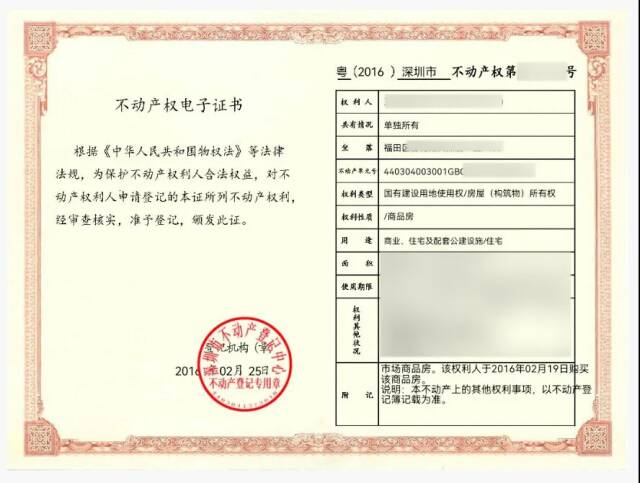
The first electronic "certificate" (source: Shenzhen Real Estate Registration)
Four, the practical application value and social effectiveness of the right to residence
The establishment of the residential right system combines the multiple values of people's livelihood security, property utilization, and social governance, providing diverse solutions for social life.
(1) At the level of people's livelihood security: to build a housing safety net for vulnerable groups
In divorce disputes, Shenzhen marriage lawyers often suggest that the parties may agree that the ownership of the house be assigned to one party, while setting up a certain period or lifetime residence rights for the other party to ensure the basic living needs of the weaker party; the elderly can transfer the ownership of the house to their children through wills or contracts, while setting up lifetime residence rights for themselves, ensuring stable living in their later years, clarifying the ownership of property, and reducing family disputes; the owner of the house can set up residence rights for elderly parents, minor children, relatives without houses, etc., solving their housing difficulties without transferring ownership, achieving the dual goals of family support and property protection.
(2) Property utilization level: achieve maximum value of residential property
The owner of residential property may establish a right of residence for others while retaining ownership, satisfying the housing needs of specific individuals without affecting the subsequent inheritance and disposition of the property, and fully utilizing the residential property's use value and property value. For example, the elderly may transfer the ownership of the property to their children or financial institutions in exchange for consideration, while setting up a lifelong right of residence for themselves, effectively avoiding the legal risks of the traditional "housing-for-old-age" model, and achieving a balance between the rights and interests of old-age care and property value.
(3) Social governance level: resolve disputes, promote social harmony
Due to the lack of clear rules for residential rights in the past, there were inconsistencies in the standards for judgments on disputes such as housing assistance after divorce and housing arrangements in wills, making it difficult to stabilize the rights and interests of the parties involved. The establishment of the residential right system provides clear legal basis for such disputes, reduces the discretion in judgments, and at the same time guides the parties to clarify their rights and obligations through prior agreements, avoiding disputes from the source and maintaining social relationship stability.
(Image source: AI generated)
Five, lawyer Dao Hua analyzes
The residential right system, as an important innovation in the Civil Code, transforms the people's livelihood vision of "having a place to live" into specific and operable legal rules, providing both a solid housing rights guarantee for vulnerable groups and a legal path for the flexible exercise of real property rights. As practical applications deepen, the institutional value of residential rights will further highlight in scenarios such as property division in divorce, elderly planning, and family support. It should be especially noted that the establishment of residential rights involves changes in property rights and the interests of multiple parties. Parties should fully negotiate before establishment, clarify the core contents such as the duration of the residential right and the boundaries of rights and obligations, and handle registration procedures in accordance with the law to ensure the legality and effectiveness of the establishment of residential rights, give full play to its institutional effectiveness, and truly realize the rule of law guarantee from "settling in" to "settling down."
Dao Hua Family Law Firm, specializing for ten years in major property, marriage, and family legal services, is an expert in marriage inheritance and family disputes (mediation/trial) and one of the influential brands in [Shenzhen] for marriage inheritance and wealth management legal services. The team has handled over 1000 cases related to marriage inheritance, and has extensive practical experience in mediation and litigation in major complex marriage and family disputes, inheritance disputes, will drafting, and family property distribution. The team applies local wisdom, excels in dealing with difficult divorce property division cases involving Shenzhen's small property rights houses, village committee shares, and other issues, as well as will drafting and notarization, inheritance disputes, winning unanimous praise from clients.
Adhering to the philosophy of "securing property safety, preventing legal risks, and empowering wealth appreciation," we gather experts from industries such as law, banking, insurance, and finance tax, with a wealth of successful cases. We provide a comprehensive package of solutions for high-net-worth individuals (including those from Hong Kong, Macau, and foreign nationals) for marriage, family affairs, and wealth inheritance, to achieve the beautiful vision of risk prevention and control, debt isolation, and family wealth inheritance. Asset types cover: real estate (commercial housing, small property rights housing, land use rights, etc.), various property rights and interests (equity, debt, relocation compensation, copyright, invention patents, etc.). The team has completed the compilation of "Daohua Successful Cases of Marriage and Inheritance" and "Legal Practice of Family Wealth Inheritance," with outstanding achievements in both legal practice and theoretical research.
Statement:The information or articles published on this website are for exchange purposes only. The names of individuals/companies mentioned in this article are pseudonyms, and the amounts/dates of the case information have been processed for confidentiality. The content of the article is created by the author and does not represent legal opinions or suggestions issued by Guangdong Daohua Law Firm or other lawyers. The information contained in this article is provided for general information purposes only, and Guangdong Daohua Law Firm is not responsible for making timely modifications or updates to this article. Decisions made by readers based on all or part of the content of this article and the consequences thereof shall be solely responsible by the individuals involved. The author and Guangdong Daohua Law Firm shall not be held liable. If any content of these articles is to be reproduced or cited, please indicate the source. If you need legal advice or legal services, please contact our lawyers.
No registration required, quick appointment, expert lawyers provide customized legal service solutions
 Consultation Appointment:400-829-6880
 Private Space:18126123723
 Law Firm: Guangdong Daohua Law Firm
 Email:DAOHUALAWMF@163.com
 Address:810, Rongchao Economic & Trade Center, 4028 Jintian Road, Futian District, Shenzhen (Next to Civic Center)

18126123723
Follow us anytime, anywhere


