
Navigation
Author: Dao Hua Marriage and Family Law FirmDate: 2024-06-05Reads:times
Introduction: On May 20, 2023, the client's father (hereinafter referred to as Mr. Wang) suddenly passed away at home due to illness, leaving several small property rights houses with a market value of over 43 million yuan. Mr. Wang had 5 marriages in his lifetime, with a total of 7 biological children. To avoid family disputes, he specially entrusted a lawyer to draft and print a will before his death. However, due to the lawyer's negligence, the will did not comply with the legal form and had serious defects in validity. Now, some of the children are questioning the validity of the will, demanding that the property be distributed equally according to the legal inheritance, and the family's affection is in danger. In order to maintain family harmony and unity, and to protect the affection between siblings, the client found the Dohua lawyer. After accepting theentrustment, the Dohua lawyer formulated a solution, through full analysis and argumentation, adopted methods such as drafting a heritage distribution agreement, assisting in negotiations, handling notarization, and filing a lawsuit for confirmation of rights, and perfectly resolved the inheritance dispute of the small property rights house, both maintaining family affection and protecting legitimate property.
Keywords: Shenzhen inheritance dispute lawyer, will, cross-border inheritance, small property rights inheritance and confirmation
One, Case Review
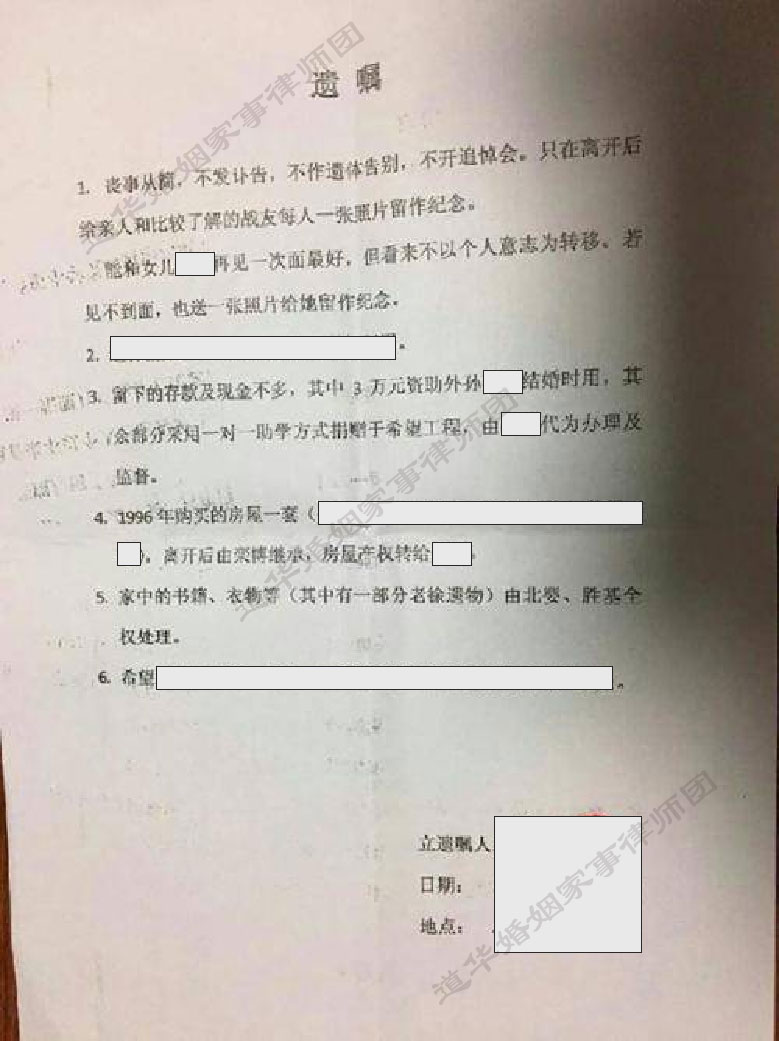
In July 2023, the client, Ms. Wang, sought legal assistance from the Dao Hua Law Firm. The client's father (hereinafter referred to as Mr. Wang) passed away at home due to illness in May of this year. According to the client's account, Mr. Wang had five marriage experiences in his lifetime, and he passed away during the marriage with his fifth wife, having a total of 7 children, including the client. Mr. Wang left a printed will witnessed by a law firm in Guangdong in 2015. The will includes four properties, such as green book small property rights houses and historical legacy illegal receipts, with a total value of over 43 million yuan. Now, the heirs have serious disputes over the division of the inheritance. The heirs have held several family meetings on the issue of inheritance, but the inheritance issue remains unresolved. The client has also tried various methods to mediate family conflicts but has failed. Not only is the issue of inheritance unresolved, but there are also cracks in the sibling relationships. With no other options, in order to maintain family harmony and the stability of family ties, and to smoothly inherit and divide the small property rights houses mentioned in the will, the client, on behalf of all the heirs, has sought the help of a marriage and family law firm in the hope of providing legal assistance in this case. The client hopes to resolve the issue of the inheritance of the small property rights houses through mediation or litigation while maintaining family unity and to legally and reasonably distribute the small property rights houses.

Two, the inheritance of the small property rights houses involved in the case is fraught with difficulties, the will is invalid, and there are many heirs.
1The printed will does not comply with the legal form, and the will has serious defects in validity.
The deceased Wang father, being fully aware that he owned several small property houses under his name, some of which only had "green books" or "historical legacy receipts," knew that the houses might be in a state of "unclear ownership," making it difficult to confirm whether the small property houses belonged to the deceased's "personal legal property." Moreover, with many children, he was concerned about potential conflicts among his offspring after his death due to inheritance issues, which could lead to the disintegration of the extended family. Therefore, in 2015, when he was mentally clear and in good health, he entrusted a law firm in Guangdong to draft a will, detailing the distribution of the small property houses under his name, and signed the printed will in the presence of a lawyer.According to Article 1123 of the Civil Code of the People's Republic of China: "After inheritance begins, it shall be handled in accordance with the statutory succession; where there is a will, it shall be handled in accordance with the testamentary succession or donation; where there is a agreement for inheritance and support, it shall be handled in accordance with the agreement."
This printed will, witnessed by a law firm in Guangdong, consists of three pages. The deceased Wang's father and the witness lawyer both signed on the third page of the will, filled in the year, month, and day, and the seams were signed and fingerprinted by Wang's father, as well as stamped with the seal and year, month, and day of the law firm in Guangdong.According to Article 1136 of the Civil Code of the People's Republic of China: "The making of a printed will shall be witnessed by two or more witnesses. The testator and the witnesses shall sign on each page of the will, and indicate the year, month, and day."However, the printed will does not comply with the statutory form required by the Civil Code, which stipulates that each page must be signed by the testator and the witnesses, and the year and month must be noted. The will has serious defects in validity. Therefore, there is a major controversy over how to distribute the small property house.
2There are many heirs with Australian and Japanese nationalities, making it difficult to coordinate the distribution of the inheritance.
Wang's father had five marriages before his death, fathering a total of 7 children, all from different wives, which also laid thehidden risks for inheritance disputes. The age gap among the seven children is 20 years, and they are now scattered across the country, with some having obtained Australian and Japanese nationalities. This also increases the difficulty of inheritance distribution. Moreover, Wang's father was still in the fifth marriage at the time of his death, and the couple had not clearly divided their property, leaving a lot of doubt about whether the property is jointly owned by the couple and whether it can be distributed as inheritance. How to coordinate the agreement on inheritance distribution among the deceased's wife and the eight children of the heirs, and how to ensure that each heir can legally and effectively inherit the property, has become a top priority.
3The existence of small property rights houses poses a risk that they do not belong to the personal “legally owned property” of the deceased heir.
Because the involved property is a small property house, the ownership certificate of immovable property has not been obtained, and the relevant departments have not reviewed and recognized the legality of the involved property, the court is very likely to consider that the involved small property house cannot be determined as the personal legal property left behind by Wang's father at the time of his death, and it is not appropriate to divide it.
According to Article 1122 of the Civil Code of the People's Republic of China: "Inheritance refers to the legitimate personal property left behind by a natural person at the time of their death. Property that cannot be inherited according to the law or based on its nature shall not be inherited." Whether small property rights houses belong to the personal legitimate property of the deceased person also exists different handling in judicial practice.
4Unprocessed small property rights houses without administrative handling are highly likely to be not accepted by the court.
The property involved in this case is a small property house without real estate registration and without obtaining construction planning permits at the time of construction. According to the "Decision on the Handling of Historical Illegal Buildings in the Process of Rural Urbanization by the Standing Committee of the Shenzhen Municipal People's Congress," although the property has reported the historical illegal building survey registration to the two planning departments during the use process and obtained the "historical legacy receipt," the administrative authorities have not yet handled the historical legacy issue of the illegal buildings. According to past judicial experience, the court may consider that before the administrative authorities handle the historical legacy issue of the illegal buildings of the property, there is no condition to recognize the legitimate ownership of the property, and will not accept the small property inheritance case of this case. If the court does not accept the case involving the small property house for trial, the heir's inheritance interests will be greatly damaged.
Three, comprehensive analysis and judgment, Da Hua family law lawyer summarizes case risks
1、Regarding the issue of the validity of a will, a will witnessed by a law firm in Guangdong in 2015: This will is a printed will, consisting of three pages, with the deceased Wang's father and the witness lawyer signing on the third page, filling in the year, month, and day, and having Wang's father's signature and fingerprint, as well as the seal and year, month, and day of the lawyer's signature from the law firm in Guangdong. This printed will does not comply with the statutory form stipulated in the "Civil Code" that requires the testator and the witness to sign on each page and indicate the year, month, and day. The will has defects in its validity.
2、Regarding the content of the supplementary will document, the supplementary will document signed by Wang's father in 2022 states, "I, Wang's father, made a will on a certain date in a certain month of 2015, which is the only will," and the supplementary will document notes a will signing date that does not match the existing will signing date.
3、There are many heirs and the property involves complex legal relationships. In this case, there are many heirs, some of whom reside overseas, making the court's delivery procedures more complicated and the litigation cycle longer. Moreover, the deceased had multiple marriages, and the heirs do not have complete information about the deceased's marriage and divorce documents, which may lead to disputes over the distinction between personal and joint property, and a large amount of investigation and evidence collection will be required later. The case involves complex property situations with a variety of types, some of which have been changed in registration by the heirs, involving various legal relationships such as gifts, sales, inheritance, and bequests, and there are related risks in returning the property as inheritance for redistribution.
4、Regarding the risks related to illegal buildings such as small property rights houses. The properties involved include green book small property rights houses, brown book houses, and added parts of properties. There is a risk of non-identification of property ownership and invalidity of relevant clauses in wills and gift agreements for this part of the properties.
5、Regarding the risks related to urban renewal and demolition. For immovable properties such as green-card small property rights houses, brown-card houses, added parts of properties, commercial housing, factories, etc., when facing urban renewal and demolition, developers require that the ownership of the immovable property is not in dispute. If the heirs cannot reach a consensus on the ownership of the immovable property, there is a dispute over the ownership, the developer will not be able to carry out the demolition and compensation, and there is a risk of depreciation of the immovable property value or inability to handle it.
Four, Daohua lawyer customizes the "Triple Insurance" solution, to implement the inheritance distribution and achieve the client's demands
1Clarify the scope of the inheritance, clearly distinguish the categories of inheritance, and avoid legal risks.
Dawhua Lawyer has many years of experience in dispute resolution in the field of inheritance, and after accepting the case, combined with the case situation, conducted a comprehensive analysis, quickly initiated the case, and assigned a Dawhua family lawyer to issue a property list to the client, guide and assist the client in self-checking from different categories of property, filling in relevant property information, and clarifying the scope of inheritance. Clearly defined the personal property of the deceased and the joint property of the couple, and clearly distinguished the personal property of the deceased from the small property houses that have been registered in the name of others, to avoid possible disputes and omissions of inheritance, which may lead to further disputes and disputes among the heirs in the future.
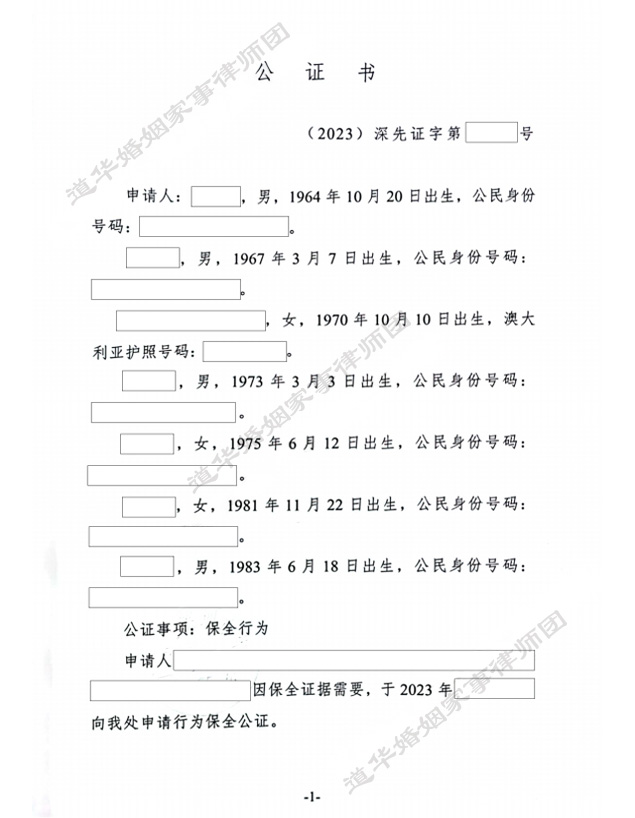
2Encourage the surviving spouse of the deceased to sign a declaration of renunciation of inheritance and have it notarized.
Although Wang's father's will did not leave a legacy share for his current spouse Li Meiling, the will in question does not comply with the legal form, and it cannot exclude the risk of Li Meiling suing the testator and Wang's other children for inheritance according to the law, which will result in significant property losses for the testator. Dao Hua lawyer discovered this problem first, and through personal communication with Ms. Li, found that Li Meiling did not have any children with Wang's father after marriage, Ms. Li is of advanced age with no other high expenses, and her main need for property is still for old-age care. Dao Hua lawyer keenly grasped the key to the problem, organized all heirs to ensure the implementation of the supplementary will document, and insisted on paying Li Meiling a pension every month, using actions and attitude to move Li Meiling. Since Wang's father's will did not leave any inheritance for Li Meiling, Dao Hua lawyer took advantage of the situation and immediately issued a statement of renunciation of inheritance, guiding Li Meiling to the notary office to sign the statement of renunciation of inheritance, enhancing the legal effectiveness of the document. Thus, solving a major problem in the distribution of inheritance.
3Intervene in the negotiation and communication between children in advance, and promptly draft a heritage distribution agreement.
Dahua lawyer analyzed the relevant legal provisions involved in inheritance distribution, first organizing the four children in China for mediation, and logically and emotionally analyzing the pros and cons to each heir. Once the will of the deceased is overturned and the shares of the small property house are distributed according to the statutory inheritance, it may lead to more statutory heirs joining the division of the house, resulting in the heirs receiving less inheritance, seriously damaging the inheritance interests of the will heirs. Under the professional legal mediation of Dahua lawyer, the will heirs finally reached a consensus. On this basis, Dahua lawyer took the opportunity of the Mid-Autumn Festival to coordinate the return of the three children abroad for a gathering, and with the weighing of pros and cons and the lawyer's perfect inheritance distribution plan, all the children agreed to rewrite the agreement according to the father's will for the inheritance distribution. In this case, Dahua lawyer quickly drafted the inheritance division agreement and other supporting documents based on the original will, laying a solid foundation for the smooth division of the small property house shares among the heirs, and avoiding the relevant litigation risks of inheritance.
4The notarization of small property rights houses is difficult, but Dao Hua lawyer successfully notarized it, enhancing its legal effectiveness.
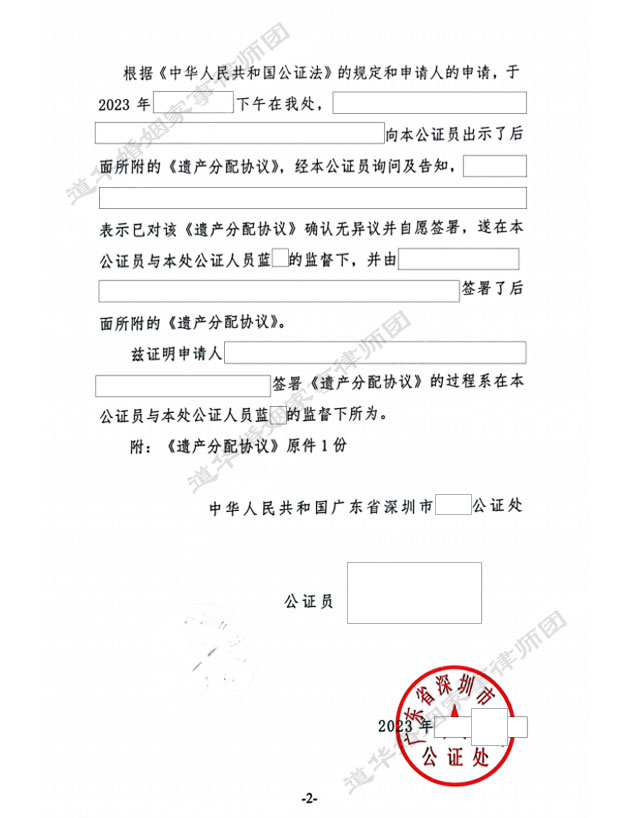
Small property houses, due to the particularity of their property rights, once the agreement documents involve the disposition of small property houses, the notary office will not notarize such agreement content. However, Dao Hua lawyer has long handled cases related to small property houses and is familiar with the legal nature of small property houses. After the negotiation and communication of Dao Hua lawyer, the notary office agrees to notarize. With the assistance and guidance of Dao Hua lawyer, all testamentary heirs carry the heritage distribution agreement to the notary office for agreement notarization. This measure ensures that all heirs sign the heritage distribution agreement on an equal and voluntary basis and agree to divide the small property houses according to the shares specified in the heritage distribution agreement. This measure not only further enhances the legal effectiveness of the heritage distribution agreement but also perfectly solves the issue of the original will's effectiveness defect.
5Commence litigation procedures to ensure the maximum protection of the parties' interests through a favorable judgment.
The lawyer of Dao Hua, based on the genuine demands of the client, filed a testamentary inheritance lawsuit on behalf of the plaintiff, Wang Lady and two other siblings, against the remaining heirs, requesting the court to order the defendant to return the plaintiff's due share of the inheritance in accordance with the will and the heritage distribution agreement.
The involved small property rights houses in this case have been reported for the historical illegal private houses according to the "Some Provisions on Handling Historical Leftover Illegal Private Houses in the Shenzhen Special Economic Zone" and the "Decision on the Handling of Historical Leftover Illegal Buildings in the Process of Rural Urbanization." However, they have not obtained property confirmation and the issuance of property certificates, and there is no handling result from the relevant administrative departments. During the trial, lawyer Dao Hua pointed out in court that after the builder of the houses reported the illegal buildings, they obtained the "Receipt for Reporting Historical Leftover Illegal Buildings," which means that the builder has the possibility of confirming property rights under certain conditions. This is an anticipated interest, although the illegal construction of the houses themselves does not yet have complete legality. However, this anticipated interest in the possibility of converting the buildings into legal ones is legitimate. The builder also, in fact, has relevant rights and interests in possession, use, and benefits over the buildings. This anticipated interest and related rights and interests can be disposed of through will and inheritance.
Dahua lawyer submitted past judicial cases to the competent court, "The involved property is a historical leftover illegal construction. Although it has not been registered as property and does not have complete ownership, it has already gone through the relevant application procedures for historical leftover illegal constructions at the local street office. The applicant has the rights to manage, use, and benefit from the property." After the application procedures for the historical leftover illegal construction in this case were completed, although the applicant did not obtain complete ownership, the applicant has relevant rights and interests in the management, use, and benefits of the house, and can also transfer these rights and interests to heirs through wills and inheritance.
The Daohua family law attorney guided the judge's thinking during the trial. Although the involved small property rights houses have not obtained ownership certificates, they have utility value and can be divided as inheritance after the deceased leaves them behind. After a strong argument, the judge supported all of our litigation requests and ruled that the usage rights of our small property rights house shares belong to the client. According to Article 229 of the Civil Code of the People's Republic of China, the establishment, alteration, transfer, or termination of property rights shall take effect from the time when the legal documents of the people's courts, arbitration institutions, or government expropriation decisions take effect. Therefore, the mediation or judgment documents of the court have become a legally valid certificate for determining the inheritance rights of small property rights houses.
Five, insights from law enforcement
Tang Yunhong, a lawyer, has ten years of experience in dispute mediation and litigation in the field of marriage and family law. Based in Shenzhen, he is well-versed in the historical evolution, policies, and regulations of Shenzhen. Over the past ten years, he has handled numerous cases related to Shenzhen's small property rights houses, including divorce, inheritance, and property confirmation, establishing a distinctive position in the field of marriage and inheritance involving Shenzhen's small property rights houses.
After accepting the case, Tang Yunhong, lawyer, led the team to conduct a meticulous layout, planning each step of the scheme in advance according to the case risks, conducting feasibility arguments and demonstrations, and at the same time, initiating two plans: negotiation and litigation, taking both approaches to ensure that the legitimate demands of the client are fully met. In the process of handling the case, rich experience in handling cases was also accumulated:
1. This case involves a dispute over inheritance, which falls under family law cases. How to complete the division of the inheritance while ensuring family harmony is the key issue in this case. For the legal team, litigation plans are often the conventional option, but how to promote mediation to achieve the client's demands requires the legal team to possess a strong professional level and sufficient wisdom to resolve disputes.
2. Lawyers play a crucial role in testamentary succession, helping individuals plan their heritage, draft legally valid wills, and provide professional legal representation in disputes or legal proceedings. Our goal is to ensure the smooth process of heritage distribution, avoid disputes, and at the same time, protect the wishes and rights of the heritage owners. Regardless of the size of an individual's property, seeking advice from professional lawyers can bring safe and reliable solutions to matters of heritage succession.
3. In this case, the estate encompasses multiple small property rights houses. Although the properties involved have not yet received real estate ownership certificates, relevant departments have reviewed and recognized their legality, determining that they are the personal legitimate property left behind at the time of the father's death. Even though the small property rights houses have not obtained ownership certificates, they hold utility value and can be considered as part of the estate, especially when they are properties left behind at the time of the deceased's death. If such properties are not legally divided in terms of usage rights, it may easily lead to the principle of "first come, first served" among the heirs, which is against the principle of fairness and not favorable to social harmony and stability.
Article 6: Legal Provisions Guidance
Article 1122 of the Civil Code of the People's Republic of China stipulates: "The inheritance is the legitimate personal property left behind by a natural person at the time of their death. The inheritance that cannot be inherited according to the law or based on its nature shall not be inherited."
Article 1123 of the Civil Code of the People's Republic of China stipulates: "After inheritance begins, it shall be handled in accordance with the statutory succession; where there is a will, it shall be handled in accordance with the testamentary succession or donation; where there is a agreement for inheritance and support, it shall be handled in accordance with the agreement."
Article 1127 of the Civil Code of the People's Republic of China stipulates: "The inheritance shall be succeeded in the following order:"
(1) First priority: spouse, children, parents.
(Second priority: siblings, grandparents, and great-grandparents.)
Upon the commencement of inheritance, the first-order heir shall inherit, and the second-order heir shall not inherit; if there is no first-order heir to inherit, the second-order heir shall inherit.
Article 1136 of the Civil Code of the People's Republic of China stipulates: "The making of a printed will shall be witnessed by two or more witnesses. The testator and the witnesses shall sign on each page of the will, and indicate the year, month, and day."
Article 1133 of the Civil Code of the People's Republic of China stipulates: "A natural person may, in accordance with the provisions of this Law, make a will to dispose of personal property and may appoint an executor of the will; a natural person may make a will to specify that personal property be inherited by one or more of the statutory heirs; a natural person may make a will to donate personal property to the state, collective entities, or organizations and individuals outside of the statutory heirs; a natural person may establish a testamentary trust in accordance with the law."
Section 7: Team Introduction
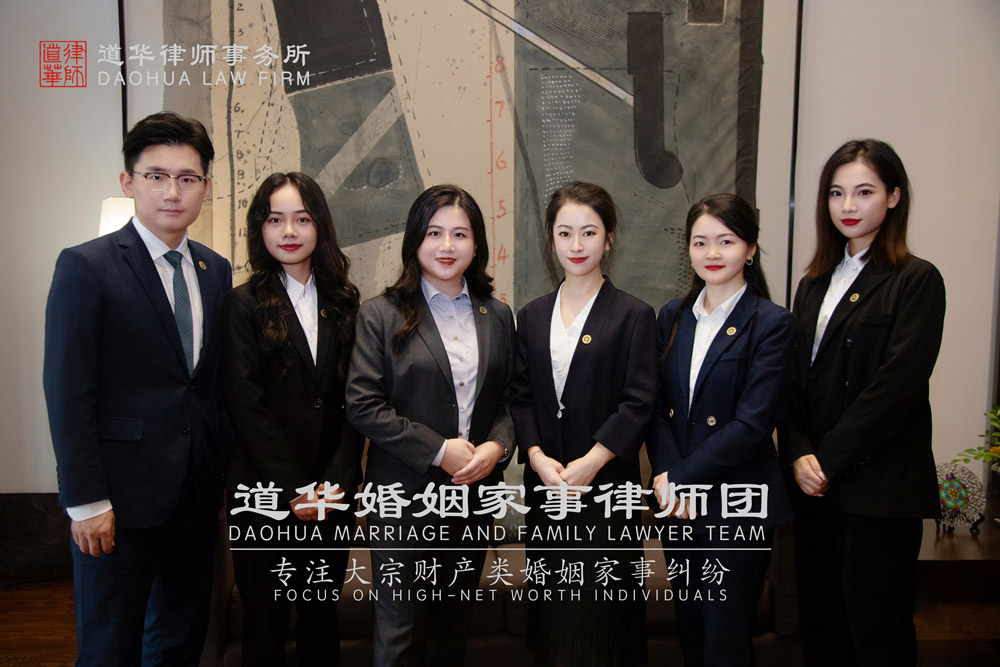
Daohua Family Law and Matrimonial Lawyers TeamTen years of focus on... marriage and family law services for bulk property, expert in marriage inheritance and family disputes (mediation/trial), is a...Shenzhen native]- One of the influential brands in marriage inheritance and wealth management legal services. TeamHandle over 1000 cases of marriage inheritance.In major complicated marriage and family matters,Succession inheritance disputeHe has extensive mediation and litigation experience in dispute resolution areas such as will drafting and family property distribution, is adept at handling difficult divorce property division cases involving Shenzhen small property rights houses, village committee shares, will drafting and notarization, and inheritance disputes, winning unanimous praise from clients.
Adhering to the philosophy of "ensuring property safety, preventing legal risks, and empowering wealth appreciation," we gather experts from industries such as law, banking, insurance, and finance tax, with rich successful cases. We provide a comprehensive package of solutions for marriage, family affairs, and wealth inheritance for high-net-worth individuals (including those from Hong Kong, Macau, and foreign nationals), to achieve the beautiful vision of risk prevention and control, debt isolation, and family wealth inheritance. Asset types cover: real estate (commercial housing, small property rights houses, land use rights, etc.), various property rights and interests (equity, debt, relocation compensation, copyright, invention patents, etc.). The team has completed the compilation of "Dahua Marriage and Inheritance Successful Cases Collection" and "Legal Practice of Family Wealth Inheritance," and both legal practice and theoretical research have achieved remarkable results.
No registration required, quick appointment, expert lawyers provide customized legal service solutions
 Consultation Appointment:400-829-6880
 Private Space:18126123723
 Law Firm: Guangdong Daohua Law Firm
 Email:DAOHUALAWMF@163.com
 Address:810, Rongchao Economic & Trade Center, 4028 Jintian Road, Futian District, Shenzhen (Next to Civic Center)

18126123723
Follow us anytime, anywhere


