
Navigation
Author: Dao Hua Marriage and Family Law FirmDate: 2022-05-02Reads:times

Introduction: A Beijing man passed away leaving behind a property, but his uncle, after repaying part of the mortgage, was unable to inherit the property. The court ruled that the civil affairs bureau should act as the executor of the estate? What legal knowledge is involved here? Attorney Dao Hua explains.
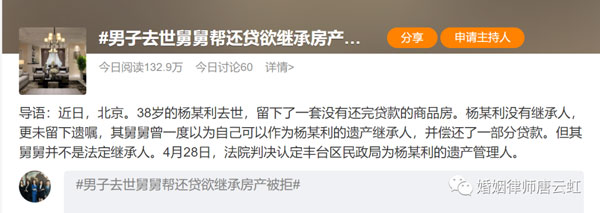
Case Summary
A 38-year-old man from Beijing named Yang died, leaving behind a commercial residential property with an outstanding mortgage. Yang's parents are both deceased, he is unmarried and has no children, no grandparents, and no siblings, and he has never left a will. This means, from a legal perspective, Yang has no heirs.
According to the report in the Beijing Daily, Yang purchased the house for 1.15 million yuan at the end of 2014, and applied for an 800,000 yuan public housing fund loan in March 2015. The loan was provided by the Shaoyaoju Branch of Bank of Beijing, and the Beijing Housing Loan Guarantee Center provided joint and several guarantees.
Yang Mou passed away in 2016. As he had no father or mother and no other direct relatives, his uncle thought he could be the heir to Yang Mou's estate and therefore repaid a portion of the loan. Later, as the Beijing Housing Loan Guarantee Center was the creditor of Yang Mou, the uncle approached the center hoping to transfer the house into his own name.
And from January 26, 2019, to November 22, 2019, the house failed to repay the loan in a timely manner for 10 consecutive periods. As a result, the Beijing Housing Loan Guarantee Center fulfilled its guarantee obligations and repaid the remaining principal, interest, and penalties. On November 22, 2019, the Beijing Housing Loan Guarantee Center paid RMB 76,000 plus, and thus the mortgage on the commercial housing was fully settled.
Subsequently, the Beijing Housing Loan Guarantee Center applied to Fengtai Court to have the Fengtai District Civil Affairs Bureau appointed as the executor of the estate of Yang.
April 28th, the court ruled that the Fengtai District Civil Affairs Bureau is the executor of the estate of Yang.
After the incident was reported, it sparked widespread discussion, with the inheritance management system once again attracting extensive attention.
What is an executor of an estate?
"The executor of the estate" is a new system added to the "Civil Code" that was implemented starting from January 2021, which highlights the function of managing property and can, to some extent, avoid issues that may arise in inheritance disputes.
Through the executor's management, distribution, and civil liability issues of the inherited property, to ensure the proper management, reasonable distribution, and debt repayment of the inheritance process, and better protect the interests of the heirs and creditors.
Why couldn't Yang's uncle inherit the house in the above case?
In accordance with the relevant provisions of the Civil Code, the inheritance in our country is divided into statutory inheritance andWill inheritanceAfter the deceased, if there is a legally valid will, the inheritance shall be distributed according to the will; if there is no will, it shall be inherited in accordance with the statutory inheritance order.
The order of legal inheritance is divided into the first inheritance order and the second inheritance order, with parents, spouse, and children belonging to the first order, while grandparents, great-grandparents, and siblings are listed as the second order. When there are no heirs in the first order, the property is inherited by the heirs in the second order. When the property of the deceased has no heirs, it belongs to the state and is used for public welfare purposes; if the deceased was a member of a collective ownership organization during their lifetime, it belongs to the collective ownership organization they belonged to.
In the above case, Yang某 did not make a will before his death, so the inheritance had to be handled according to the law. As the uncle is not a legal heir, he cannot inherit Yang某's property.
It is worth mentioning that the Civil Code mentions a "discretionary inheritance right," which refers to the right of people who were supported by the deceased but are not heirs, or those who supported the heirs more, to appropriately receive a portion of the deceased's inheritance. In other words, if Yang's uncle can prove that he has provided support to Yang, he can appropriately receive a portion of the inheritance.
Can a nephew inherit his uncle's estate if the situation is reversed?
The answer is acceptable. Article 1128, second paragraph of the Civil Code, adds the system of substituted succession. If the children of the deceased predecease the deceased, the direct descendants of the deceased children shall succeed in their place. If the siblings of the deceased predecease the deceased, the children of the deceased siblings shall succeed in their place.
According to this legal provision, for the nephews and nieces to succeed by substitution, three conditions must be met simultaneously: first, the deceased has no heirs in the first order, and the deceased children also do not have descendants to succeed by substitution; second, the deceased's siblings predeceased the deceased; third, the deceased's siblings and their children have not lost the right of inheritance.
From "executor" to "executor of the estate"
The executor of a will is a new concept added in the "Civil Code," whereas previously, according to Article 16 of the "Inheritance Law" (which has been abolished), there was an executor of the will.
Article 1145 of the Civil Code of the People's Republic of China stipulates that after the inheritance begins, the executor of the will shall act as the executor of the estate; if there is no executor, the heirs shall promptly elect an executor of the estate; if the heirs fail to elect, the executor of the estate shall be jointly held by the heirs; if there are no heirs or all the heirs renounce the inheritance, the executor of the estate shall be appointed by the civil affairs department or the village committee at the deceased's place of residence before death.
Executors and administrators are two different concepts. Assuming that someone is appointed as the executor before the deceased passes away, then after the deceased's death, this executor becomes the administrator of the estate. Of course, there are also situations where there is no executor specified in the will, no heirs exist, or all heirs renounce their inheritance.
In the aforementioned case, Yang's situation falls under the situation where "there is no heir, and the civil affairs department of the deceased's place of residence before death acts as the executor of the estate."
After the civil affairs department becomes the executor of the estate, how will it handle the house?
The most concerned issue among everyone should be how the Fengtai District Civil Affairs Bureau, as the executor of Yang's estate, will handle Yang's property? This involves how the executor manages the estate.
Article 1147 of the Civil Code of the People's Republic of China: The executor of the estate shall perform the following duties:
(1) Clear up the inheritance and make an inventory of the inheritance.
(2) Report the estate situation to the heir;
(Take necessary measures to prevent the damage and loss of heritage.)
(4) Handling the deceased's liabilities and debts.
(Five) Divide the inheritance according to the will or as stipulated by law.
(Six) Implementing and managing other necessary actions related to heritage.
Then, in the above case, if the Civil Affairs Bureau takes over a house with an outstanding loan, it should first help him repay the debt. Since the Beijing Housing Loan Guarantee Center has fulfilled its guarantee obligation and repaid the loan in full, the Civil Affairs Bureau, as the executor of the estate, should fulfill its repayment obligation to the center. Moreover, as Yang's uncle had repaid part of the loan, the Civil Affairs Bureau should also return that part of the loan to the uncle. If there is still an outstanding loan after the above debt is settled, it shall belong to the state and be used for public welfare.
At the same time, the Civil Code also stipulates the responsibilities and remuneration of the executor of the estate.
Article 1148 of the Civil Code of the People's Republic of China: The executor of the estate shall perform its duties in accordance with the law. If it causes damage to the heirs, legatees, or creditors due to intentional or gross negligence, it shall bear civil liability.
Article 1149: The executor of an estate may receive remuneration in accordance with the law or as agreed upon.
No registration required, quick appointment, expert lawyers provide customized legal service solutions
 Consultation Appointment:400-829-6880
 Private Space:18126123723
 Law Firm: Guangdong Daohua Law Firm
 Email:DAOHUALAWMF@163.com
 Address:810, Rongchao Economic & Trade Center, 4028 Jintian Road, Futian District, Shenzhen (Next to Civic Center)

18126123723
Follow us anytime, anywhere


