
Navigation
Author: Dao Hua Marriage and Family Law FirmDate: 2025-03-06Reads:times
I. Review of the Case
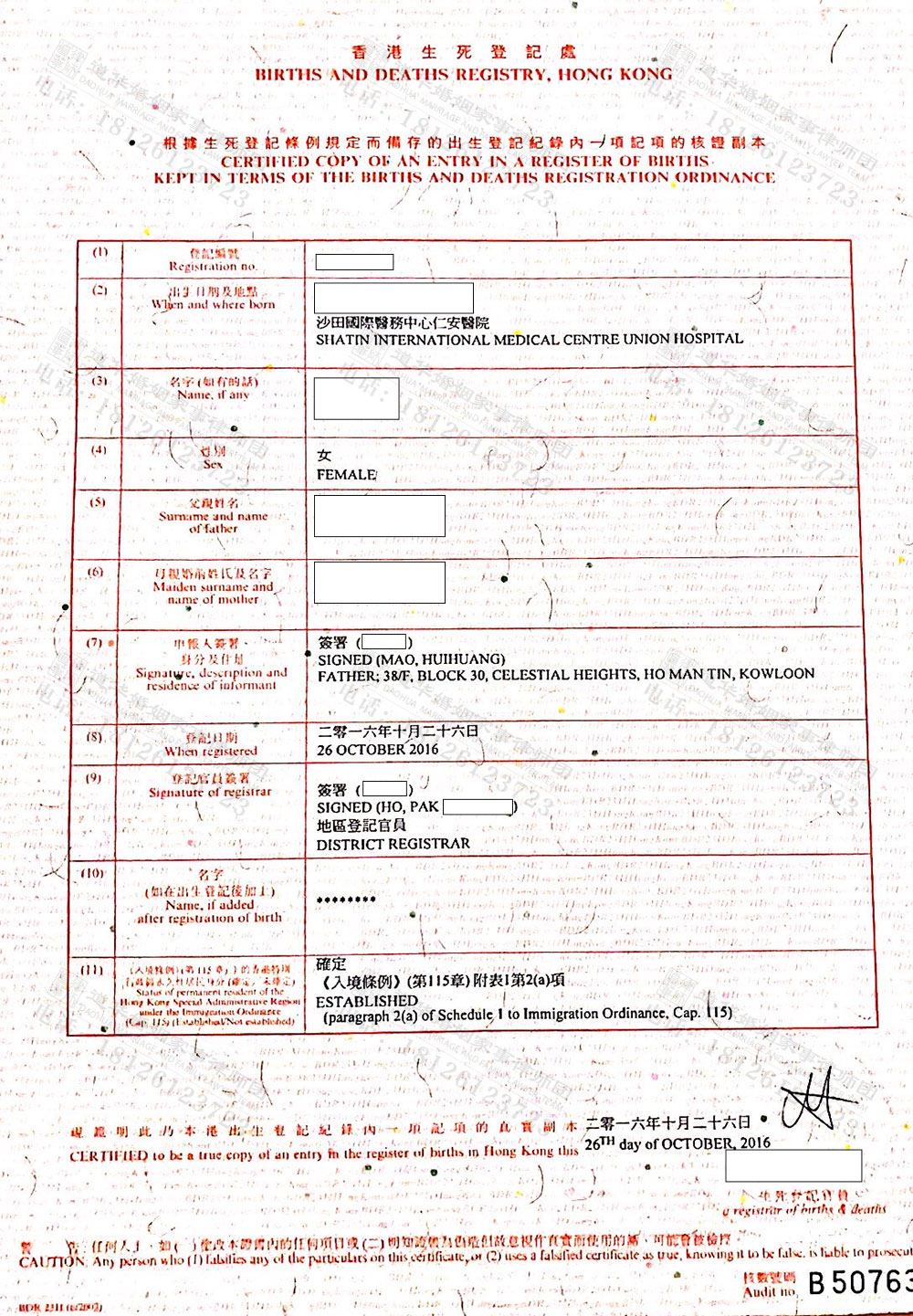
In 2008, Ms. Wei and Mr. Zhang registered their marriage at a marriage registration office in Hong Kong shortly after they met. After marriage, Mr. Zhang engaged in business outside the home, while Ms. Wei resigned from her job to take care of the family and assist Mr. Zhang in managing the business during her free time. Later, they each had a daughter in 2011 and 2016. However, as time went by, the happiness and sweetness of their marriage at the beginning had faded away, and the trivial matters of the family gradually eroded the fragile foundation of their marriage. By 2018, Ms. Wei had moved with her two daughters to Longgang District, Shenzhen, while Mr. Zhang remained settled in Hong Kong, and they had been separated since then.
Seeing that the long-term separation had been unable to repair their feelings, Ms. Wei repeatedly approached Mr. Zhang to propose handling the divorce procedures, but Mr. Zhang always delayed and never positively responded to the divorce matter. In order to quickly conclude this unhappy marriage, Ms. Wei actively sought a way out and, after learning that the Daohua Family Law Firm specializes in handling divorce disputes, decided to entrust the matter entirely to Ms. Tang Yunhong, who would handle the divorce matter on her behalf. After fully understanding Ms. Wei's case, Ms. Tang proposed a strategy of "mediation as the main approach, litigation as the auxiliary approach" and made every effort to properly resolve Ms. Wei's divorce difficulties.
II. Daohua Lawyer Accepts the Trust, Conducts a Comprehensive Analysis of the Case, and Quickly Identifies the Disputed Issues:
1. Since both parties registered their marriage in Hong Kong and Mr. Zhang currently resides in Hong Kong, which court should Ms. Wei file for divorce litigation?
2. Are the parties currently eligible for divorce under the statutory conditions?
3. How should the joint property and debts of the marriage during its existence be handled?
4. How should the custody and child support for the two legitimate daughters be allocated and borne?
III. Daohua Lawyer Analyzes the Case, Seeks Solutions for the Disputed Issues, and Lays a Solid Foundation for Subsequent Negotiation and Communication with Mr. Zhang, Ultimately Reaching an Agreement on Mediation Divorce.
1. The court with jurisdiction for the divorce litigation should be the Longgang District People's Court, where Ms. Wei is registered.
According to Article 22 of the Civil Procedure Law of the People's Republic of China, "Civil actions against citizens shall be heard by the people's court at the defendant's place of residence; if the place of residence of the defendant is not the same as the place of habitual residence, the people's court at the place of habitual residence shall have jurisdiction." In this case, civil actions against citizens must be filed with the people's court at the defendant's place of residence. Since Mr. Zhang is a resident of Hong Kong, if this provision is applied, the case would need to be filed with the Hong Kong court.
But in fact, although Mao is a resident of the Hong Kong Special Administrative Region and the two were married at a marriage registration office in Hong Kong, Wei's current place of habitual residence is in Longgang District, Shenzhen. According to Article 22 of the "Civil Procedure Law of the People's Republic of China" “The following civil actions shall be subject to the jurisdiction of the people's court at the place of residence of the plaintiff; if the place of residence of the plaintiff is not the same as the place of habitual residence, the people's court at the place of habitual residence of the plaintiff shall have jurisdiction: (1) actions concerning personal relationships against persons residing outside the territory of the People's Republic of China” and Article 15 of the "Interpretation of the Supreme People's Court on the Application of the Civil Procedure Law of the People's Republic of China" “If one party of a Chinese citizen resides abroad and the other party resides within the territory of the People's Republic of China, regardless of which party files a divorce action with the people's court, the people's court at the place of residence of the domestic party shall have jurisdiction.”, where the plaintiff has a Shenzhen household registration or the place of habitual residence is Shenzhen, and the defendant is a Hong Kong citizen, whether they were married in Hong Kong or on the mainland, if the plaintiff wishes to file for divorce in Shenzhen, the Shenzhen court can accept the case, therefore, the case can be filed with the people's court at the place of habitual residence of Wei, that is, the Longgang District People's Court.2、Since 2018, Wei and Mr. Zhang have been separated for two years, satisfying the statutory conditions for divorce.
According to Article 1079 of the "Civil Code of the People's Republic of China" “In any of the following circumstances, where reconciliation fails, divorce shall be granted: ……(4) separation due to irreconcilable differences for a period of two years……”. In this case, Wei has been living in Longgang District, Shenzhen since 2018, so the lawyer Dao Hua guided Wei to obtain her "Shenzhen Special Economic Zone Residence Registration Inquiry Form", successfully obtained the inquiry form by applying to the "Shenzhen Public Security" official account, which clearly states that Wei has been living in Longgang District, Shenzhen since 2018, and Mr. Zhang is a resident of the Hong Kong Special Administrative Region and is still doing business in Hong Kong, which can preliminarily prove that the two have been separated for two years and the separation is not due to unavoidable reasons such as work, and the two have met the statutory conditions for divorce due to irreconcilable differences for a period of two years.
3、How to handle the joint property of the couple and the debts incurred during the marriage:
Over the ten years of their marriage, the main joint property of the couple is the residential property purchased in 2010 in a certain community in Longgang District, Shenzhen, which is registered in Wei's name, and the monthly mortgage payments are transferred out of the bank account in Wei's name; the debts include the 5 million Hong Kong dollars loan taken by Mr. Zhang in his own name from a bank in 2019, as well as the mortgage loan in Wei's name.
Regarding the property: Since the property is a joint debt of the couple, it is necessary to divide the property. As the property is registered in Ms. Wei's name, the purchase contract and the loan contract were both signed in her name, and the monthly mortgage payments were paid from the bank account in her name. Therefore, for this property, if both parties are fighting for ownership of the property, the court is likely to rule that the property belongs to Ms. Wei, but Ms. Wei will need to compensate Mr. Zhang for the paid mortgage amount and the corresponding increase in property value.
Regarding the debt: Since the debt under Mr. Zhang's name arose during the marriage, the court may possibly determine that both parties bear half of the responsibility, but this debt arose in 2019, that is, after the two had separated, and there has been no financial transaction between them since then. It is particularly difficult to determine whether the debt was used for the couple's daily life needs. Ms. Wei has a certain chance of winning the case without bearing the debt. As for the mortgage loan under Ms. Wei's name, it is generally borne by the owner of the property.
4. Custody and child support of the legitimate daughter:
Article 1084 of the Civil Code of the People's Republic of China stipulates that "after divorce, children under the age of two shall be primarily cared for by the mother. For children over two years old, if the parents cannot reach an agreement on custody, the People's Court shall decide according to the specific circumstances of both parties, in accordance with the principle of the greatest benefit to the minor children. If the child is over eight years old, their real wishes shall be respected." In this case, the elder daughter of the two has already turned eight years old, and the court will inquire about her preference for living with one party and respect her real wishes. The younger daughter is five years old, and the court will make a judgment according to the principle of the greatest benefit to her life, in accordance with the law.
Since 2018, the two daughters have been living with Ms. Wei in Longgang District, Shenzhen, and have long been accustomed to Ms. Wei's and the Shenzhen lifestyle. The elder daughter also wishes to live with Ms. Wei, so Ms. Wei has a high possibility of winning the custody of both children. As for child support, the court will make a judgment after considering both parties' economic conditions and living areas.
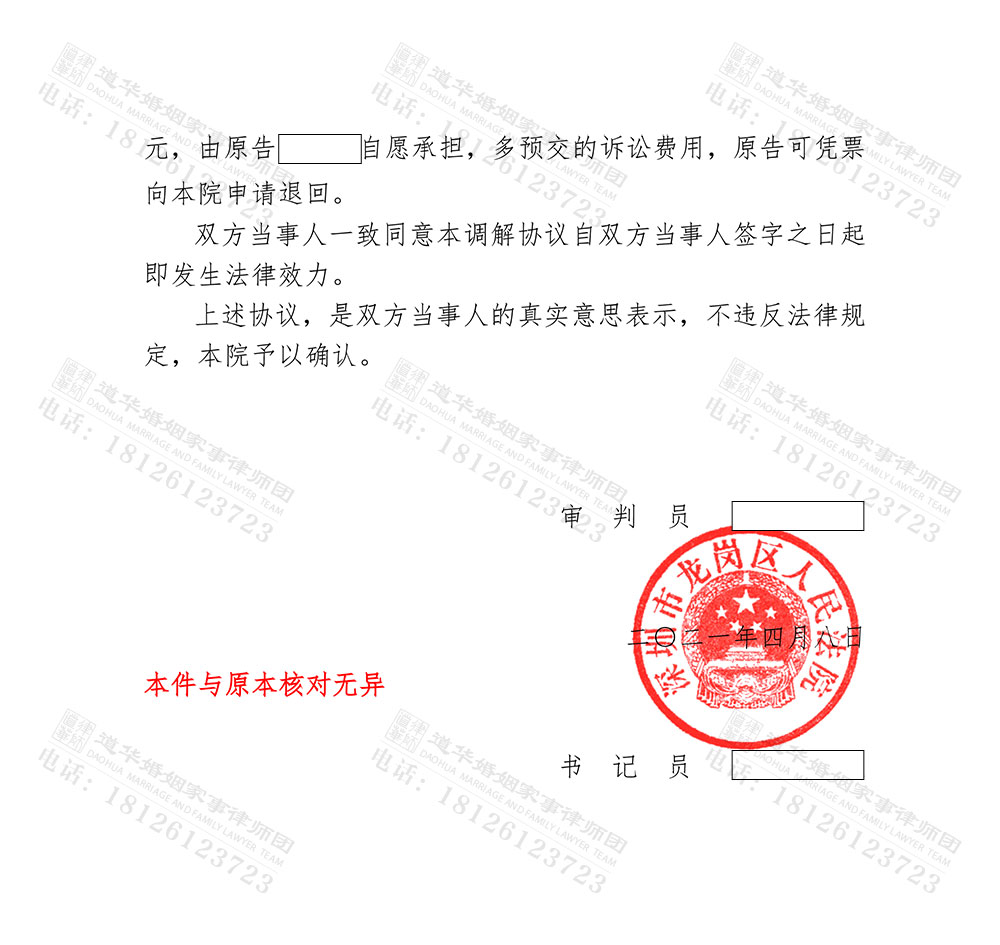
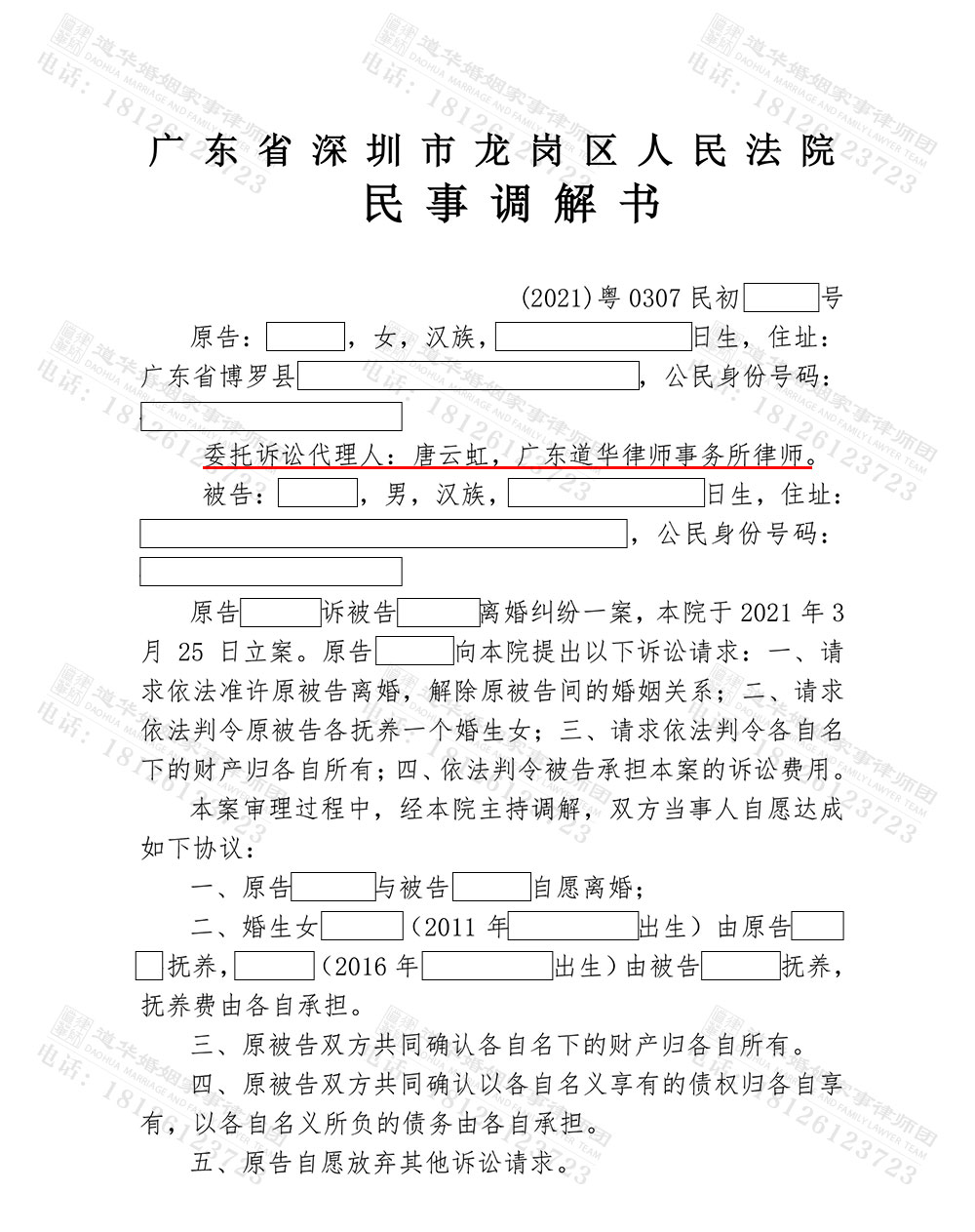
Four, Dahu Law Firm has always adhered to the litigation strategy of "mediation first, litigation as a supplement." While filing a lawsuit with the Longgang Court, the firm actively communicated and negotiated with Mr. Zhang. After several rounds of communication and negotiation, the two parties successfully reached an agreement, and the court issued a civil mediation document, resolving this dispute smoothly within three months.
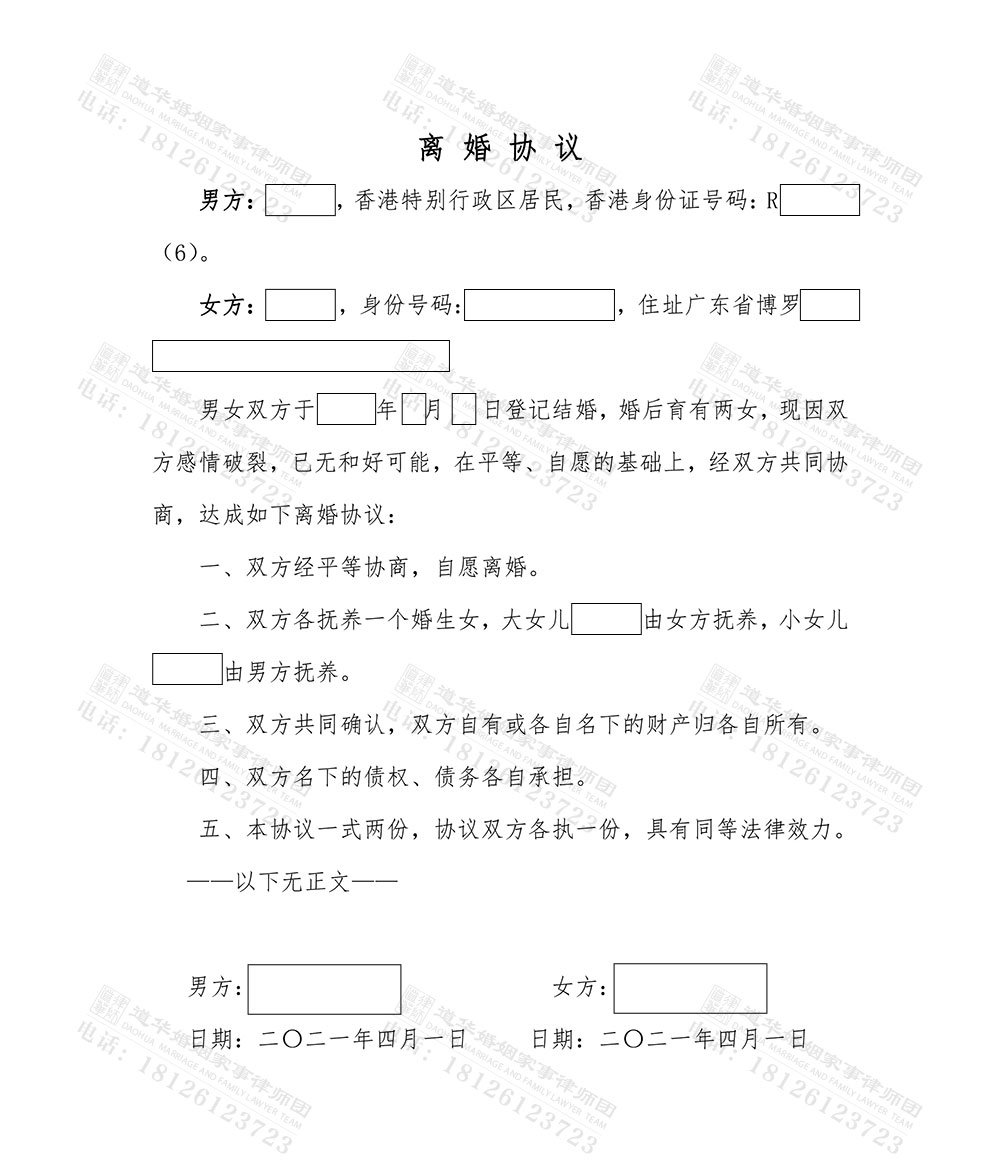
After accepting Ms. Wei's委托, Dahu Law Firm, with its rich experience in resolving marital and family disputes, comprehensively analyzed and assessed the focal points of the dispute in this case and proposed a response plan accordingly. By engaging in multiple negotiations with Mr. Zhang, the firm successfully reached an agreement on issues such as the division of property, debt, and child custody between the two parties:
登记在韦女士名下的房产归韦女士所有,后续的购房贷款由韦女士自行承担,韦女士无需向张先生支付补偿款项,至于张先生于2019年贷款的港币500万元,未用于夫妻共同生活,且未交付给韦女士,双方在2018年以后亦无任何款项往来,故该债务由张先生自行承担,与韦女士无关。对于两名婚生女,则双方约定由韦女士抚养大女儿,张先生抚养小女儿,抚养费各自承担。
简而明之,即各自名下的财产归各自所有,以各自名义享有的债权归各自享有,以各自名义所负的债务由各自承担。自此,韦女士的离婚案件得以快速解决,道华律师成功为韦女士争取了最大化权益,超额完成了韦女士的诉讼预期。
五、唐律说法
婚姻家事案件中,处理的不仅仅是夫妻关系,更多的是涉及夫妻财产、债权债务以及子女的抚养权等各项内容,以及过往的夫妻情分,往往非一纸法律文书所能承载的。因此,道华婚姻家事律师团始终坚持“调解为主的,诉讼为辅”,尽可能促使夫妻双方调解离婚,毕竟婚姻不易,且行且珍惜,但如果离婚已成定局,不若双方各退一步,海阔天空。
本案中,道华婚姻家事律师团经过综合评估,即认为二者是存在调解的可能性的,因而在充分分析案件争议焦点后,以韦女士代理人的身份,多次与张先生进行协商沟通,向其陈明案件诉讼中,双方可能存在的风险,以及韦女士自身的想法、对孩子未来的考虑等等,成功说服张先生接受调解,并在就调解方案磋商过程中,充分运用自身对婚姻家事案件的纠纷处理经验,成功为韦女士争取了最大化利益,超额完成了韦女士的诉讼目的。
唐律师认为,离婚是夫妻感情破裂的结果,涉及财产分割,债务划分以及子女抚养等多方法律关系,调解这一柔性解决冲突的方式,不仅能够深入了解对方诉求,也能平和解决二人矛盾,让这段不完美的感情画上一个完美的句号。本案的成功调解,也顺利地解决了困扰韦女士多年的离婚难题,快速地处理这一问题,也能够让韦女士及张先生迈入新的生活,积极追求属于自己的幸福生活。
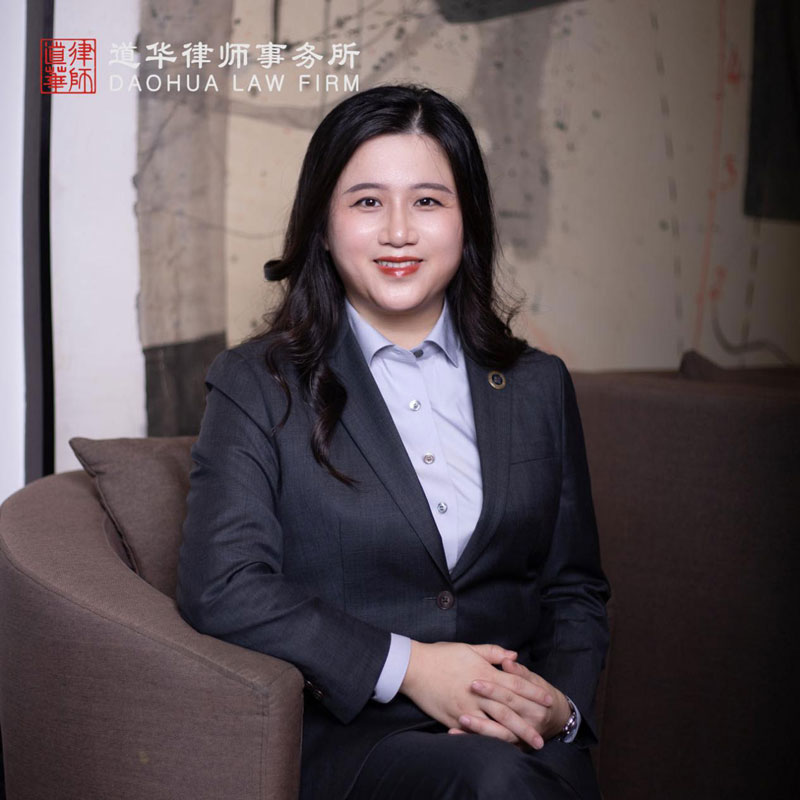
(唐云虹律师)
六、法条指引
1、《民法典》
Article 22 The following civil lawsuits shall be under the jurisdiction of the people's court at the place of residence of the plaintiff; if the place of residence of the plaintiff is not the same as the place of habitual residence, the people's court at the place of habitual residence of the plaintiff shall have jurisdiction:
(1) Litigations concerning personal status matters against persons residing outside the territory of the People's Republic of China;
(2) Litigations concerning personal status matters against persons who are missing or declared missing;
(3) Litigations against persons subjected to compulsory education measures;
(4) Litigations against persons who are imprisoned.
2., Civil Code
Article 1079 The party of a marriage may seek divorce by mediation by relevant organizations or by directly filing a divorce lawsuit with the people's court.
When the people's court tries a divorce case, it shall conduct mediation; if the marriage has indeed broken down and mediation is ineffective, the divorce shall be granted.
Where any of the following circumstances exist, the divorce shall be granted if mediation is ineffective:
(1) Bigamy or cohabitation with another person;
(2) Implementation of domestic violence or abuse, abandonment of family members;
(3) Habitual indulgence in vices such as gambling and drug abuse, despite repeated correction;
(4) Separation due to lack of harmony in feelings for a full two years;
(5) Other circumstances that lead to the breakdown of the marriage.
Where one party is declared missing and the other party files a divorce lawsuit, the divorce shall be granted.
Where the people's court has ruled that the divorce shall not be granted and the parties are separated again for a full year, and one party files a divorce lawsuit again, the divorce shall be granted.
3., Interpretation of the Supreme People's Court on the Application of the Civil Procedure Law of the People's Republic of China
Article 15 Where one party of a Chinese citizen resides abroad and the other party resides domestically, regardless of which party files a divorce lawsuit with the people's court, the people's court at the place of residence of the domestic party shall have jurisdiction.
4., Civil Code
Article 1084 After divorce, the custody of a child under two years of age shall, as a principle, be with the mother. For a child who is two years of age or older, if the parents cannot reach an agreement on the issue of custody, the people's court shall decide according to the specific circumstances of both parties, in accordance with the principle of what is most beneficial to the minor child. If the child is over eight years of age, his or her real wishes shall be respected.
No registration required, quick appointment, expert lawyers provide customized legal service solutions
 Consultation Appointment:400-829-6880
 Private Space:18126123723
 Law Firm: Guangdong Daohua Law Firm
 Email:DAOHUALAWMF@163.com
 Address:深圳市福田区金田路4028号荣超经贸中心810(市民中心旁)

18126123723
Follow us anytime, anywhere


