
Navigation
Author: Dao Hua Marriage and Family Law FirmDate: 2024-10-24Reads:times
Introduction: Ms. Zhang and Mr. Lu were registered as married in Hunan in 2001 and had a son after marriage. Due to work requirements, both Ms. Zhang and Mr. Lu moved to Shenzhen together after marriage. However, due to personality incompatibilities, they often had arguments and conflicts kept escalating. Finally, Ms. Zhang even discovered that Mr. Lu had engaged in extramarital affairs, which seriously violated morality and completely destroyed the couple's emotional bond, leading Ms. Zhang to firmly demand a divorce from Mr. Lu. But Mr. Lu repeatedly refused to divorce, citing that the child had not yet settled down as the reason, which exhausted Ms. Zhang physically and mentally, forcing her to resort to legal means to end this marriage. In this situation, Ms. Zhang sought legal assistance from the Daohua Family Law Firm, hoping to resolve all issues between the couple at once. After Tang Yunhong, a lawyer from the Daohua Family Law Firm, intervened, she helped Ms. Zhang solve the divorce difficulties through mediation and litigation, and smoothly dissolved the marital relationship.
Keywords: Divorce Dispute, Divorce Property Division, Marriage Lawyer, Divorce Mediation

One, Case Review
Ms. Zhang and Mr. Lu were registered as married in Hunan in 2001 and had a son after marriage. Due to work requirements, both Ms. Zhang and Mr. Lu moved to Shenzhen together after marriage. However, due to personality incompatibilities, they often had arguments and conflicts kept escalating. Finally, Ms. Zhang even discovered that Mr. Lu had engaged in extramarital affairs, which seriously violated morality and completely destroyed the couple's emotional bond, leading Ms. Zhang to firmly demand a divorce from Mr. Lu. But Mr. Lu repeatedly refused to divorce, citing that the child had not yet settled down as the reason, which exhausted Ms. Zhang physically and mentally, forcing her to resort to legal means to end this marriage.
After Ms. Zhang searched online, she found that the Daohua Family Law Firm had a large number of similar successful cases and had rich experience in marriage cases. Therefore, Ms. Zhang came to the law firm to seek legal assistance, hoping to resolve all issues between the couple at once.
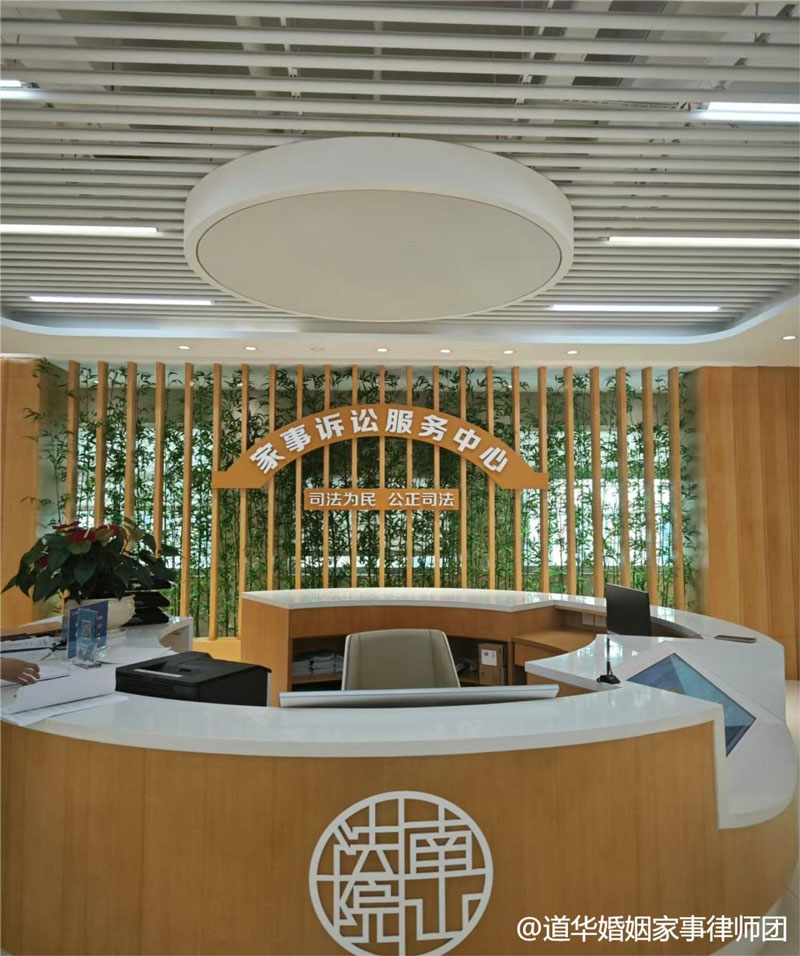
Two, The Case Involves Multiple Issues Such as Property Division, Asset Distribution, and Debt Assumption, Making the Case Complex and Both Parties Have Great Disputes.
1. The Male Party Clung to Divorce Refusal, Apparently Worrying About Property Division.
After accepting Ms. Zhang's委托, the Daohua marriage lawyer thoroughly understood the parties' marital situation and found that Ms. Zhang had communicated with the male party about the divorce matter more than once. The male party had always refused to divorce for the sake of the child. However, after investigation, the Daohua lawyer found that Ms. Zhang's son was now an adult and was studying at a university in another city, not living with the couple, and the divorce would not have a significant impact on the child. Moreover, the couple had been separated for a long time due to the divorce matter for over two years, and their feelings had completely broken down. 针对男方拒绝离婚这一情况,道华婚姻律师制定专业法律服务方案,离婚协议,调解离婚、诉讼离婚,多方面多层次着手准备。力求为当事人解决婚姻问题。
2、夫妻共同财产繁多、种类复杂,道华律师详细统计。
夫妻双方在婚姻存续期间共同出资在惠州、东莞分别购买不动产房屋二套,在湖南老家还共同建造房屋一套,婚后还购买了汽车一辆。夫妻双方各自名下还有银行存款若干,张女士还购买了大量的基金股票与理财保险。男方名下财产张女士并不了解,这为男方多分张女士财产而自己转移、隐匿夫妻共同财产的风险大大提高。
3、男方在外存在大量债务,存在与男方共同承担债务风险。
通过和张女士了解,男方有赌博的恶习,长期参与赌博活动,在外有大额赌债,因为两人长期分居,张女士对男方具体的债务情况也不清楚。在前期与男方协商离婚的过程中,男方曾以此威胁张女士,如果张女士坚持要求离婚,那么将和男方一起还债,要将赌债分割给张女士。
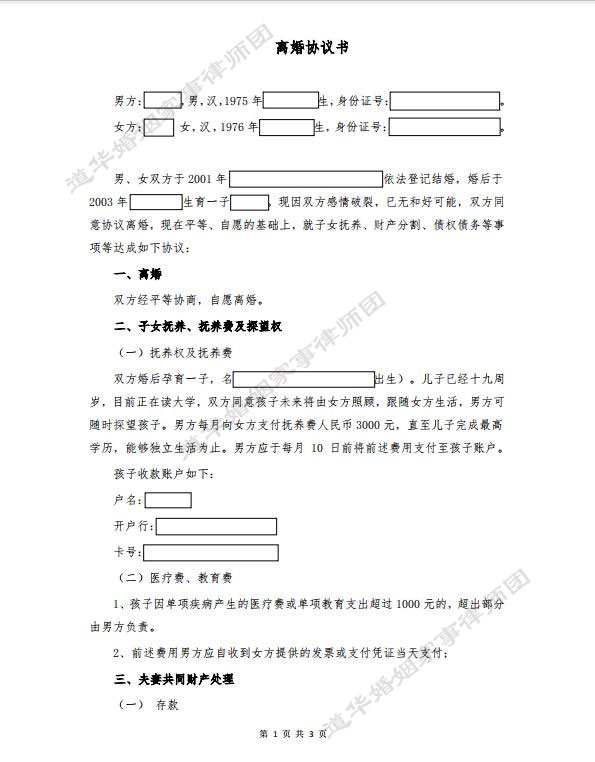
三、道华律师制定专业离婚方案,详细整理夫妻共同财产,多手段协助当事人达成离婚目的。
1、道华律师通过对张女士提供的财产信息对张女士的婚前个人财产及其掌握的夫妻共同财产进行了详细的梳理,对于张女士未掌握的男方财产信息,道华婚姻律师向法院提交调查取证申请书和律师调查令申请书,将张女士不了解的男方财产也进行调取,为当事人做到夫妻共同财产公开化,透明化,有效地遏制了男方隐匿、转移夫妻共同财产的可能性。
2、道华律师为张女士起草离婚协议书,先以沟通调解为主,希望在法庭外解决双方离婚事宜,避免夫妻双方在法庭上“剑拔弩张”,引发不必要的争端,在道华律师的沟通调解下,男方同意了离婚女方的离婚诉求,并在道华律师的陪同下一同前往了婚姻登记处办理离婚手续,在进行登记后,婚姻登记机关给了夫妻双方离婚冷静期,在冷静期后再到婚姻登记处签署离婚协议。
3、婚姻冷静期到期后,男方又反悔拒绝离婚。在此情况下道华律师果断采取诉讼手段,向深圳市南山区人民法院提交诉讼材料,起诉要求与男方解除婚姻关系,并且要求分割夫妻共同财产。将先前整理的详细的夫妻共同财产情况提交法院,为后续分割夫妻共同财产提供了坚定的证据基础。
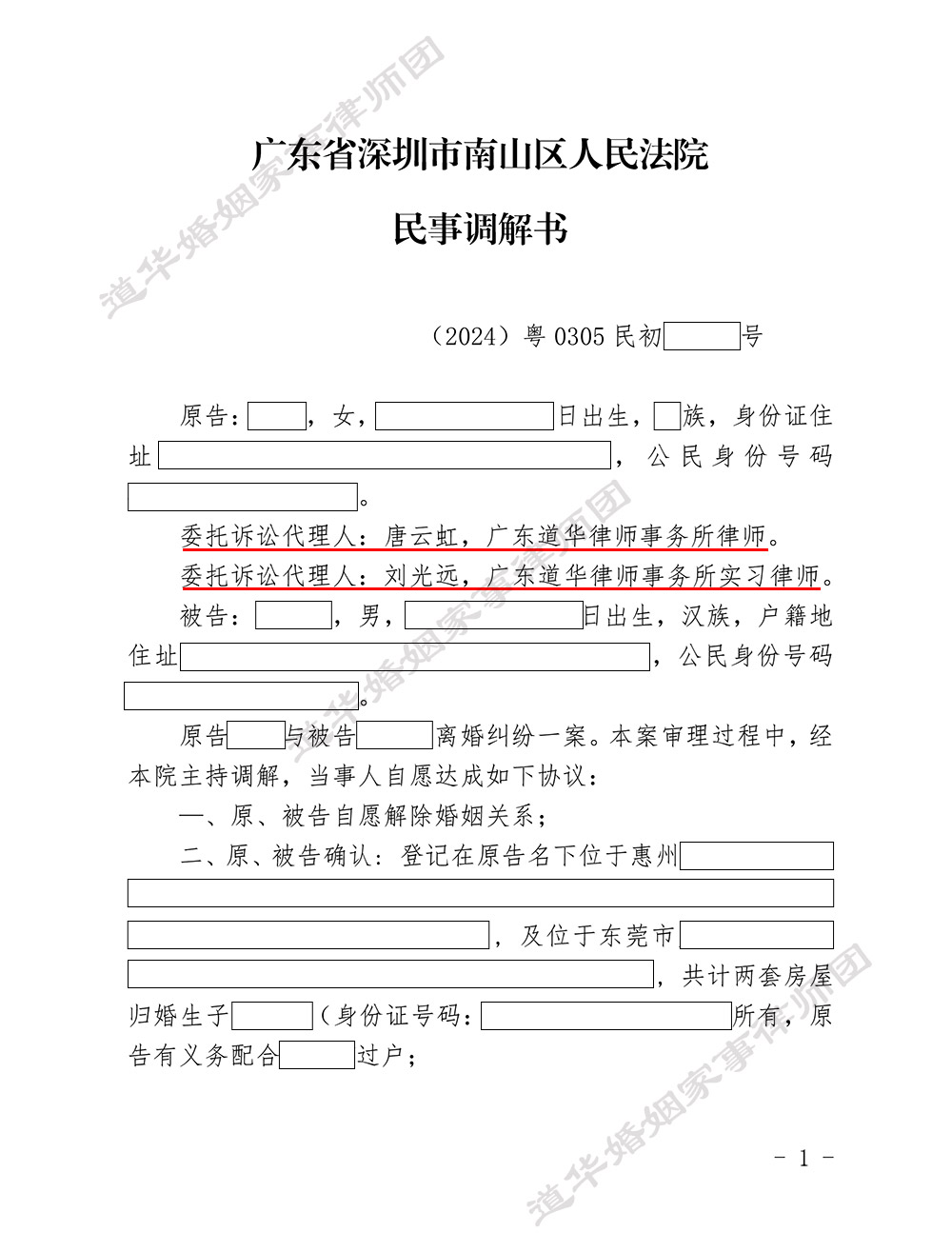
Four, with the assistance of Dahu Law Firm, the parties' litigation claims were realized, and the marriage relationship was successfully dissolved.
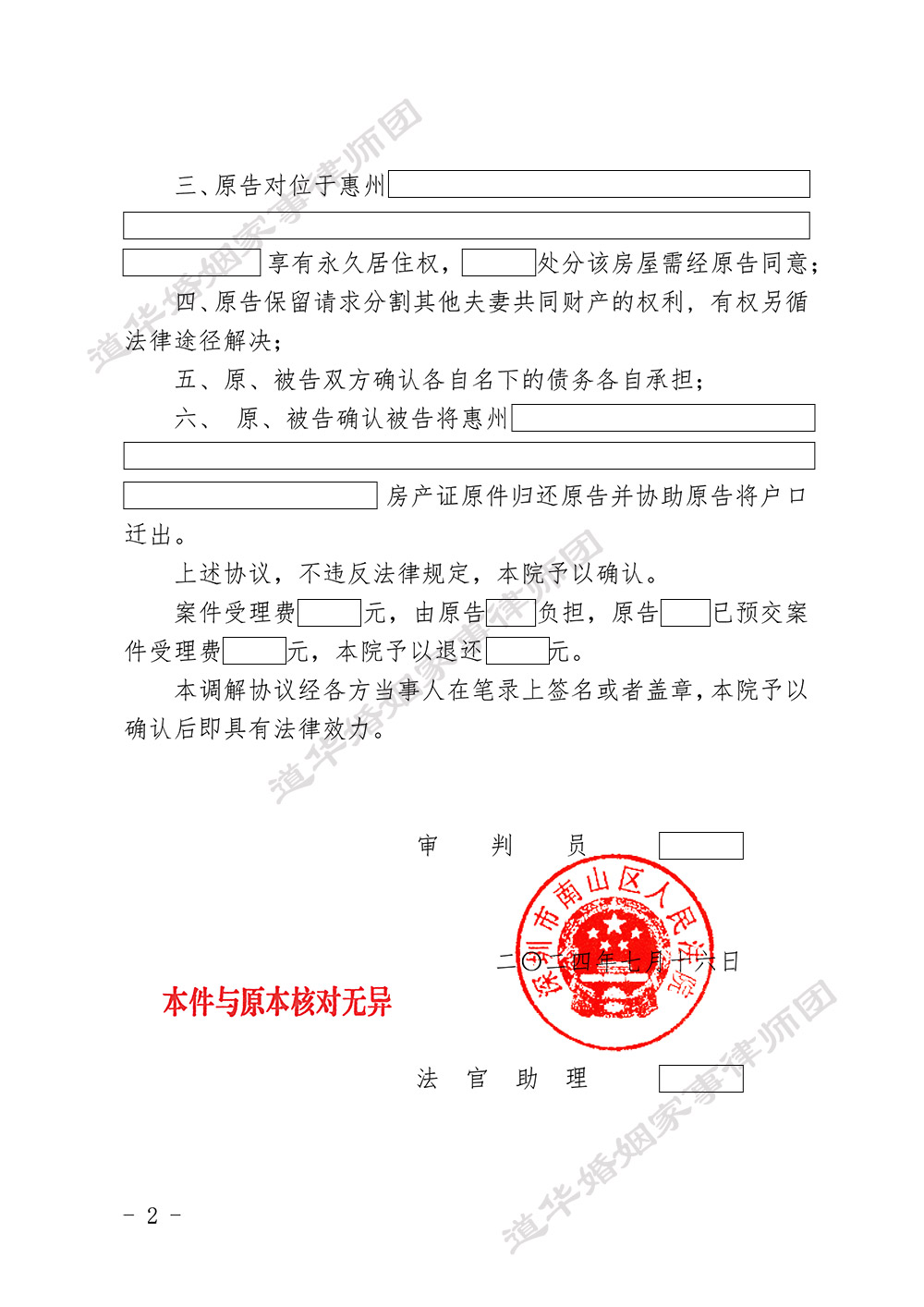
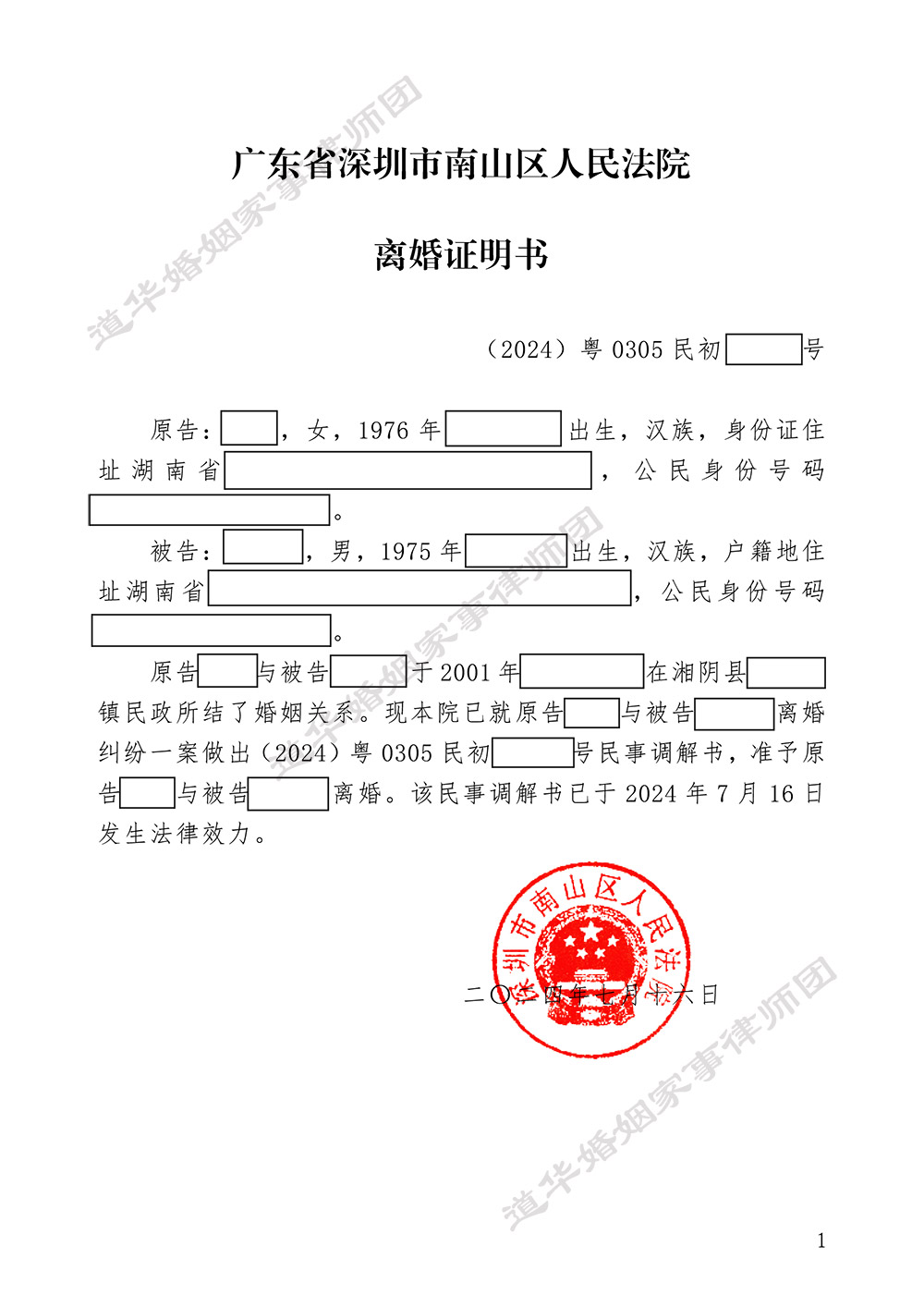
During the trial, under the mediation of the judge and the Dahu family law attorney, Ms. Zhang ultimately reached an agreement with the male party on the divorce matter and property distribution. In this case, the judge issued a "Civil Mediation Document" for both parties to sign and confirm. The next day, the "Divorce Effective Certificate" was delivered to both parties. With the help of Dahu Law Firm, the parties successfully dissolved the marriage relationship, perfectly meeting the parties' claims.
Five, Tang Law Explanation
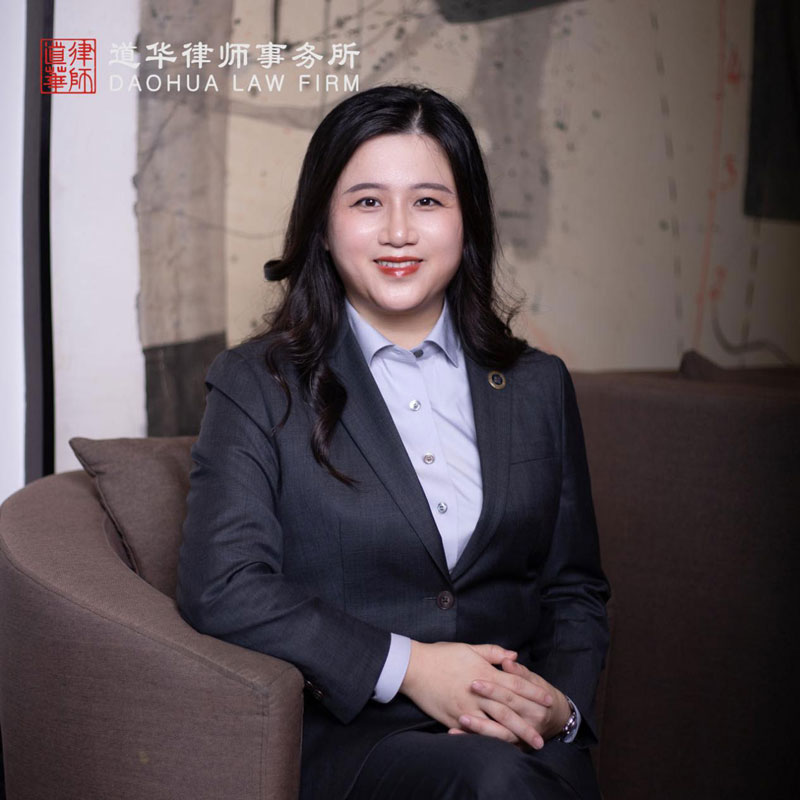
The Dahu family law team specializes in large property family disputes, proficient in handling disputes involving more than 10 million yuan in marriage and family matters. The lead attorney, Tang Yunhong, has been deeply involved in marriage and family legal services for ten years, skilled in comprehensively utilizing mediation, litigation, and other methods to resolve marriage and family disputes and alleviate family conflicts.
Tang Yunhong attorney points out:
Regarding the issue of joint liabilities of married couples, the "Civil Code" has appropriately increased the review obligations of creditors and the spouses who incurred the debts in order to balance the interests of creditors and the spouses who incurred the debts, and has made reasonable provisions for the recognition of joint liabilities of married couples. The basic principle of debt repayment at the time of divorce as stipulated by the "Civil Code" is: joint liabilities of married couples shall be repaid jointly, and personal liabilities shall be repaid by the individual. Joint liabilities of married couples shall be repaid first from the joint property, and the remaining joint property shall be divided between both parties after the repayment is completed. If the joint property is insufficient to repay the joint liabilities, the repayment shall be agreed upon by both parties; if the agreement cannot be reached, the People's Court shall make a judgment based on the economic capabilities of both parties. There is also another situation where, if the married couple agrees to have separate ownership of property after marriage, the joint liabilities shall be repaid by agreement of both parties, and if the agreement cannot be reached, the People's Court shall make a judgment.
In light of the circumstances of this case, the male party threatened Ms. Zhang with gambling debts, claiming that he wanted to split the gambling debts with Ms. Zhang and demanded that they repay them together. It needs to be clarified that joint liabilities of married couples refer to debts incurred for the daily needs of the family, mainly debts incurred within the scope of daily household agency, and the gambling debts of the male party in this case clearly do not fall within this scope and should not be jointly repaid by the female party.
Five, Index of Relevant Laws and Regulations
1. Article 1064 of the Civil Code of the People's Republic of China stipulates: "Debts incurred through joint signatures by both spouses or subsequent recognition by one spouse, as well as debts incurred by one spouse in the name of the individual for the needs of family daily life during the marriage, are considered joint debts of the couple.
Debts incurred by one spouse in the name of the individual that exceed the needs of family daily life during the marriage are not considered joint debts of the couple; however, this does not apply if the creditor can prove that the debt was used for the couple's joint life, joint business operations, or based on a joint intention expressed by both spouses."
2. Article 1066 of the Civil Code of the People's Republic of China provides: "During the marriage, if any of the following circumstances occur, one spouse may apply to the People's Court for the division of joint property:
(i) One spouse has engaged in serious acts of concealment, transfer, sale, destruction, squandering, or falsification of joint property of the couple, or has incurred joint debts in a fraudulent manner, thereby severely damaging the joint property interests of the couple;
(ii) One spouse has a legal obligation to support a person who is suffering from a serious illness and requires medical treatment, but the other spouse does not agree to pay the relevant medical expenses."
3. Article 1084 of the Civil Code of the People's Republic of China states: "After divorce, for children under the age of two, custody by the mother is the principle. For children who are two years of age or older, if the parents cannot reach an agreement on custody, the People's Court shall decide according to the specific circumstances of both parties, in accordance with the principle of what is most beneficial to the minor children. If the child is over eight years old, their real wishes should be respected."
4. Article 1079 of the Civil Code of the People's Republic of China provides: "If one spouse requests a divorce, mediation may be conducted by relevant organizations or the divorce lawsuit may be filed directly with the People's Court. The People's Court shall mediate in divorce cases; if it is determined that the feelings have indeed broken down and mediation is ineffective, the divorce should be granted. In any of the following circumstances, if mediation is ineffective, the divorce should be granted:
(i) Bigamy or cohabitation with another person;
(ii) The implementation of domestic violence or abuse, or abandonment of family members;
(iii) Habitual and unrepentant bad habits such as gambling or drug use;
(iv) Separation due to lack of harmony for a full two years;
(v) Other circumstances that lead to the breakdown of the couple's feelings.
If one spouse is declared missing and the other files for divorce, the divorce should be granted. If the People's Court rules that the divorce should not be granted and the parties separate again for a full year, and one spouse files for divorce again, the divorce should be granted."
5. Article 16 of the Interpretation of the Civil Procedure Law states: "If both parties are Chinese citizens living abroad but have not settled down, and one party files for divorce with the People's Court, the jurisdiction should be with the People's Court at the original place of residence of the plaintiff or the defendant."
Article 145 of the Interpretation of the Civil Procedure Law states: "The People's Court shall mediate in civil cases according to the principles of voluntariness and legality. If one party or both parties insist on not mediating, a judgment should be made promptly. The People's Court shall mediate in divorce cases, but should not drag out the mediation process indefinitely."
Seven, Introduction to the Marriage and Family Law Team
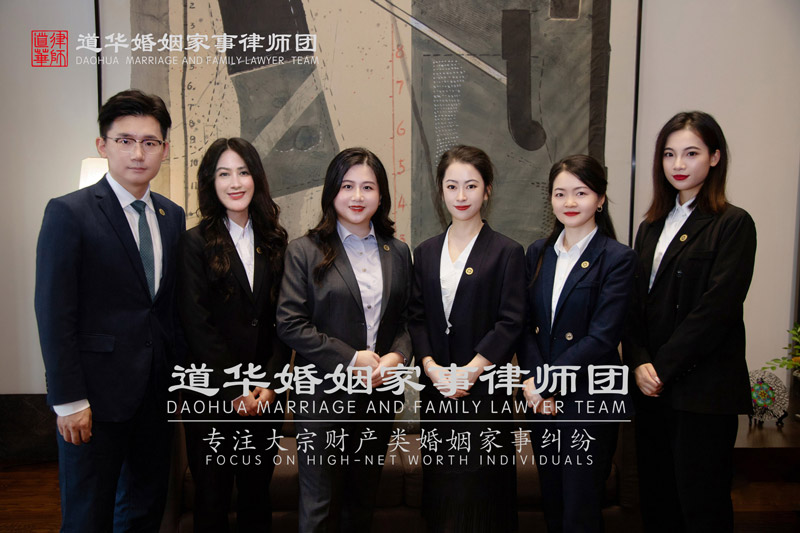
Dowah Marriage and Family Law Firm, with ten years of focus on major property-related marriage and family legal matters, is skilled in handling cases involving marriage and family matters exceeding 10 million yuan. It is one of the influential brands in [Shenzhen] for marriage inheritance and wealth management legal services.
The team has handled over 1000 cases related to marriage and inheritance, and has extensive experience in dispute resolution, mediation, and litigation in complex and difficult marriage and family matters, inheritance disputes, will drafting, and family property distribution. Utilizing local wisdom, the team is adept at dealing with difficult divorce property division cases involving Shenzhen's small property rights houses, village committee shares, and other complex issues, as well as will drafting and notarization, inheritance disputes, and has won unanimous praise from clients. Adhering to the philosophy of "securing asset safety, preventing legal risks, and empowering wealth growth", the team assembles experts from the legal, banking, insurance, and tax industries, boasts a wealth of successful cases, and provides a comprehensive one-stop solution for marriage and family matters and wealth inheritance for high-net-worth individuals (including Hong Kong, Macau, and foreign nationals), to achieve the beautiful vision of risk prevention and control, debt isolation, and family wealth inheritance.
Asset types cover: real estate (commercial housing, small property rights houses, land use rights, etc.), various property rights and interests (equities, debts, relocation compensation, copyrights, invention patents, etc.).
The team has completed the compilation of "Dowah Successful Cases in Marriage and Inheritance" and "Legal Practice of Family Wealth Inheritance", achieving remarkable results in both legal practice and theoretical research.
No registration required, quick appointment, expert lawyers provide customized legal service solutions
 Consultation Appointment:400-829-6880
 Private Space:18126123723
 Law Firm: Guangdong Daohua Law Firm
 Email:DAOHUALAWMF@163.com
 Address:深圳市福田区金田路4028号荣超经贸中心810(市民中心旁)

18126123723
Follow us anytime, anywhere


